As the CIAC 2026 results approach on October 10, we revisit four past champions: Josh Sim, Yoyo Prayogi, Acho Choky and Muhammad Yusuf. Their victories span the competition's opening season in 2017 through its most recent completed edition in 2025.
Their published records reveal different paths to the title. Official interviews add the creators' own perspectives where those are available. Together, these sources offer a more personal way to explore the CIAC archive and the careers connected through AquaRank.
Four champions at a glance
| CIAC winning year | Champion | Country | Winning work featured here |
|---|---|---|---|
| 2017 | Josh Sim | Malaysia | Winning aquascape from the 2017 archive |
| 2019 | Yoyo Prayogi | Indonesia | Autumn Has Come |
| 2024 | Acho Choky | Indonesia | Borneo Life |
| 2025 | Muhammad Yusuf | Indonesia | Veins of Nature 2 |
This is a selection of four champion stories, rather than a complete list of CIAC winners. The 2019 title refers specifically to the Medium to Large Aquarium category; the 2024 and 2025 titles refer to the Aquascaping Group.
Josh Sim: a landmark season built on an established career
Malaysia — CIAC 2017 champion
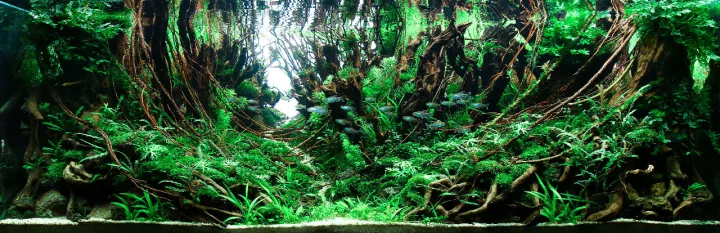
Josh Sim — CIAC 2017, Rank 1. Winning photograph from the AquaLibs contest archive.
Josh Sim's CIAC victory arrived in a remarkable season. His published competition record includes first-place finishes at CIAC, IAPLC and IIAC in 2017. KIAC's official judges' biography independently lists his CIAC 2017 first place.
By that point, Sim already had significant international results behind him. AquaRank records fourth place at IAPLC 2009 and category wins at AGA in 2012 and 2013. Those earlier achievements give the 2017 season context: it followed years of competition experience.
The winning photograph offers a visual counterpart to that history. Large roots and branches surround a bright opening, while smaller wood forms and planted surfaces connect the foreground to the distance. The scene contains considerable detail, but its strongest organising feature is easy to recognise: the enclosed forest opens towards light.
It is worth following the individual branches with your eye. Their directions, the spaces between them and the distribution of planting determine whether the dense construction remains readable. That relationship between structure and space gives the image its sense of depth.
Sim's later IAPLC Grand Prize wins in 2019 and 2025 extend the career beyond this early CIAC milestone. The opportunity for readers is to compare those seasons and look for recurring design interests alongside new solutions.
The story to follow: how an established creator develops a visual language across different competitions and years.
Explore Josh Sim's AquaRank profile and browse the CIAC 2017 gallery.
Yoyo Prayogi: a championship after changing fortunes
Indonesia — CIAC 2019 champion, Medium to Large Aquarium category

Autumn Has Come — Yoyo Prayogi — CIAC 2019, Rank 1, Medium to Large Aquarium category. Published contest photograph from the AquaLibs archive.
Yoyo Prayogi's CIAC record gives this story its shape: eighth place in 2017, sixteenth in 2018, then first in 2019. The sequence includes a lower finish before the championship. It offers a useful perspective for anyone waiting for their own results: one season is a limited view of a competitive career.
He had already reached the IAPLC Top 7 in both 2016 and 2017. The CIAC title added another major achievement, confirmed in CIPS's official 2019 results announcement.
His winning work, Autumn Has Come, brings warmth into a planted forest. Substantial tree-like wood forms establish the scene, with roots spreading into the foreground and reddish-brown planting contrasting with the greens. Bright gaps behind the wood help separate the main forms, while a visible group of fish gives scale to the surrounding landscape.
The image invites a slower look. Attention moves between the trunks, the planted ground and the openings beyond them; the warm colour returns across different parts of the composition. Those connections help the aquarium feel like one place rather than several independent planting areas.
Prayogi subsequently won the IAPLC Grand Prize in 2021. Viewed together, these records show why a career deserves more attention than any isolated result. Different seasons can carry different outcomes, even for an aquascaper with championship achievements.
The story to follow: the next chapter after a difficult season, and the wider career surrounding a breakthrough result.
Explore Yoyo Prayogi's AquaRank profile and browse the CIAC 2019 gallery.
Acho Choky: bringing observation and imagination together
Indonesia — CIAC 2024 champion
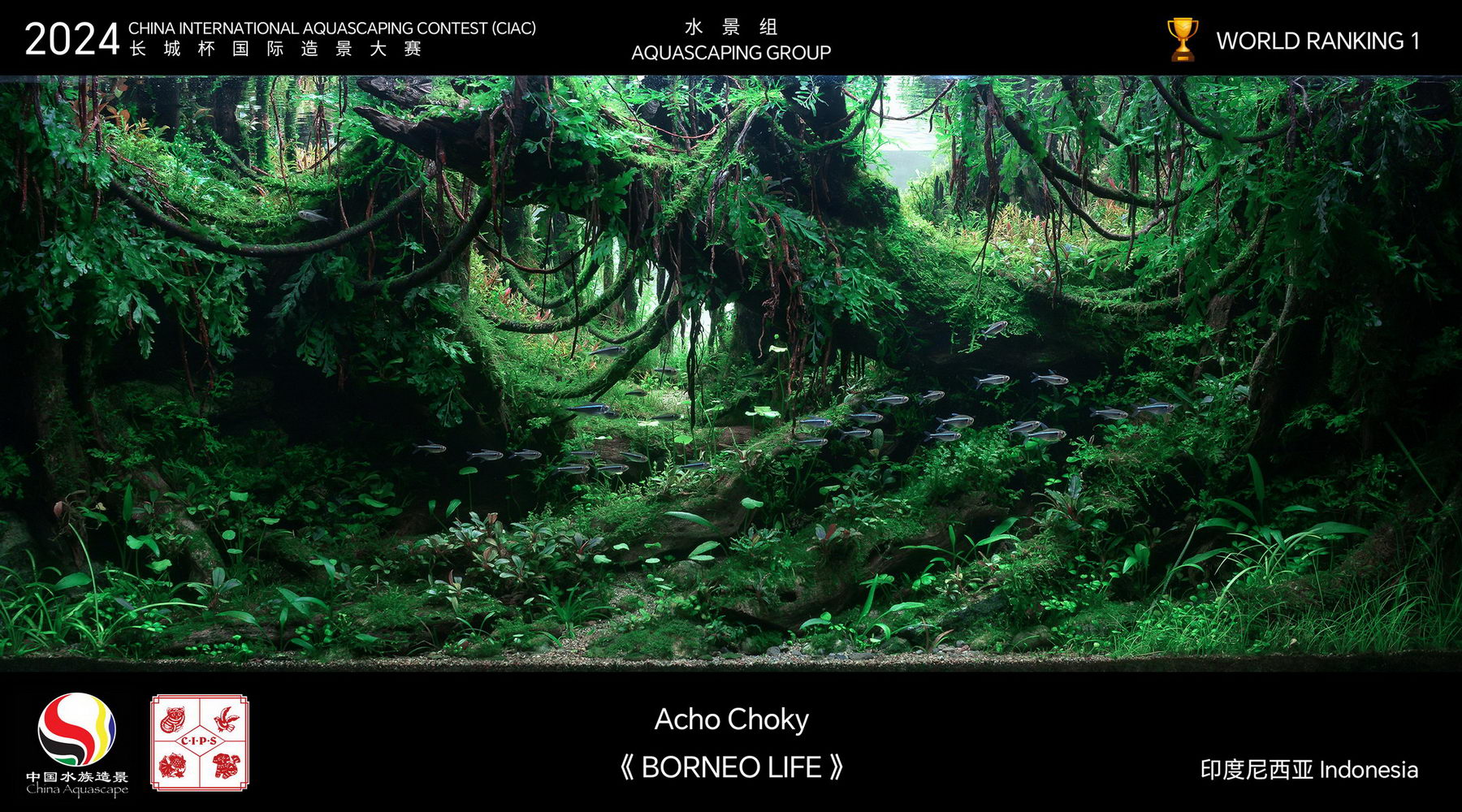
Borneo Life — Acho Choky — CIAC 2024, Rank 1, Aquascaping Group. Published contest photograph from the AquaLibs archive.
In his official CIPS interview, Acho Choky introduced himself as a freelance photographer from Makassar in South Sulawesi. He described travel, forests and unusual landscapes as sources of ideas, which he combines with imagination when developing an aquascape.
His account also brings attention to the work before planting begins. Searching for hardscape materials involved time, effort and difficult locations. For the final photograph, he waited until the plants had matured. These details connect the finished image with decisions made well before the competition deadline.
Borneo Life presents a forest with several routes through its hanging roots and planted wood. Bright openings interrupt the dense upper structure, and fish remain visible across the middle water. The atmosphere comes from the relationship between those openings and the surrounding vegetation.
The title was preceded by strong results elsewhere. AquaRank records fourth place at IIAC 2021 and IIAC 2022, followed by sixth at IIAC 2023. In 2024, his record includes both the CIAC championship and the KIAC Grand Prize.
Those achievements provide context for the victory without making every earlier result a necessary step towards it. The interview adds something the rankings cannot: his interest in finding distinctive scenery and translating it into a design of his own.
The story to follow: how direct observation, material selection and photographic judgment meet in a finished aquascape.
Explore Acho Choky's AquaRank profile and browse the CIAC 2024 gallery.
Muhammad Yusuf: a forest idea developed through repeated practice
Indonesia — CIAC 2025 champion

Veins of Nature 2 — Muhammad Yusuf — CIAC 2025, Rank 1, Aquascaping Group. Published contest photograph from the AquaLibs archive.
Muhammad Yusuf's account begins with curiosity. In his official CIPS interview, he said that looking at aquascapes on Facebook and Instagram helped draw him into the hobby in 2019. For Veins of Nature 2, he took inspiration from the Petungkriono rainforest in Central Java.
The finished work followed a demanding process. Yusuf described spending almost a month assembling and adjusting the hardscape, then caring for the planting as the scene developed. Photography became another substantial task: he reported three days of adjustments and roughly 750 shutter releases before obtaining the images he wanted.
His earlier CIAC results provide a clear sequence. AquaRank records eighteenth place in the combined 2021–2022 edition, seventh in 2024 and the championship in 2025. The combined edition is stored under 2022 in the profile.
The winning photograph shows a dense forest organised around curved wood, hanging roots and a brighter opening. A modest sandy entrance gives the viewer a way into the foreground, while the planted structure carries attention towards the distance.
Yusuf's 2025 record also includes the KIAC Grand Prize and AGA Best of Show. His CIAC interview identifies that season as his third participation in the contest, placing the championship within a short but increasingly accomplished competition history.
The story to follow: how a personal source of inspiration becomes a finished work through repeated construction, care and photographic decisions.
Explore Muhammad Yusuf's AquaRank profile and browse the CIAC 2025 gallery.
What these careers bring to the 2026 countdown
These four stories make the coming announcement more interesting. An established champion can be working towards another breakthrough. A creator with a recent lower finish may have a compelling next work. Someone receiving their first major recognition may already have years of results behind them.
The photographs also reward attention beyond placement. A forest opening, a warm planting accent or a carefully presented school of fish can become the detail another aquascaper remembers and learns from. That exchange of ideas is part of what keeps earlier contest galleries useful after the awards have been presented.
For entrants waiting on October 10, the records offer perspective. A high finish can mark an important milestone; a lower one adds another season to a longer body of work. The next design will still involve observing, choosing, building and caring for an aquarium.
The official CIAC schedule lists October 10 as the 2026 results date. The champions featured here are historical examples, not a confirmed list of this year's entrants or a prediction of its winners.
Follow the career beyond the winning photograph
Use the linked AquaRank profiles to explore how published results connect across years and competitions. Open the archived works, compare their compositions and look for ideas that recur or change over time.
For a closer study of the most recent season, continue with CIAC 2025 Revisited: Six Design Lessons Before the 2026 Results.
Which past CIAC champion—or which winning aquascape—would you like us to feature in greater detail? Share your choice in the comments.
AquaRank is AquaLibs' independent ranking of published competition records. Its career scores are separate from official contest rankings.
Records and sources were checked on October 6, 2026. Visual descriptions are editorial observations of the published photographs. Earlier placements provide career context; they do not establish why a later work won. Work titles are used where supported by the published contest image. The 2017 image is identified by author, year and placement without assigning a title.
Leave your comments