The IAPLC 2025 gallery rewards that return visit. Beyond the first impression of dramatic wood, striking stone or immaculate planting, its photographs reveal smaller decisions: a branch that interrupts a sightline, a patch of light behind a dark trunk, or a group of fish that makes an entire landscape feel larger.
We have selected 12 aquascapes, spanning world ranks 1 to 120, for a closer reading before the IAPLC 2026 announcement. This is an editorial selection of contrasting designs, rather than a new ranking. The observations below concern what is visible in the published photographs; they do not reproduce judges’ comments or identify unverified plant and fish species.
Open the IAPLC 2025 results and gallery alongside this article. Enlarge each photograph, let your eye travel through it, and then compare the next work. The differences become more interesting when the images have room to breathe.
1. Josh Sim — A River......Somewhere
World rank 1 · Malaysia · Grand Prize
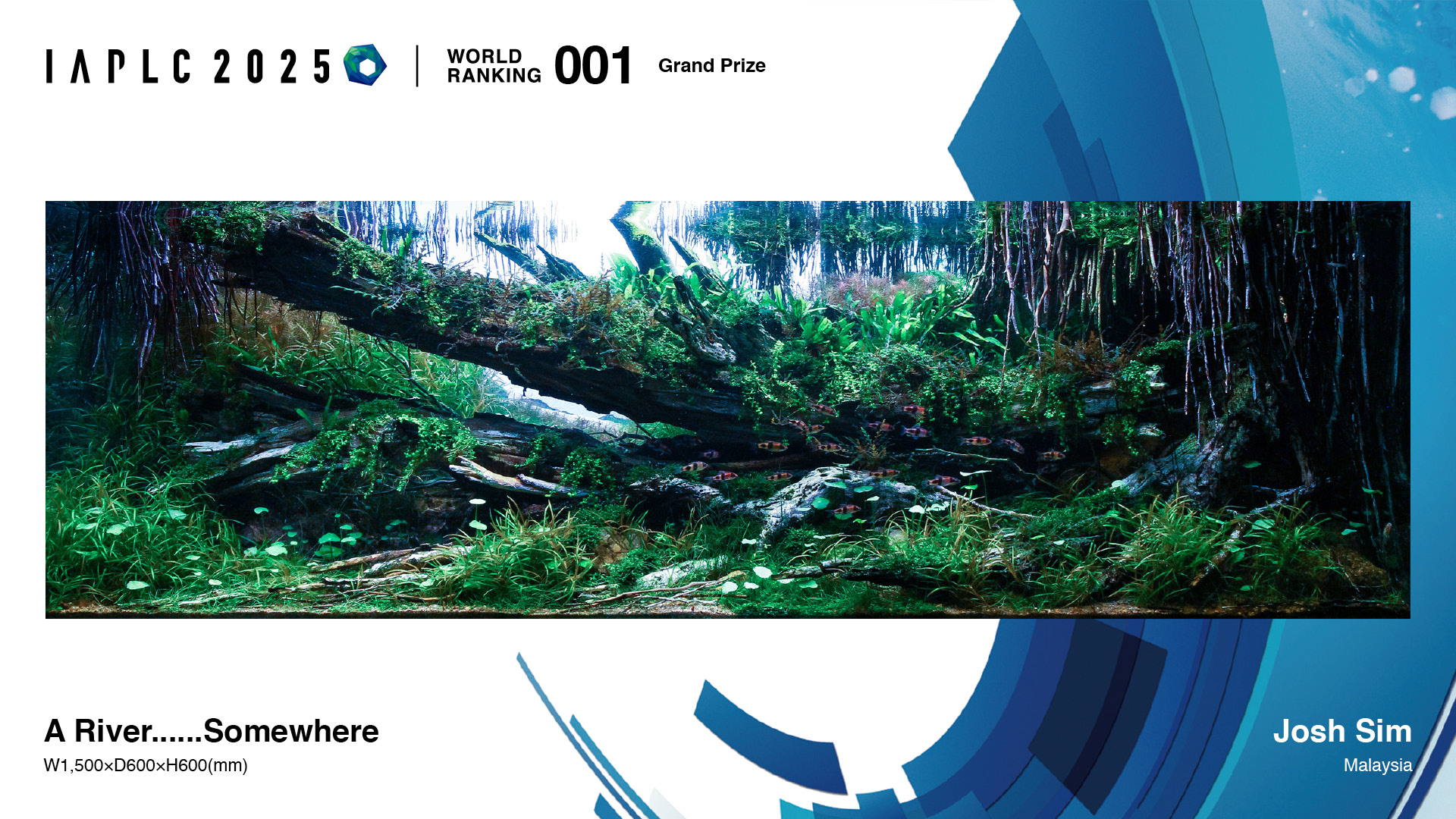
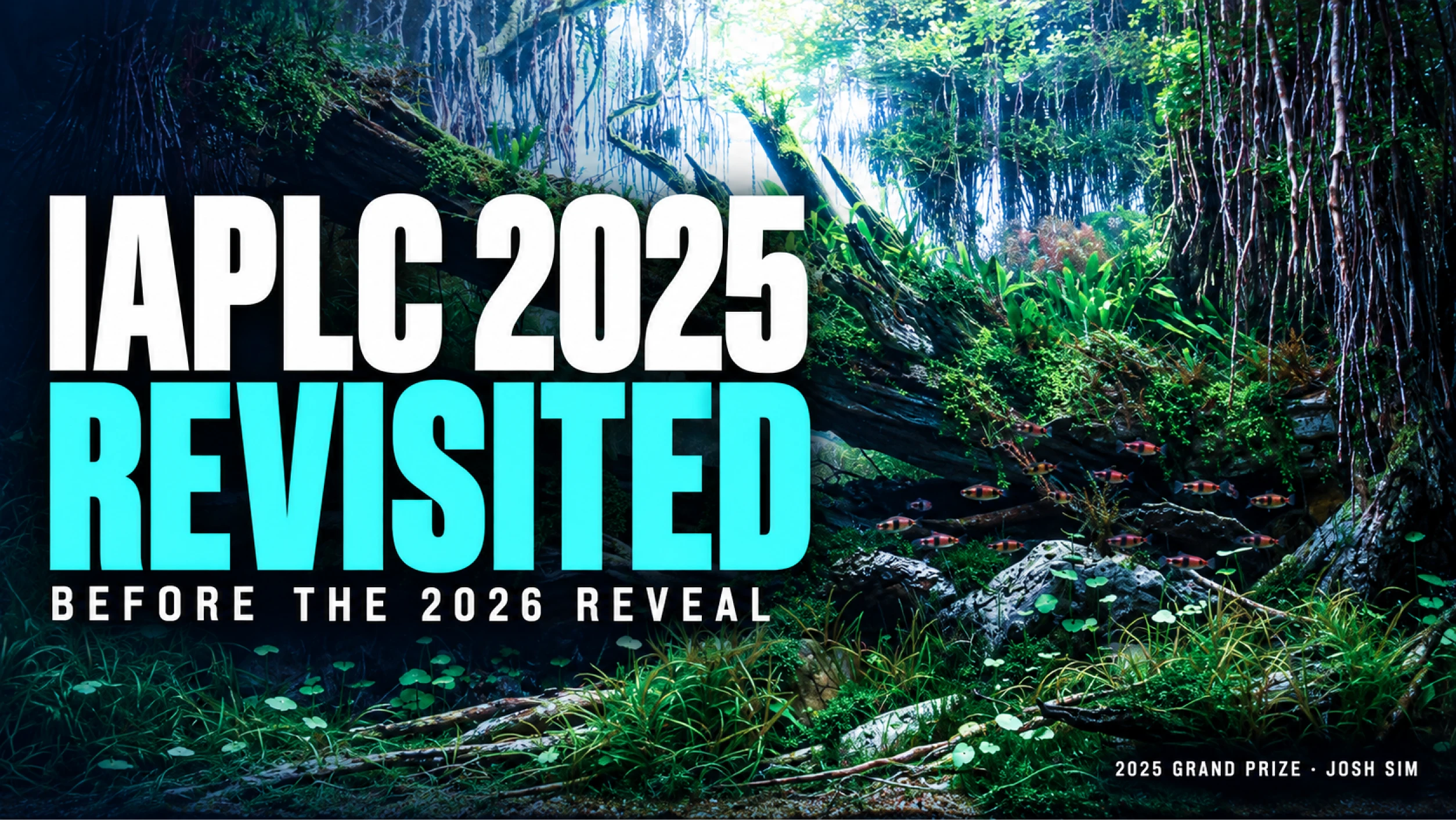
The winning aquarium invites us into a shaded river scene rather than presenting a simple, uninterrupted route to the back. A massive fallen trunk crosses the upper middle of the photograph. Smaller pieces beneath it introduce overlapping planes, while glimpses of brightness behind the wood suggest space beyond what we can immediately see.
Planting strengthens that sense of a place already inhabited. Fine leaves, rounded foliage and trailing growth break up the heavy timber without disguising its structure. Small foreground details matter as much as the large silhouette above them.
The fish group occupies the darker middle area, where warm body markings punctuate the green and brown surroundings. Their scale makes the trunk feel substantial; their presence also gives the sheltered space a purpose.
A question for 2026: Will the strongest new works create depth through partial concealment, letting viewers discover a scene gradually?
Explore Josh Sim’s competition record on AquaRank.
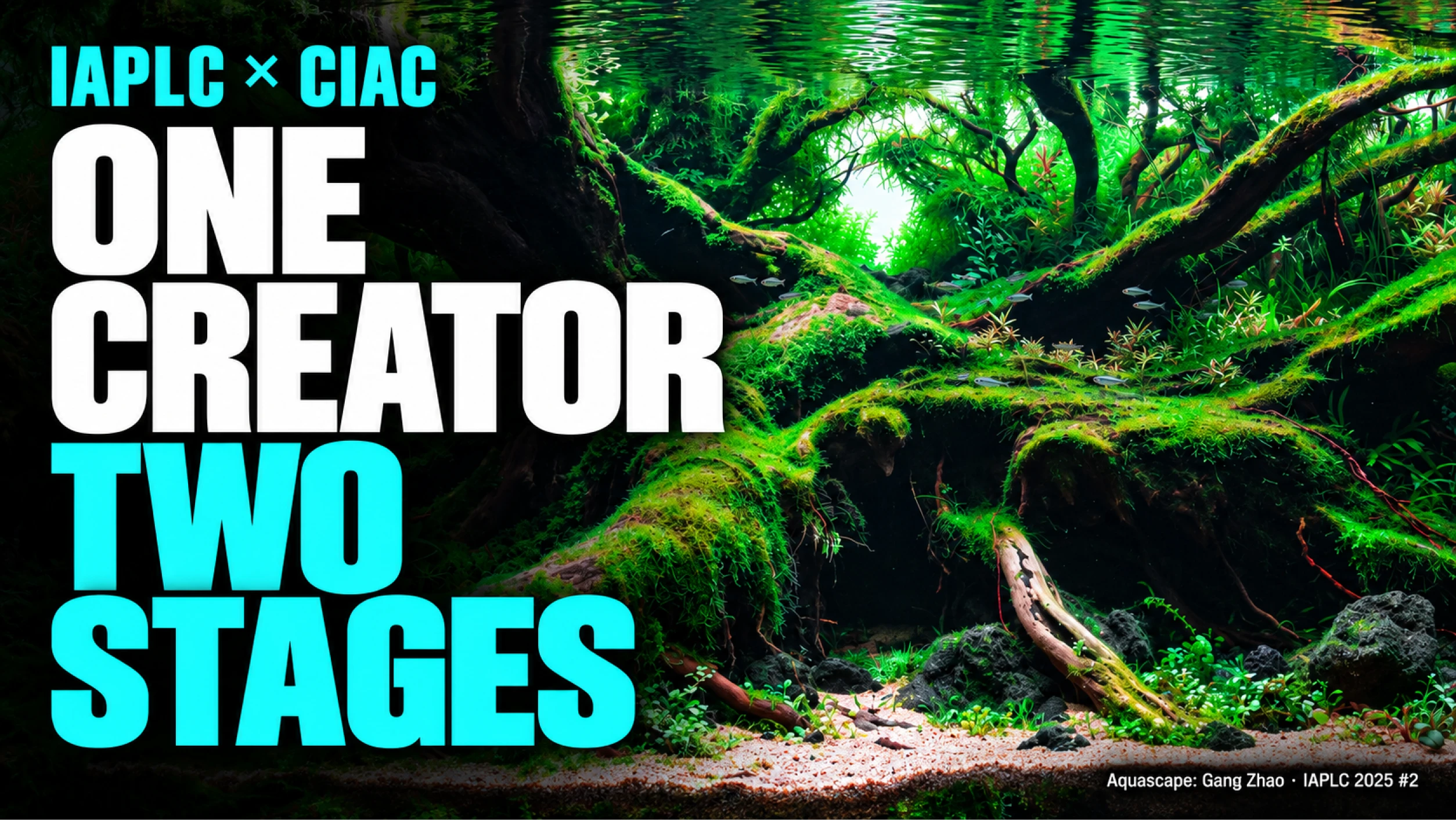
2. Gang Zhao — 灵境
World rank 2 · People’s Republic of China · Gold Prize

Here, depth comes from a network of roots and trunks converging around a luminous opening. A large dark mass on the left establishes a near plane, while branching forms on the right lead inward. The bright background reads as a destination, even though several pieces of wood interrupt the route towards it.
Green growth follows the contours of the wood, turning exposed surfaces into connected ridges. Small reddish planting accents offer contrast without taking attention away from the central light. The darker pockets beneath those ridges remain visible, helping separate one layer from another.
Small fish appear against the shaded wood around the middle of the image. They are relatively understated, which suits a composition whose principal drama lies in its sweeping roots and changes in brightness.
A question for 2026: Can increasingly intricate wood arrangements retain a clear visual destination?
Follow Gang Zhao’s recorded results on AquaRank.
3. Katsuki Tanaka — PRIMAL BURST
World rank 3 · Japan · Silver Prize

PRIMAL BURST offers a vivid counterpoint to the predominantly green scenes above. Broad, dark wood surfaces cut across the photograph, with finer branches and planted shelves creating additional layers. The eye moves between those strong diagonals and the brighter area near the upper centre.
Red, orange and green foliage forms a varied canopy above and between the timber. Colour is concentrated in distinct areas, while substantial dark spaces prevent the whole aquarium from becoming an uninterrupted tapestry. That balance makes the wood readable despite the richness of the planting.
Warm-toned fish are visible in open pockets across the middle. Their colour connects with the foliage, while their separation from the planted surfaces helps distinguish living movement from stationary texture.
A question for 2026: Will more leading layouts combine intense plant colour with equally assertive hardscape?
Explore Katsuki Tanaka’s AquaRank profile.
4. Kiat Fuil Yap — Nebula
World rank 5 · Malaysia · Bronze Prize

Nebula is particularly rewarding when viewed with attention to the fish. A conspicuous silver-blue group stretches across the shaded face of the large wood mass on the right. The dark background makes individual bodies legible, while the collective line gives that side of the aquarium movement.
The composition counterbalances this mass with a bright opening towards the upper left of centre. Smaller foreground wood pieces overlap the larger structure, producing a sequence of near and far surfaces rather than a single flat wall.
Low green planting and restrained reddish patches trace the timber, while long leaves reach across the upper margins. Together, those textures frame the opening and soften the transition between solid wood and open water.
A question for 2026: Which new photographs will make the fish group essential to the composition, with a clearly readable space of its own?
5. Francesco Rampinelli — Aurora
World rank 6 · Italy · Bronze Prize

Aurora changes the atmosphere immediately. Jagged rocks rise from bright green ground cover, and a broad, pale area of open water gives the scene an expansive quality. A narrow sandy opening in the foreground leads between the planted slopes.
Depth emerges from the relationship between larger near rocks and smaller forms behind them. Fine planting around their bases and taller growth towards the rear connect these separate groups. Warm foliage near the upper right adds another tonal layer without obscuring the rock faces.
Red fish stand out strongly against both the green planting and the light background. Smaller fish are also visible higher in the photograph, introducing another level of scale. Unlike the shaded woodland compositions, this work makes much of its activity readable in bright water.
A question for 2026: How prominently will open, rock-led landscapes feature among the new leading works?
6. Qi Lin — LIFE AFTER LIFE
World rank 7 · People’s Republic of China · Bronze Prize

Large root forms spread outwards from the middle, giving LIFE AFTER LIFE an energetic silhouette. Their overlapping branches produce several openings of different sizes. A pale passage towards the centre-right draws attention beyond the closest wood, so the composition has somewhere to go as well as a strong foreground presence.
Green growth runs along the branches, linking distant and nearby elements. Finer leaves and modest reddish accents occupy the spaces around them. Exposed dark timber remains important: it defines the branching pattern and stops the plant textures from merging together.
Pale fish are especially easy to read against the dark mass left of centre. Their small, repeated forms provide a quieter rhythm beneath the much larger gestures of the wood.
A question for 2026: Can a dramatic root silhouette remain open enough for both depth and fish movement to register clearly?
7. Ha Le Trinh — Silent Resilience
World rank 15 · Vietnam

Silent Resilience deserves a close look at its foreground. Rounded stones and irregular patches of low growth establish the entrance to a narrow central channel. Taller wood banks frame this route, while a slender bright opening behind them suggests that the scene continues beyond the visible corridor.
The planting works at several scales. Low green cushions soften stones near the front; small leaves and reddish stems inhabit the wood; broader leaves near the surface introduce a larger shape above the finer textures. These changes give different parts of the aquarium distinct identities.
The fish group occupies the upper right area rather than crowding the central foreground channel. That distribution gives the photograph two complementary attractions: a route to explore below and living activity above.
A question for 2026: Will more memorable designs combine convincing ground-level detail with an equally considered surface canopy?
8. Jungwoo Yoo — Stream
World rank 16 · Republic of Korea

Stream demonstrates how a largely horizontal piece of wood can create movement across an aquarium. Its long, flowing surface links the left foreground with the right side, while branching forms above it introduce lighter outlines against the rear water.
Low green planting in front, leafy growth attached to the timber, and finer background foliage create distinct bands of texture. Small sandy and stony openings at ground level keep the foreground from becoming a continuous carpet. Reddish planting behind the main wood adds separation between the green middle layer and the back.
Small blue fish are visible around the middle-right, where their bright markings interrupt the dark timber and surrounding greens. Their modest scale allows the sweeping trunk to remain the principal shape.
A question for 2026: Could broad horizontal rhythms offer an alternative to layouts dominated by a central vanishing point?
9. Luiz Junior — Between the mountains
World rank 24 · Brazil

Two substantial rock groups frame a green valley, giving this work an immediate and accessible structure. Smaller rocks occupy the middle, creating steps between the largest foreground forms and the light opening at the back. The centre remains planted, so the sense of passage does not depend on an exposed sandy road.
The colour arrangement reinforces the structure. Bright green growth gathers around the valley, while warmer stems rise behind the rocks, particularly on the right. Dark stone faces provide firm edges between these soft planted areas.
The blue-marked fish group crosses the central opening, making the water between the rock groups a visible part of the design. It offers a useful comparison with Nebula: both give fish prominence, but one uses a bright valley and the other a shaded overhang.
A question for 2026: How will new layouts integrate conspicuous fish groups with their principal opening or focal area?
10. Luis Cardoso — River Echoes
World rank 27 · Portugal

River Echoes balances a bright, pebble-strewn foreground with heavier, darker wood above it. A long diagonal piece leads from the lower middle towards the right. Other wood layers and a bright rear opening prevent that dominant line from flattening the scene into one plane.
Green growth follows the exposed wood, with orange-red accents near the surface and finer leaves towards the sides. The irregular stones and small plant patches along the sand create a detailed transition between open ground and the denser banks.
The fish group is concentrated towards the shaded middle-left. Pale bodies and red markings remain visible there, adding activity beside the strongest diagonal rather than directly over the bright rear opening.
A question for 2026: Which works will make the transition from open substrate to planted hardscape feel most convincing?
See Luis Cardoso’s competition history on AquaRank.
11. Eri Tokusashi — The Neural Forest
World rank 79 · Japan

The Neural Forest is a reminder to keep browsing after the award positions. Pale, finely branching forms stand out against dark, broken rockwork. Their light outlines create a distinctive visual language, very different from the thick green-covered timber seen in several higher-ranked selections.
Bands of red, orange and muted green foliage occupy both the rear ridge and the spaces beneath it. Depth comes through overlapping plant groups and dark cavities, rather than a broad, brightly lit central path. The contrast between delicate pale branches and heavy stone is the photograph’s strongest invitation to look closer.
Fish are visible lower in the image, particularly towards the left, but their contribution is quieter here. Colour and branching structure command the initial attention.
A question for 2026: Which distinctive compositions outside the leading awards will stay in viewers’ memories longest?
Discover Eri Tokusashi’s recorded works on AquaRank.
12. Abhirup Dasgupta — Pursuit
World rank 120 · India

Pursuit brings the review back to green, but with a different organisation of mass and space. Large pieces of wood rise diagonally above rounded clusters of planting. A light opening between those forms allows the eye to move beyond the nearest green cushions.
Plant shapes are central to the effect. Compact, rounded foliage contrasts with taller, finer growth at the sides and warm-toned leaves higher up. Those changes in texture separate surfaces that might otherwise merge into a single green bank.
The fish group crosses the middle-right, where pale bodies remain legible against shaded wood. This small band of activity connects the larger planted masses and provides a useful scale reference within the composition.
A question for 2026: What strong design ideas will we discover by exploring the wider gallery, beyond the first photographs everyone shares?
What these 12 works help us see
Viewed together, the selection offers several ways to read an aquascape. These are recurring devices within this group, not a statistical account of the entire IAPLC 2025 field.
Depth depends on separation. Overlapping wood, differences in rock size, patches of brightness and changes in plant texture all help one plane stand apart from another. A visible path is only one possible device. The winner’s obstructed river scene and Aurora’s open rocky landscape create space in markedly different ways.
Planting gives hardscape its character. Growth can trace a branch, soften a stone, establish a surface canopy or introduce a contrasting colour band. The useful question is how each planted area contributes to the photograph’s structure. PRIMAL BURST and The Neural Forest are particularly revealing when compared with the greener works.
Fish need a readable setting. Nebula makes its group conspicuous against dark timber; Between the mountains places bright fish in the central valley; Silent Resilience shows activity higher above its ground-level channel. A group’s visual contribution changes with its position, apparent size and contrast against the background.
For another way into the archive, read our IAPLC 2025 Top 300 style review, then return to the 2025 gallery and choose your own contrasting pair.
From one photograph to an aquascaper’s wider story
A memorable image can be the beginning of a longer exploration. After studying a work in the contest gallery, visit AquaRank to discover aquascapers and follow their recorded competition results across seasons and contests.
The two views serve different purposes. The gallery lets you examine a particular aquarium; a profile places that result within a wider competition history. Together, they make it easier to follow familiar names, discover less familiar ones and revisit earlier work with fresh questions.
Try starting with a single detail you admire—a fish group, a wood silhouette or a planted rock transition—and exploring another recorded season by the same author where photographs are available. You may find continuity, experimentation, or simply another reason to look more closely.
The questions we take into IAPLC 2026
Will the new leading aquascapes draw us into shaded, layered environments, or give open water and exposed rock a larger role? Will richer plant colour become more conspicuous? Which works will make fish feel inseparable from the scene? And which aquarium, well beyond the first award photographs, will become your personal favourite?
According to ADA’s official announcement, IAPLC 2026 Top 100 photographs and world rankings will be unveiled on October 10 at 1:00 PM JST—11:00 AM in Vietnam—via ADA VIEW. The complete ranking list will follow on the official IAPLC website after the livestream.
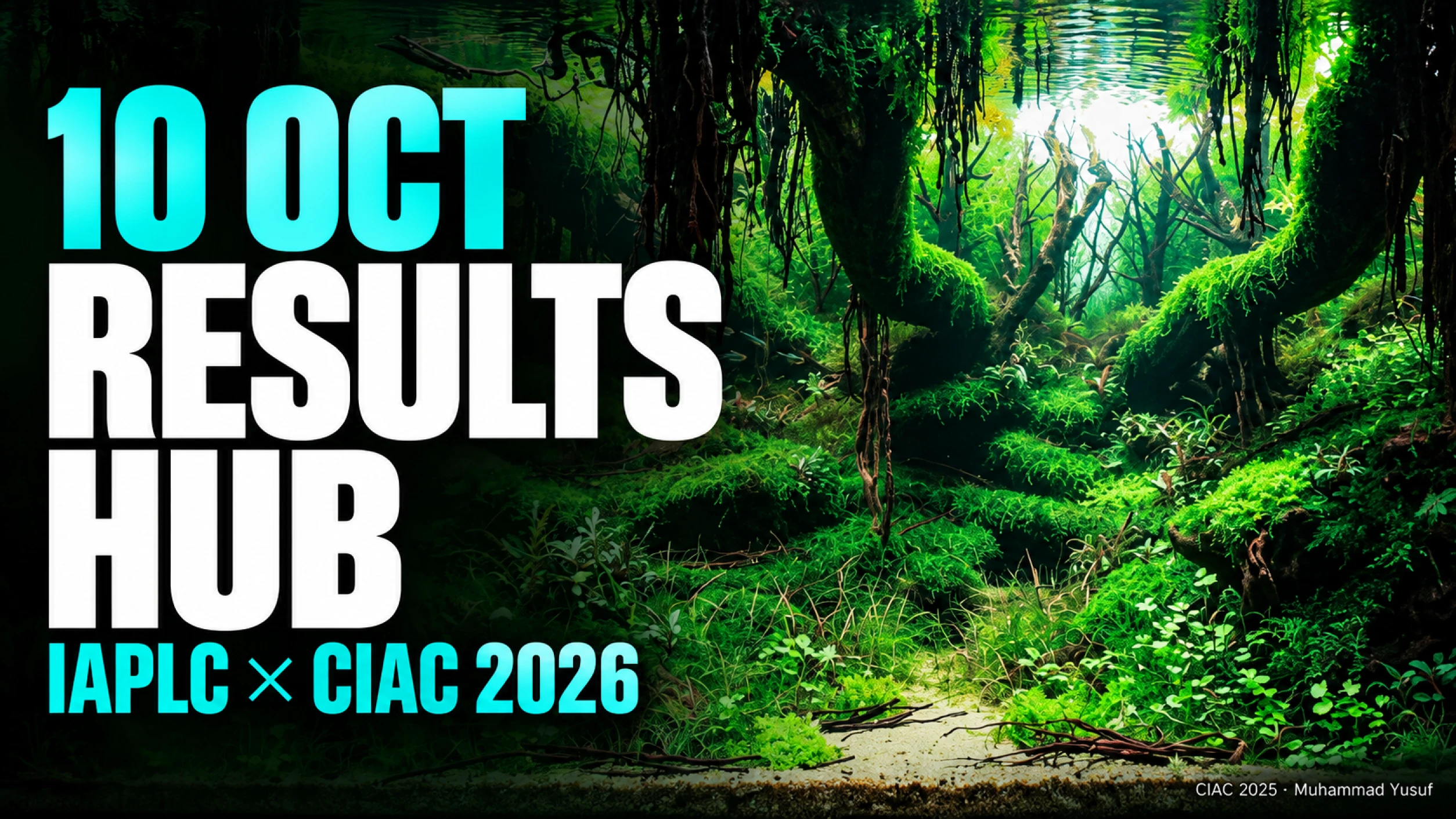
Keep the IAPLC livestream and our October 10 results hub close at hand. Before the reveal, spend a little longer in the 2025 archive.
Which of these 12 works would you return to first—and what do you hope to see in IAPLC 2026? Share your choice, its rank and the detail that caught your eye.


Leave your comments