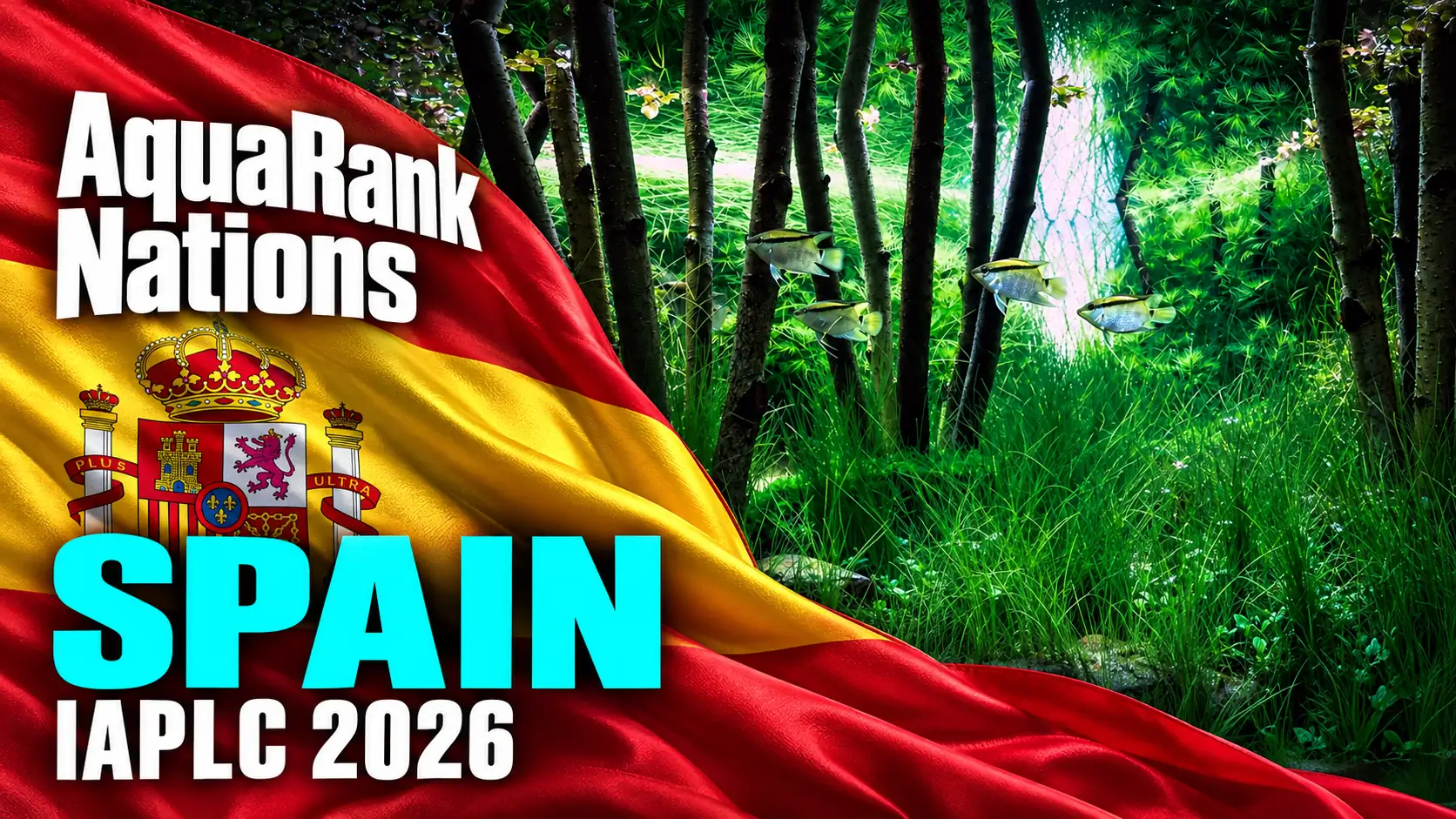
Follow the photographs into the wider country story with the new AquaRank Nations: explore Spain’s IAPLC 2026 results and the creators behind them.
This is part of AquaLibs’ IAPLC 2026 Country Studies, returning to our archived Spain introduction through this season’s photographs. The archive is historical commentary; the new observations are AquaLibs’ independent visual analysis, separate from official judging. The 1 selected work is a case study, not a census of national styles.
The 2026 result in context
| Published ranking range | Spain places |
|---|---|
| Ranks 1–7 | 0 |
| Ranks 1–27 | 0 |
| Ranks 1–100 | 0 |
| Ranks 1–300 | 1 |
Counts are calculated from the official final ranking, using the country-and-area label Spain. They count published places, not total submissions or participants. Rank 61 is vacant, so the global ranks 1–300 contain 299 published names.
From individual aquariums to the national view
Roberto Buenadicha’s photograph is Spain’s only work inside ranks 1–300, but the national calculation continues beyond that threshold. Nations lets readers follow five contributing results without pretending that this one forest represents an entire community. Read the aquarium closely, then open Spain’s edition page and competition history to discover the other creators and available earlier results.
| AquaRank Nations · IAPLC 2026 | Spain |
|---|---|
| AquaRank national position | #31 |
| Average of five contributing overall ranks | 496.4 |
| Contributing individual ranks | #143, #336, #594, #644, #765 |
| Published country results in the full edition | 8 |
These are AquaRank’s calculated national standings, not official IAPLC national awards. The average uses the five lowest overall ranks from five confirmed aquascapers; a lower average is better. The 2026 edition is marked as complete on Nations. This full-ranking view is broader than the Top 300 photo selection used in this article. Figures were checked on 16 October 2026.
Explore Spain at IAPLC 2026 on AquaRank Nations →
Open the contributing five, follow available artwork and creator profiles, then use the edition selector or Spain’s IAPLC history to explore other available seasons. Use the IAPLC 2026 nations comparison to see the same method applied across countries and regions.
Inspired by Josh Sim’s IAPLC Nations Challenge. Read the Nations methodology for coverage and ranking rules. The average describes results; it does not measure a design style or explain a judge’s decision.
Follow the country journey
Explore Spain through the years below. Switch between nation position and average rank, then open an edition or its contributing aquascapers to continue the journey.
Spain at IAPLC
Loading country history…
Returning to the archive
The archived Spain introduction, published in 2021 and attributed to IAPLC Nations Challenge, discussed a mixture of styles and often subdued, atmospheric photographs. That broad historical account is a reason to ask new visual questions, not a basis for assigning a national identity to one aquarium. Here, the principal question is how the intervals between repeated trunks make the water and fish readable.
The photographs to study
| World rank | Creator | A detail to follow |
|---|---|---|
| #143 | Roberto Buenadicha | A fish passage between dark vertical trunks |
Rank 143 — Roberto Buenadicha

A fish passage between dark vertical trunks. Slender, predominantly vertical trunks stand in front of layered green foliage. A narrow bright opening behind the middle-right creates a destination, while larger pale fish occupy the water between the trunks. The lower growth is fine and comparatively continuous; the dark uprights supply the repeated rhythm. Depth develops through partial views past those uprights, rather than through a wide sandy foreground road.
The fish have unusual visual prominence because their pale bodies remain readable against the green and shaded wood. Their size makes the upright forms feel substantial, and their positions reveal a middle water plane. The photograph captures a moment; it cannot establish sustained behaviour or habitat conditions. Visually, however, the fish help distinguish this scene from an empty woodland model.
Look closer: Compare the fish bodies with the intervals between the trunks.
Discover aquascapers on AquaRank · Back to the selected works
What the comparison reveals
Repeated verticals make the scene feel like a grove, while their changing spacing allows glimpses of background foliage and the brighter middle-right area. The darker near timber gives the pale fish contrast. That combination matters: the viewer reads living subjects at a particular depth rather than seeing a row of sticks against a flat planted wall.
A useful connection with the older article is the role of atmosphere. Subdued dark greens do not automatically make an aquarium persuasive; the image still needs legible differences between wood, vegetation and water. Buenadicha’s photograph gives us those relationships to discuss. Its ranking cannot tell us how other Spanish entries looked, and one work cannot establish a national design trend.
A design exercise to take away
Look at the intervals between repeated forms. A convincing grove needs variation in spacing and a visible plane of water, not only a collection of upright trunks.
All published places at ranks 1–300
| World rank | Published name | Country / area |
|---|---|---|
| 143 | Roberto Buenadicha | Spain |
Continue through the archive
Revisit the original Spain introduction, then open the IAPLC 2026 gallery to view the selected works at full size and keep browsing beyond them. For a related reading, explore the IAPLC 2026 Top 10 design guide.
Keep exploring with AquaRank Nations. Open Spain’s country overview to move from this season’s photographs to recorded results across available competitions and years. Start with the 2026 IAPLC result, choose an earlier available edition, and follow a creator whose work catches your attention. Country overviews keep competition and edition context visible; they do not combine raw ranks from different contests into one overall score.
Which Spanish creator’s history would you explore after this close reading of Buenadicha’s forest?




Leave your comments