First principle: visible rock is not automatically Iwagumi
A convincing Iwagumi is built around a deliberate stone hierarchy rather than simply placing rocks in a planted aquarium. The main stone normally establishes direction and scale; supporting stones reinforce that direction without competing for attention. A useful composition should still read clearly when the plants are young, after trimming, and in a contest photograph.
The supplied examples also show why classification should remain careful. Some layouts are confidently stone-led, while others use rocks as part of a broader forest, valley or planted-scene design. Calling every rocky aquarium Iwagumi can hide the real design question: are the stones carrying the composition, or are they supporting another subject?
For contest work, visual legibility matters. A reviewer should be able to identify the focal area, follow the intended path through the aquarium and understand the depth arrangement without relying on a dense plant canopy to conceal weak stone placement.
Single focal stones and the value of open foreground
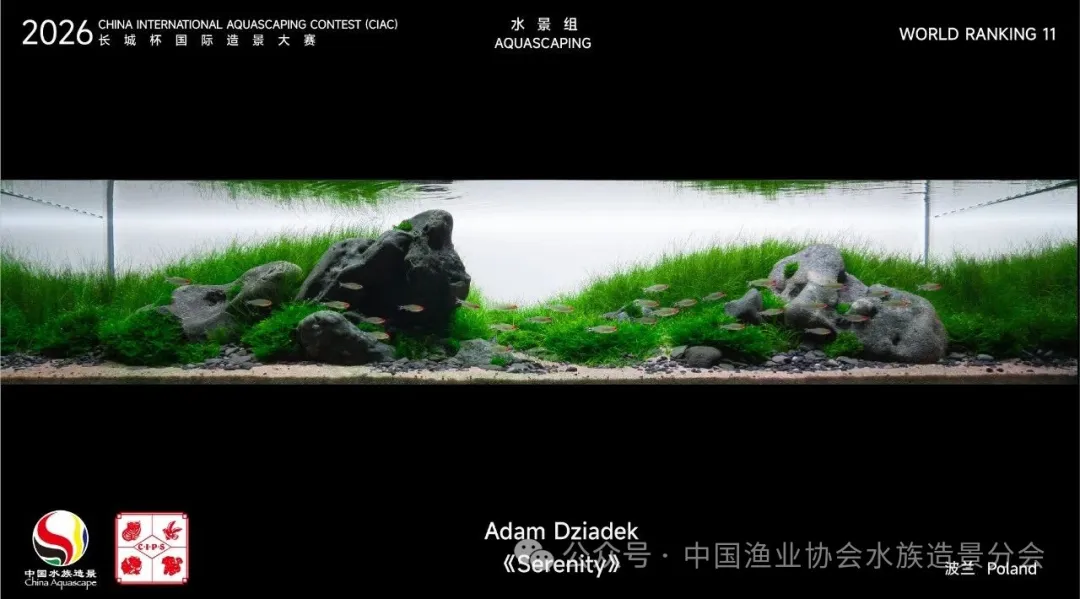
The supplied image of CIAC 2026 work “Serenity” by Adam Dziadek is a clear example of a restrained, stone-led approach. The composition leaves a broad, pale foreground around relatively compact stone groups. Low planting forms a horizontal base, while the open water and substrate make the stones easy to read.
This kind of design has several strengths. The empty foreground creates visual calm, gives the main stones room to breathe and makes the tank appear more spacious. It also provides a clean scale reference: the viewer can compare the stone height with the low carpet and the tank’s horizon. A limited number of elements can create a stronger first impression than many equally prominent details.
The weakness is exposure. With less planting to soften transitions, every misplaced stone, abrupt substrate edge and uneven carpet becomes obvious. An open foreground also offers fewer places to hide algae, melt or inconsistent growth. The aquarist must keep the carpet level, the glass clean and the stone relationships stable throughout the photographic period.
Sanzon-style groupings and sloped movement
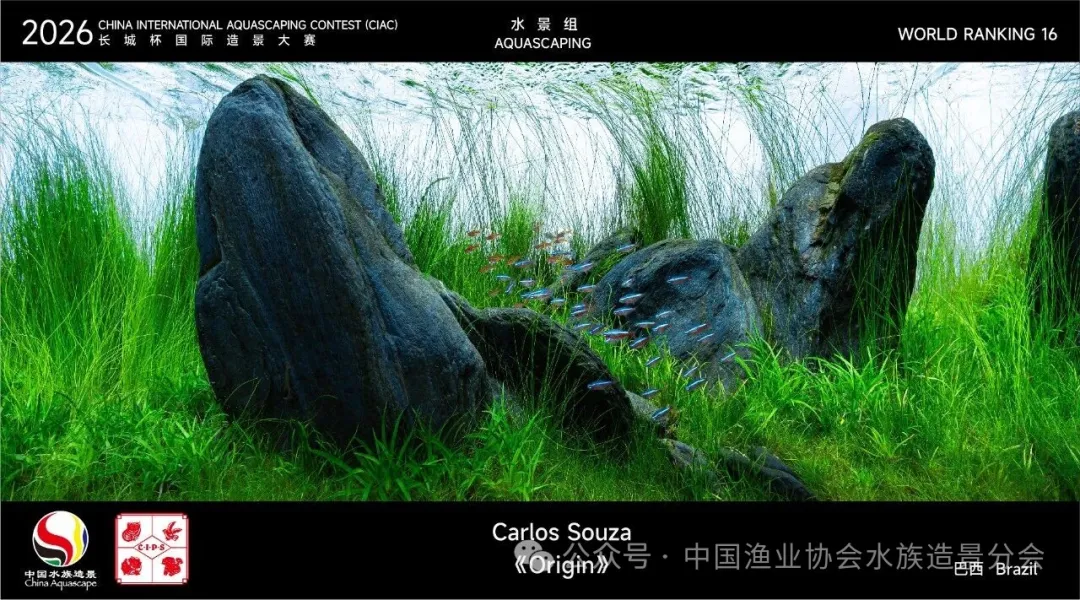
CIAC 2026 work “Origin” by Carlos Souza uses a prominent upright stone with supporting stones arranged around a central passage. The visible planting is fuller than in “Serenity”, but the rock structure remains easy to identify. The rising and falling stone directions suggest a sloped landscape rather than a flat row of objects.
A Sanzon-style grouping can give an aquarium an immediate focal hierarchy: one dominant stone, one supporting stone and a smaller companion or balancing element. The arrangement works best when the stones share a believable geological direction. Similar surface texture, consistent tilt and partially buried bases help the group feel connected to the substrate.
Slopes add depth because the foreground, middle ground and background occupy different heights. They also introduce technical risk. A steep substrate can slump, expose soil, trap debris or make carpeting plants grow unevenly. Large stones need secure support before substrate is added; otherwise a later shift can damage roots, disturb the layout or cloud the water. Keep the slope moderate enough to maintain safely, and test the composition from the final camera position before planting heavily.
Dense planting: naturalism can help, but it can also hide the structure
The CIAC 2026 work “丘壑” by 李陶然 is a useful example of a denser, rock-led variation. Broad, pale stones form a strong diagonal and are surrounded by multiple plant textures. The image presents more visual detail than a minimalist carpet-and-stone arrangement, yet the rock surfaces remain important to the scene’s structure.
Dense planting can improve naturalism by softening hard edges, varying scale and suggesting a larger landscape beyond the glass. It may also make a composition more forgiving during the early stages of growth. However, density becomes a weakness when plants cover the stone hierarchy, obscure negative spaces or create one undifferentiated green mass. A contest image needs both richness and readable architecture.
Plant health is especially important in this style. Compact growth should not be confused with simply allowing plants to spread. Regular trimming preserves the intended gaps between stones, while adequate light, carbon availability, circulation and nutrition support healthy form. Avoid designing a layout that only looks correct after aggressive overgrowth. The best version should remain coherent after maintenance as well as at peak fullness.
What the AGA examples add: rock-led design is not one fixed recipe
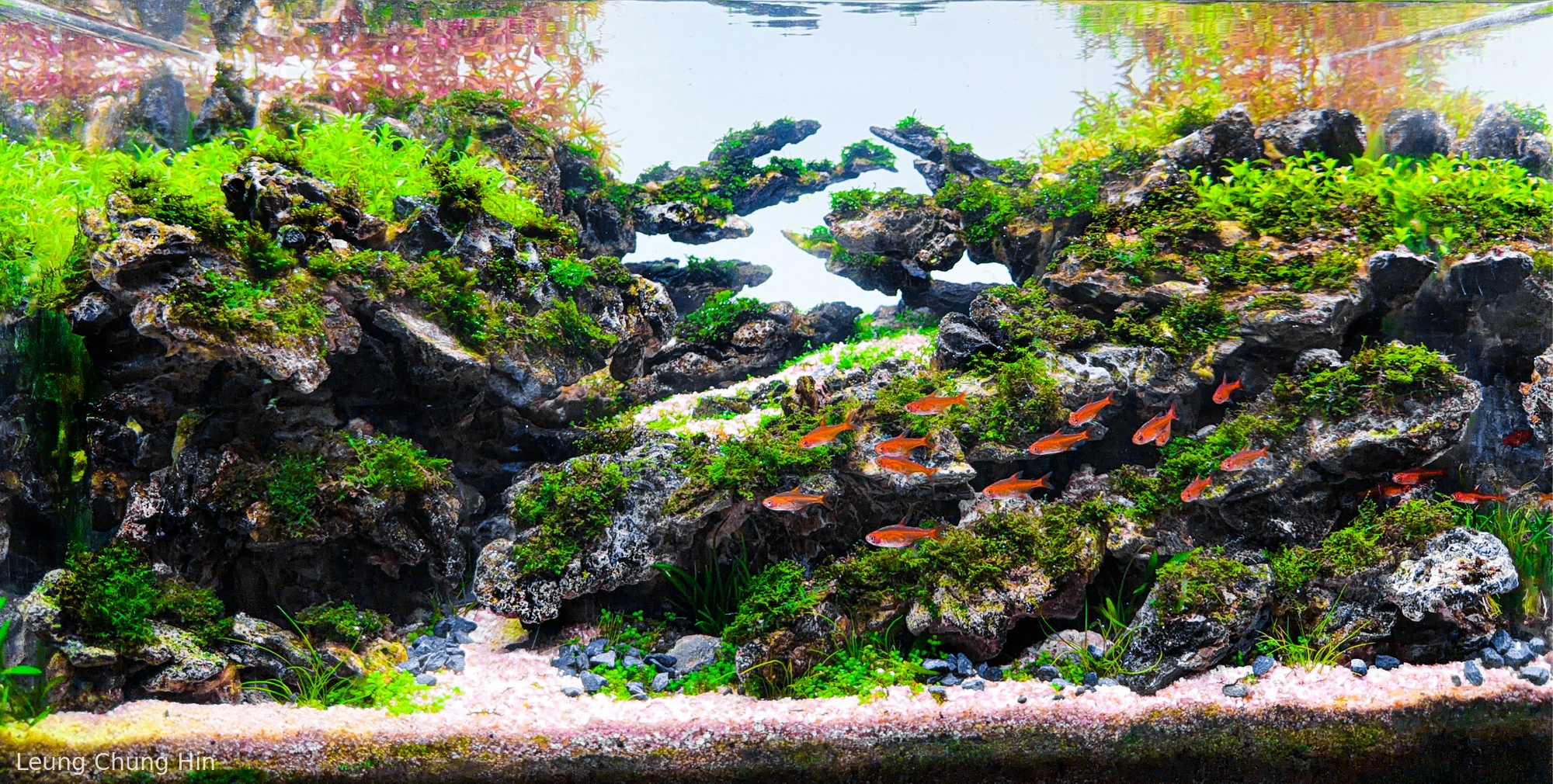
AGA 2026 work “#1367 Sky Road” by Leung Chung Hin presents a strongly rock-led valley arrangement with a bright central opening and a visible route through the middle. The stones are broken into connected masses rather than presented as one isolated object. This creates depth through repetition, gaps and a descending visual path.
The strength of this approach is narrative movement. The eye can enter through the foreground, travel toward the central opening and then return to the surrounding rock faces. The limitation is that repeated stones must remain subordinate to a clear hierarchy. If every rock has the same visual weight, the result can look busy rather than expansive.
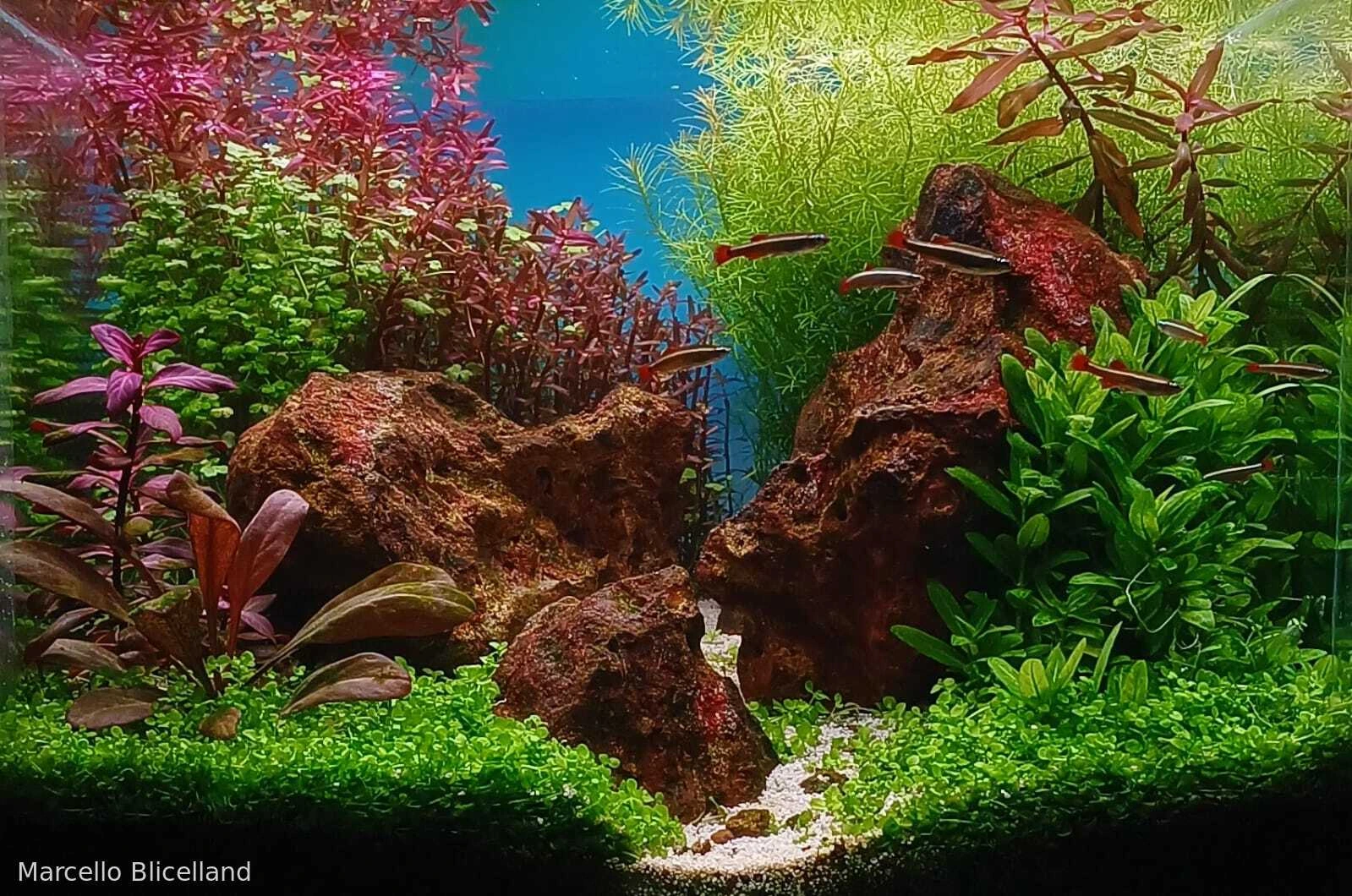
Another supplied AGA image, “#1072 Cânion de Rocha Vermelha” by Marcello Blicelland, shows how a rock-defined composition can become more densely planted and colorful. It is best treated as rock-led or Iwagumi-inspired rather than automatically classified as formal Iwagumi. The visible lesson is transferable: contrasting plant masses can frame a stone canyon, but too much color or foliage can compete with the geological idea.
Across the supplied CIAC and AGA works, the most useful comparison is not which contest has a superior style. It is how each aquascape balances focal stones, empty space, planting density and a believable sense of terrain. Those decisions can be adapted without copying a named layout.
A competition-ready Iwagumi checklist
The supplied AGA 2026 work “#1072 Cânion de Rocha Vermelha” by Marcello Blicelland illustrates why the final photograph must be considered from the beginning: stone placement, plant growth, water clarity and color balance all affect how the landscape is read. Use this step-by-step process for a more reliable result.
1. Define the story. Decide whether the tank represents a quiet plain, a mountain slope, a canyon or a valley. The story should guide stone direction and planting density.
2. Select the hierarchy. Choose the main stone first, then supporting stones that repeat its texture and geological movement. Avoid adding rocks simply to fill empty space.
3. Build securely. Support large stones on a stable base, bury them convincingly and check that none can shift under substrate pressure or maintenance.
4. Test the camera view. Photograph the hardscape before planting. Check the focal point, negative space, horizon and apparent scale from the intended contest angle.
5. Plant in layers. Keep the foreground low, use intermediate planting to connect stones and reserve taller growth for the background or selected side. Leave deliberate gaps.
6. Plan for maintenance. Estimate the mature spread of each plant. Trim before growth hides stone faces or closes the central pathway. Remove algae and damaged leaves early.
7. Protect the slope. Watch for erosion, exposed soil and debris collecting behind stones. Adjust flow and substrate before a small problem changes the composition.
8. Prepare the photograph. Stabilize water clarity, clean the glass, control reflections and use consistent lighting. Photograph when plants are healthy but not so overgrown that the original hierarchy disappears.
Minimalism is therefore not a shortcut. It is a demand for stronger decisions and more consistent maintenance. A successful Iwagumi remains legible through setup, growth, trimming and photography, with the stones, plants and empty spaces working as one composition.













Leave your comments