Follow the photographs into the wider country story with the new AquaRank Nations: explore United States’s IAPLC 2026 results and the creators behind them.
This is part of AquaLibs’ IAPLC 2026 Country Studies, returning to our archived United States introduction through this season’s photographs. The archive is historical commentary; the new observations are AquaLibs’ independent visual analysis, separate from official judging. The 4 selected works form an editorial comparison, not a census of national styles.
The 2026 result in context
| Published ranking range | United States places |
|---|---|
| Ranks 1–7 | 0 |
| Ranks 1–27 | 0 |
| Ranks 1–100 | 2 |
| Ranks 1–300 | 8 |
Counts are calculated from the official final ranking, using the country-and-area label United States of America. They count published places, not total submissions or participants. Rank 61 is vacant, so the global ranks 1–300 contain 299 published names.
From individual aquariums to the national view
The United States’ contributing five extend our four-work selection to rank 145. Rather than treating several wooded aquariums as one national signature, Nations offers a way to follow the individual creators and the country’s recorded competition history. Read the four spatial approaches here, then open the 2026 edition page to see the wider published result.
| AquaRank Nations · IAPLC 2026 | United States |
|---|---|
| AquaRank national position | #8 |
| Average of five contributing overall ranks | 97.8 |
| Contributing individual ranks | #31, #56, #120, #137, #145 |
| Published country results in the full edition | 33 |
These are AquaRank’s calculated national standings, not official IAPLC national awards. The average uses the five lowest overall ranks from five confirmed aquascapers; a lower average is better. The 2026 edition is marked as complete on Nations. This full-ranking view is broader than the Top 300 photo selection used in this article. Figures were checked on 16 October 2026.
Explore United States at IAPLC 2026 on AquaRank Nations →
Open the contributing five, follow available artwork and creator profiles, then use the edition selector or United States’s IAPLC history to explore other available seasons. Use the IAPLC 2026 nations comparison to see the same method applied across countries and regions.
Inspired by Josh Sim’s IAPLC Nations Challenge. Read the Nations methodology for coverage and ranking rules. The average describes results; it does not measure a design style or explain a judge’s decision.
Follow the country journey
Explore United States through the years below. Switch between nation position and average rank, then open an edition or its contributing aquascapers to continue the journey.
United States at IAPLC
Loading country history…
Returning to the archive
The archived USA introduction, published in 2021, emphasised variety across aquarium styles. Its demographic and competitive explanations were opinions about an earlier period; they are not needed to read the present photographs. This 2026 study tests the more useful part of that description: whether individual works remain visibly different when their common materials are placed side by side.
The photographs to study
| World rank | Creator | A detail to follow |
|---|---|---|
| #31 | Ryan Noel | A branching canopy that leaves glimpses beyond it |
| #56 | Tianxu Yang | A low diagonal beneath a fine-leaved curtain |
| #120 | Luke Shen | Long leaves define a central light window |
| #137 | Steve Leathead | Exposed timber offers a different kind of presence |
Rank 31 — Ryan Noel
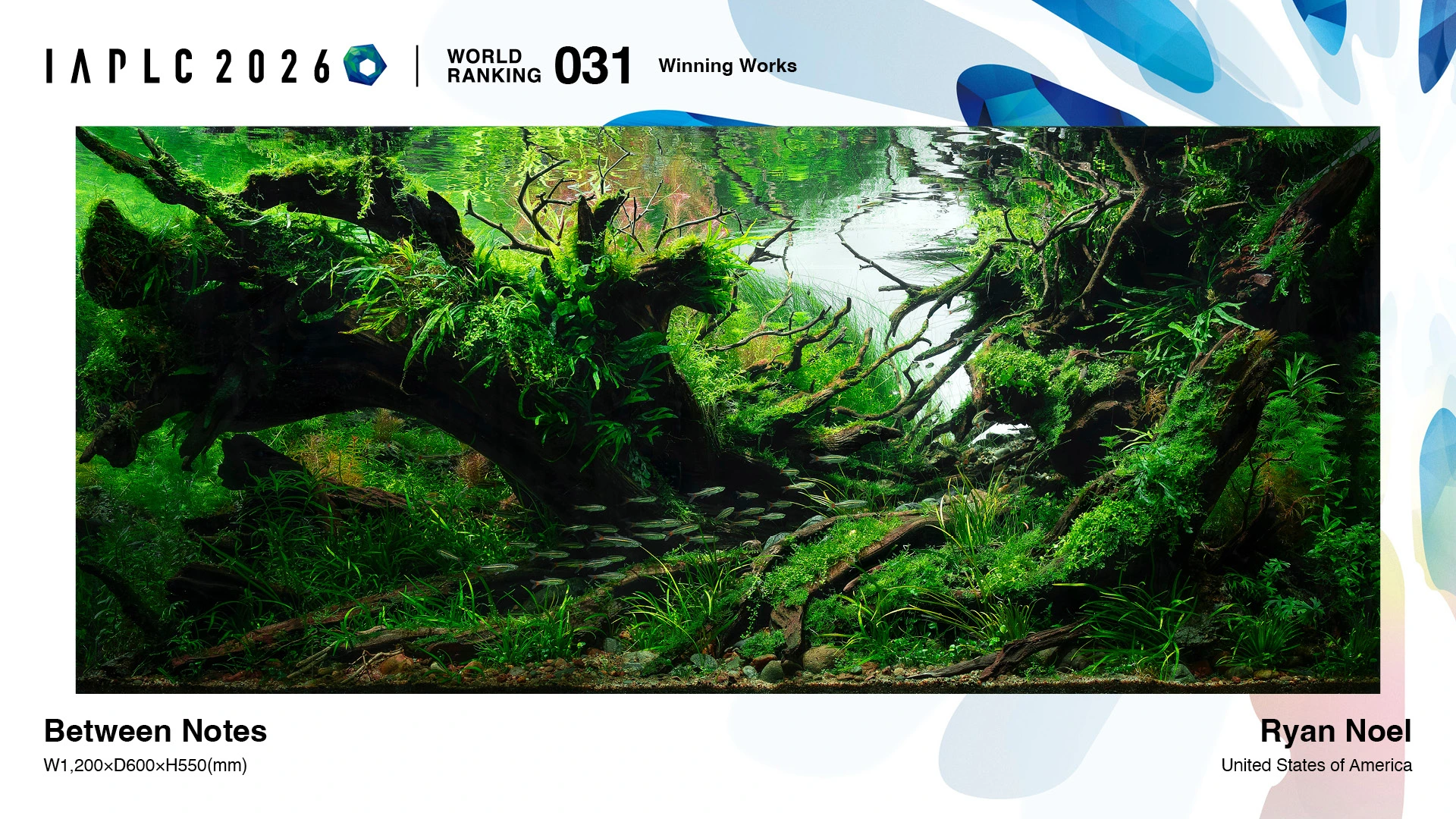
A branching canopy that leaves glimpses beyond it. Large limbs spread across the upper-left and middle, with smaller branches leading towards a bright rear area. Planting varies between rounded cushions, small leaves and finer trailing textures. The photograph feels densely inhabited, but brightness still separates portions of the wood. The scene invites a gradual reading: the first impression is the canopy, then the spaces around it begin to reveal their depth.
Look closer: Look around the branching silhouette for the smaller windows of light.
Explore Ryan Noel’s recorded work on AquaRank · Back to the selected works
Rank 56 — Tianxu Yang
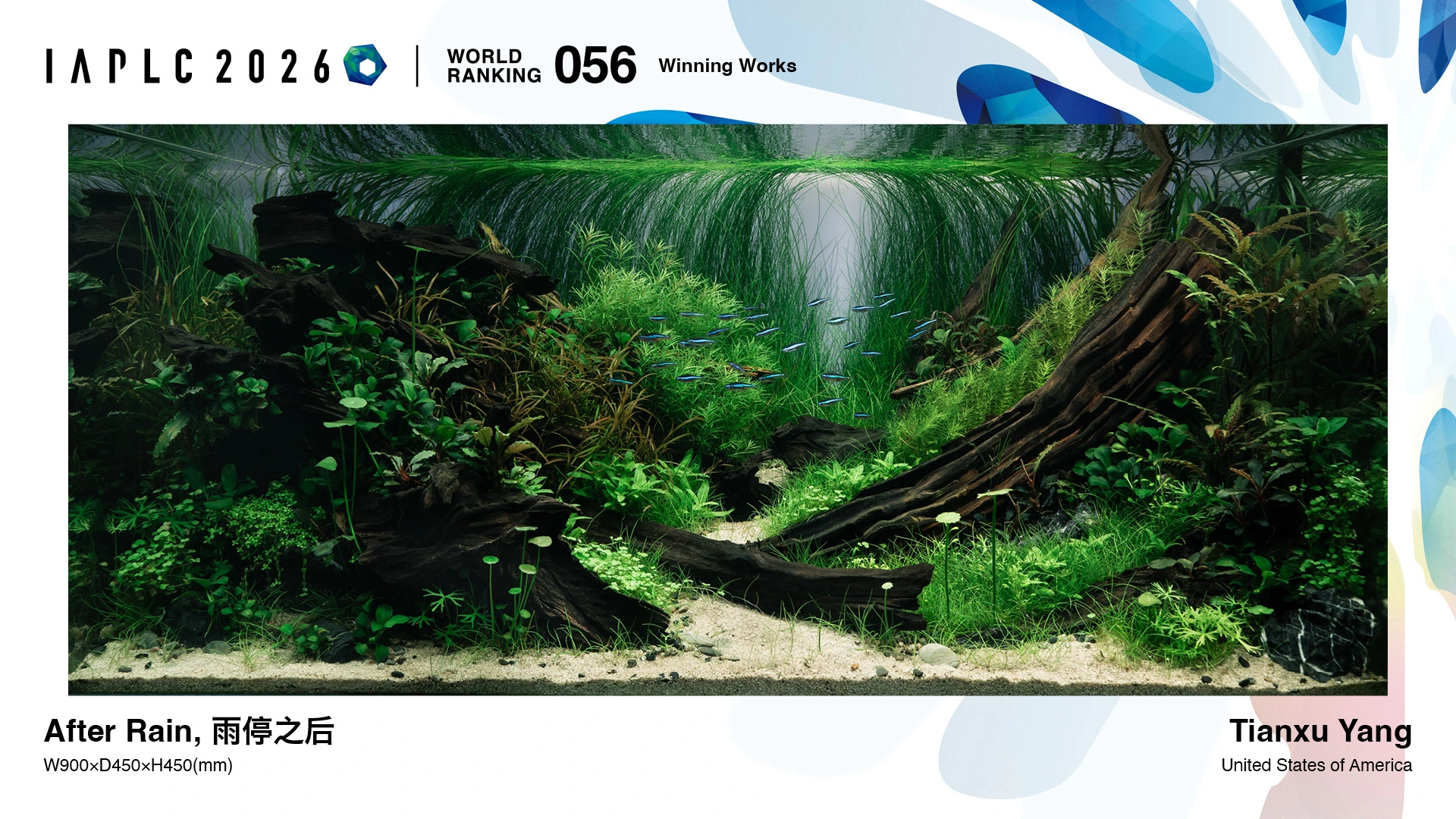
A low diagonal beneath a fine-leaved curtain. An elongated piece of wood rises from the lower middle towards the right, balanced by a darker planted mass on the left. Long narrow leaves curve across a light central background. Low greenery and pale substrate keep the near ground comparatively open. Blue-marked fish appear in the finer middle water. The photograph uses a small number of broad directions to make a planted scene readable.
Look closer: Compare the main wood diagonal with the upper leaf curves.
Discover aquascapers on AquaRank · Back to the selected works
Rank 120 — Luke Shen

Long leaves define a central light window. Fine foliage curves around a bright circular-looking area near the upper middle. Sloping green-covered wood directs the foreground towards that same space, with reddish accents appearing along higher planted surfaces. Fish are visible around the lighter middle. The composition gives the eye a clear destination, then uses changes in leaf texture and the darker timber beneath it to prevent the surrounding greens from merging together.
Look closer: Observe how the fine foliage makes a boundary around the light.
Discover aquascapers on AquaRank · Back to the selected works
Rank 137 — Steve Leathead

Exposed timber offers a different kind of presence. A substantial reddish-brown piece of wood rises from pale substrate and scattered stones. Tall fine leaves frame it at the sides and back, while smaller plants occupy the ground without covering every surface. The exposed timber remains the photograph’s principal subject. Compared with the more heavily carpeted wooded scenes, this aquarium makes the material’s shape and texture immediately legible and leaves more of the underlying structure on view.
Look closer: Look at the exposed wood grain and its contrast with the fine foliage.
Discover aquascapers on AquaRank · Back to the selected works
What the comparison reveals
Ryan Noel uses a branching canopy to control glimpses of light. Tianxu Yang keeps a lower diagonal readable beneath a fine-leaved curtain. Luke Shen gathers attention around a central light window, while Steve Leathead gives exposed wood itself a strong presence. The changes in density, coverage and opening size affect how quickly each scene can be understood.
The comparison also shows why a shared material is a weak basis for assuming a shared style. A branch covered in fine green growth behaves differently in the image from a broad bare surface surrounded by upright leaves. These four are a selected subset of eight published American places at ranks 1–300; they are not a complete inventory of US aquascaping practice.
A design exercise to take away
Choose two aquariums with wood, then describe their differences without using the word forest. Direction, surface coverage, leaf scale and the amount of visible water often produce a clearer comparison.
All published places at ranks 1–300
| World rank | Published name | Country / area |
|---|---|---|
| 31 | Ryan Noel | United States of America |
| 56 | Tianxu Yang | United States of America |
| 120 | Luke Shen | United States of America |
| 137 | Steve Leathead | United States of America |
| 145 | Phong Tran | United States of America |
| 170 | Alexander Franqui | United States of America |
| 202 | T Kawamura | United States of America |
| 257 | Bradley Wood | United States of America |
Continue through the archive
Revisit the original United States introduction, then open the IAPLC 2026 gallery to view the selected works at full size and keep browsing beyond them. For a related reading, explore the IAPLC 2026 Top 10 design guide.
Keep exploring with AquaRank Nations. Open United States’s country overview to move from this season’s photographs to recorded results across available competitions and years. Start with the 2026 IAPLC result, choose an earlier available edition, and follow a creator whose work catches your attention. Country overviews keep competition and edition context visible; they do not combine raw ranks from different contests into one overall score.
Which US creator’s earlier results would you explore to understand this season’s approach?

Leave your comments