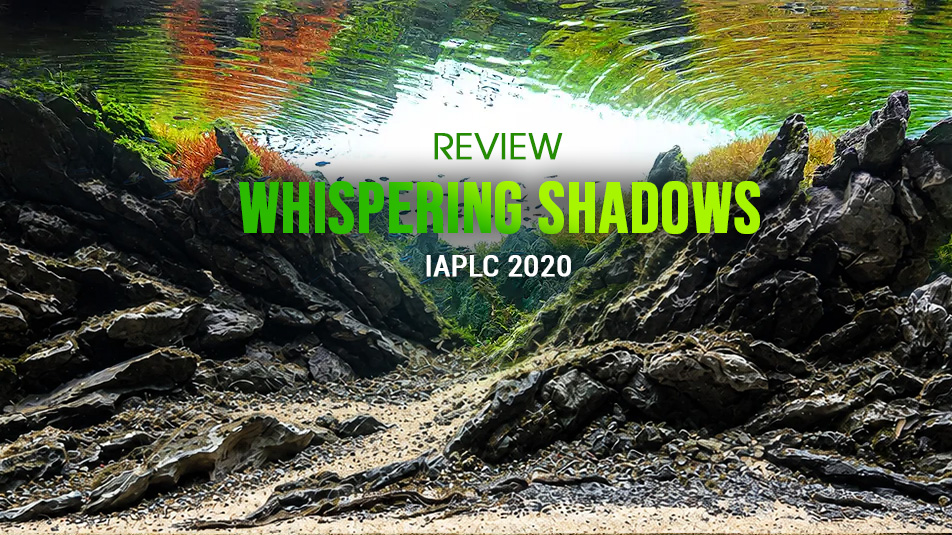
Judge's scorecard
Judging basis: IAPLC Secondary Screening Judging Criteria. The score is an editorial assessment from the submitted image, not an official contest result.
Recreation of natural habitat for fish
Judge's assessment
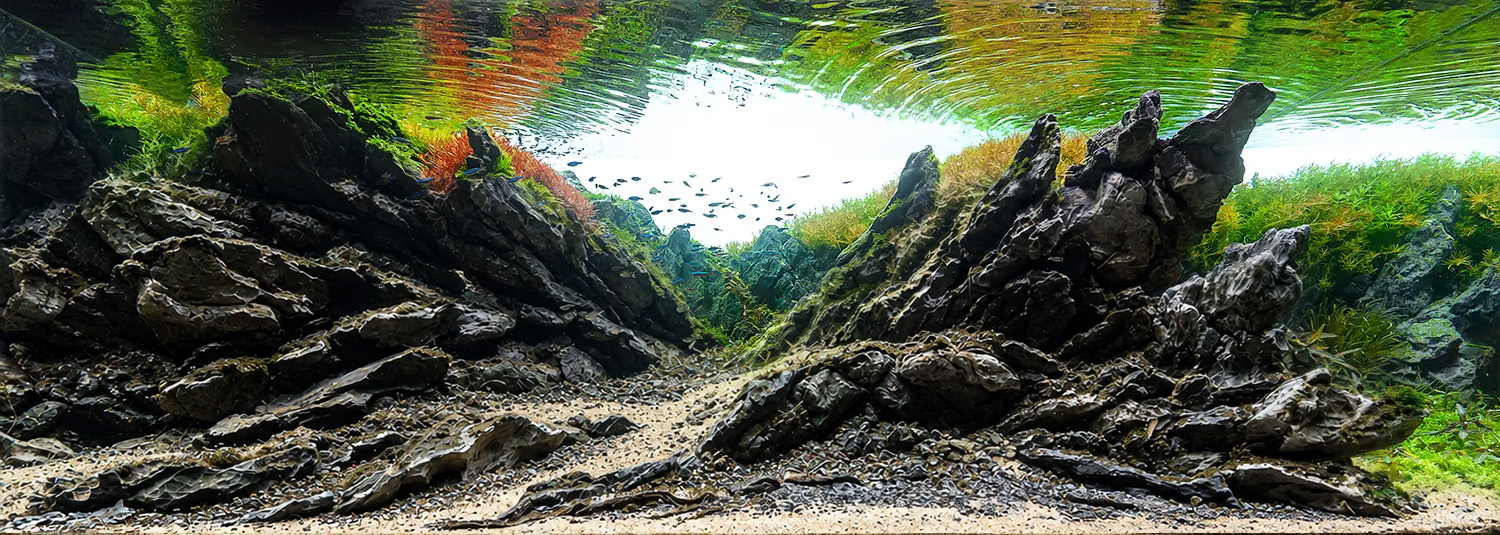
The image shows a healthy-looking planted underwater environment with extensive rocky shelter, open swimming space, and schooling fish that provide scale. Exact fish identity, compatibility, stocking level, and water conditions cannot be verified from the image, so the score remains below the top range.
Strengths: Rocky relief and planted crevices suggest habitat structure.; Open central water allows visible schooling movement.; Fish, plants, and hardscape read as one underwater scene.
Limitations: Species and ecological requirements are not identifiable.; Some fish disappear against dark rocks and foliage.; A still image cannot verify welfare or water quality.
Long-term maintenance of the layout
Judge's assessment
The mature planting and visible hardscape boundaries suggest strong control, but the photograph cannot prove sustainability, trimming practice, algae control, or stability over time.
Strengths: Growth appears established across rock surfaces.; Planting is generally integrated rather than randomly scattered.; The central valley remains visibly open.
Limitations: Dense areas could eventually obscure the rock structure.; No maintenance history or long-term progression is available.; Photographic presentation cannot establish ongoing health.
Creator's technical skills
Judge's assessment
The layered, directional stonework, planted crevices, depth management, and controlled foreground transitions demonstrate highly accomplished execution.
Strengths: Rock lines create strong inward perspective.; Small stones connect major formations convincingly.; Plant placement follows ledges and structural gaps.
Limitations: Some central transitions contain competing angles and textures.; A few areas could use more explicit separation between planting layers.
Originality and impression of the layout
Judge's assessment
The combination of a dramatic rocky valley, bright central opening, surface movement, and schooling fish produces a memorable first impression with a clear visual identity.
Strengths: The valley concept is immediately readable.; The water-surface opening adds an unusual secondary plane.; Fish movement gives the composition scale and life.
Limitations: The high detail level slightly weakens focal hierarchy in places.; The underlying valley motif is recognizable rather than wholly unprecedented.
Presentation of natural atmosphere
Judge's assessment
Weathered-looking stone, mature growth, shaded slopes, and open water create a convincing sense of an established submerged landscape, although the saturated contest presentation is visibly curated.
Strengths: Plant growth softens rock edges naturally.; Light and shadow create convincing depth.; The fish enhance the impression of a living environment.
Limitations: Strong saturation and contrast make the scene feel somewhat theatrical.; A single image cannot confirm ecological naturalness or development over time.
Overall composition and planting balance
Judge's assessment
The composition has a complete visual structure: anchored side masses, a strong central vanishing area, a readable substrate base, and planting distributed across multiple depth levels.
Strengths: Negative space is used decisively in the central valley.; Foreground, middle ground, and background are all represented.; Diagonal hardscape lines establish a clear viewing path.
Limitations: The bright opening can overpower smaller details.; Selective thinning could improve separation in dense intersections.
Judge's overall verdict
An accomplished and highly atmospheric rocky aquascape whose strongest qualities are its geological depth, mature planting integration, and memorable central valley. The estimated 89/100 reflects excellent execution and composition while reserving points because fish compatibility and long-term sustainability cannot be established from one image, and because several dense transitions could be visually simplified.
Assessment limits: This is an editorial estimate based only on the supplied image and trusted contest metadata. No species list, aquarium dimensions, water parameters, maintenance record, construction process, or additional views were supplied. The estimate is not an official contest result.
Habitat Recreation and Fish Context
The layout successfully suggests a submerged rocky habitat rather than a collection of isolated decorative elements. Fish are distributed through the open central water and along the darker left and right formations, giving the scene believable scale and making the valley appear inhabited. Their small size and schooling behavior are visually compatible with the spacious upper water, but the image does not establish species, water parameters, group size, or long-term welfare. The fish also become less legible against some dark rock and foliage, particularly toward the left side. A higher score would require clearer evidence that the chosen fish, planting, flow, and available refuge form a specifically suitable ecological community rather than merely an attractive presentation.
Hardscape Construction and Technical Execution
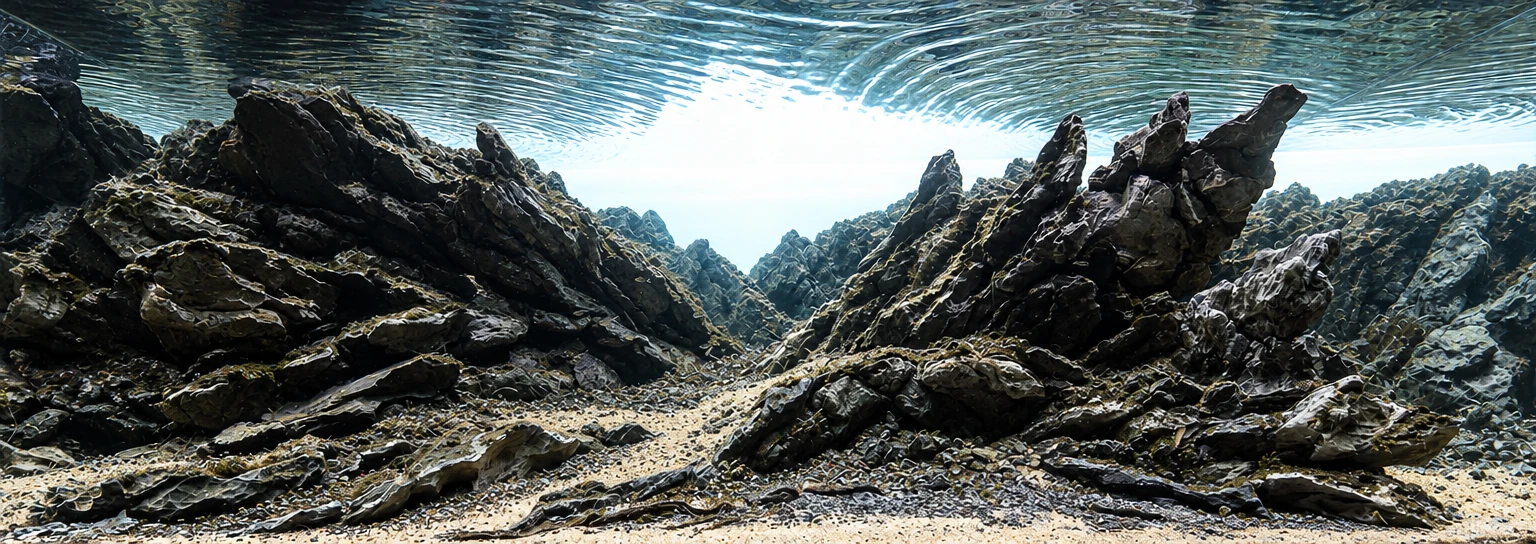
Technical control is one of the strongest aspects of the image. The stones are arranged in directional layers that lead inward from both sides, creating a pronounced valley and a readable sense of recession. Their angular faces provide repeated texture, while smaller foreground pieces bridge the larger formations and reduce the appearance of a simple pile. Planting is tucked into crevices and spread across ledges, helping integrate the hardscape with the substrate. The central opening is especially effective because it preserves depth instead of being filled completely. Some transitions remain visually busy, with several rock angles and plant textures competing in the middle ground. More disciplined simplification in those zones could make the construction even clearer.
Planting Control and Long-Term Maintenance
The image shows substantial planting maturity: mossy surfaces cover many rock edges, low growth follows the foreground contours, and taller or more textured plants occupy the rear and side masses. This creates a convincing aged appearance and prevents the stones from looking newly placed. However, a single photograph cannot verify trimming frequency, algae management, replanting, nutrient control, or whether the current balance can be sustained. Several areas appear intentionally dense, but dense growth can also conceal hardscape boundaries and narrow the visual channels if it expands further. The layout would benefit from preserving the central corridor, maintaining distinct plant layers, and periodically opening selected rock faces. These are inferred maintenance priorities, not evidence of an actual maintenance history.
Originality and First Impression
The first impression is powerful because the composition combines a dramatic, nearly mountainous rock arrangement with a bright water-surface opening. The valley is familiar as a natural subject, yet the broad panoramic treatment, strongly contrasting dark stones, and suspended school of fish give the scene a distinctive identity. The reflected or rippled upper surface adds another visual plane and makes the image feel larger than a conventional frontal aquascape. The abundance of detail rewards close viewing, although it slightly reduces the immediacy of individual focal points outside the central opening. Greater restraint in a few planted and rocky intersections could make the concept feel more intentional while preserving its richness.
Natural Atmosphere and Sense of Time
Natural atmosphere is communicated through weathered-looking stone, irregular plant coverage, layered relief, and the impression that growth has gradually settled into the rock. The fish movement reinforces the sense of a functioning underwater environment rather than a static landscape. The bright open area above the valley contrasts with the shaded side walls, producing a credible change in light and depth. At the same time, the strongly saturated greens and carefully exposed rock faces reveal the image as a highly curated contest presentation. That is not a flaw in itself, but it limits how confidently one can judge ecological naturalness from a single frame. A slightly calmer tonal balance would make the habitat impression less theatrical and more observational.
Composition, Balance, and Areas for Improvement
The overall composition is structurally complete and well balanced. Heavy rock masses anchor both sides, the central negative space supplies depth, and the pale foreground substrate provides a clear base beneath the darker middle ground. Diagonal stone lines direct the eye toward the bright opening, while fish movement prevents the center from becoming empty. Planting balance is generally strong, though the left and right masses are not equally legible because their foliage and rock textures vary considerably. The upper opening is an excellent focal destination, but its brightness can dominate the smaller details below. A judge seeking further improvement would look for slightly clearer separation between foreground, middle ground, and background, plus selective thinning where texture currently merges.















Leave your comments