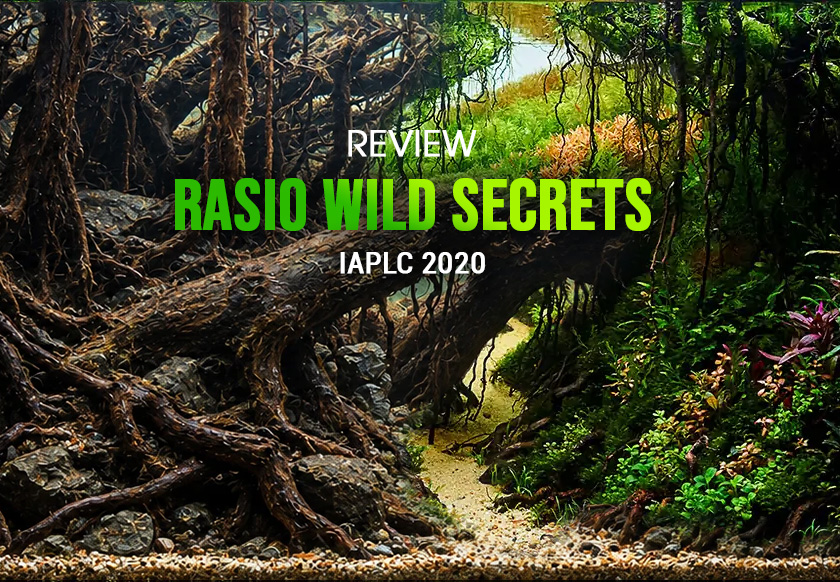
Judge's scorecard
Judging basis: IAPLC Secondary Screening Judging Criteria. The score is an editorial assessment from the submitted image, not an official contest result.
Recreation of natural habitat for fish
Judge's assessment
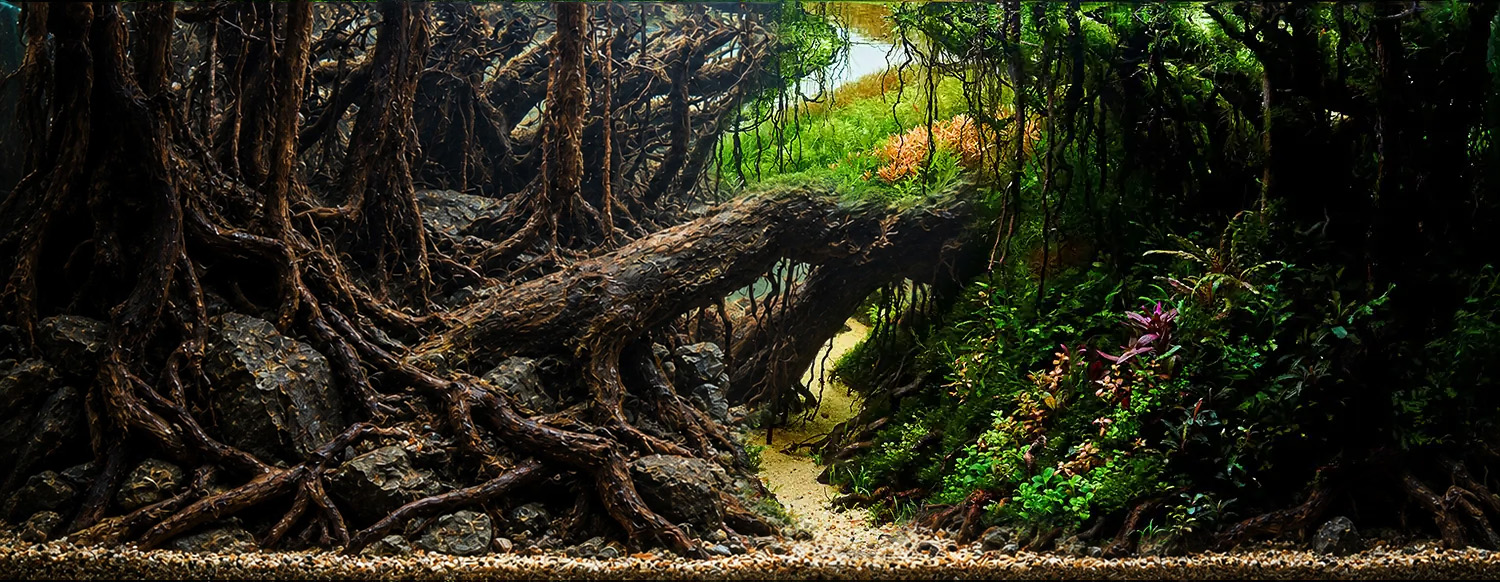
The planted root corridor, sandy substrate, shaded canopy and visible school of small fish create a convincing underwater forest habitat. Fish identity, ecological compatibility and biological condition cannot be verified from the image, so the score is conservative.
Strengths: Strong ecosystem impression rather than a purely decorative planting; Fish are integrated into the upper water column and provide convincing scale; Sandy route and root forms suggest a plausible natural environment
Limitations: Species and ecological compatibility are not identifiable; The image cannot verify water quality, fish health or available swimming space; Very dense planting may limit open-water habitat
Long-term maintenance of the layout
Judge's assessment
The maintained path, shaped canopy and separated plant groups indicate disciplined trimming and presentation. However, the extreme density and pale substrate would likely require demanding ongoing care, and no maintenance history is visible.
Strengths: Readable substrate remains exposed along the main trail; Plant masses appear deliberately controlled; Mature appearance is coherent across the full visible scene
Limitations: Dense growth may be difficult to prune and clean consistently; Dark areas make algae, debris and lower-plant condition difficult to assess; Sustainability cannot be confirmed from one photograph
Creator's technical skills
Judge's assessment
Depth management, root framing, perspective, plant grouping and tonal control are all highly accomplished in the visible image.
Strengths: Effective vanishing path and layered depth; Complex root-like forms are integrated with the planting; Color and texture are controlled across multiple planes
Limitations: Underlying hardscape construction and stability are not visible; The photograph cannot confirm how consistently the structure is maintained outside the presented view
Originality and impression of the layout
Judge's assessment
The enclosed forest passage and illuminated sandy destination create a strong, distinctive first impression with a clear visual narrative.
Strengths: Memorable canopy-and-path concept; High completeness and immersive scale; Fish, roots and foliage work together rather than appearing as isolated features
Limitations: The dense, dark treatment may reduce immediate clarity for some viewers; A more selective opening could sharpen the focal transition further
Presentation of natural atmosphere
Judge's assessment
Filtered light, hanging roots, dark margins and layered growth strongly suggest a shaded natural aquatic environment, though the image cannot establish a specific real habitat.
Strengths: Convincing sense of enclosure and underwater depth; Naturalistic green dominance with restrained warm accents; Visible fish strengthen the ecosystem impression
Limitations: Some plant groupings appear intentionally composed rather than purely irregular; Specific habitat reference cannot be confirmed from the image alone
Overall composition and planting balance
Judge's assessment
The central sandy trail, arched canopy and side framing establish clear hierarchy, while contrasting plant colors and fish movement provide balance.
Strengths: Strong inward-leading composition; Purposeful negative space in the sandy corridor and rear opening; Planting distribution supports the forest-path illusion
Limitations: Overlapping textures in the side and lower areas reduce legibility; Dark corners conceal some compositional detail
Judge's overall verdict
Editorial estimate: 87/100. This is a highly accomplished, atmospheric aquascape whose strongest qualities are its immersive forest interpretation, controlled depth and exceptionally clear sandy pathway. It falls short of a perfect score mainly because the image cannot verify biological compatibility or long-term sustainability, while the very dense planting and dark peripheral areas slightly reduce clarity and make maintenance difficult to assess. A judge seeking improvement would ask for marginally cleaner separation between selected plant masses and stronger evidence that the mature presentation remains stable over time.
Assessment limits: This review is based on one submitted image only. Plant species, fish species, tank dimensions, equipment, maintenance history, construction methods and biological condition cannot be confirmed. The numerical score is an editorial estimate under the supplied IAPLC Secondary Screening Judging Criteria, not an official contest result.
Natural Habitat Recreation — 43/50
The layout convincingly evokes a submerged forest margin or shaded stream, rather than a conventional open garden aquarium. The pale path resembles a streambed or exposed substrate corridor and leads into a brighter opening under the overhead growth. Small schooling fish are visibly integrated into the upper water column, where their silvery bodies provide scale and movement without overwhelming the planting. Dense vegetation, suspended roots and broken light reinforce the underwater habitat concept. The score is held below the highest range because the image cannot establish the fish species, their ecological compatibility, water quality or long-term condition. The livestock appear appropriately sized for the visual scale, but a single photograph cannot verify whether the school has adequate swimming space or whether the habitat is biologically balanced. A judge would also examine the fish more closely for posture, uniformity and signs of stress before awarding a near-perfect score.
Long-Term Maintenance — 8/10
The visible presentation suggests substantial control: the foreground remains readable, the sandy route is distinct, and the planted masses have been shaped into a coherent canopy rather than allowed to become an undifferentiated thicket. Repeated trimming appears to preserve the arching corridor and the separation between colored plant groups. These are positive signs for maintainability. Nevertheless, the density is extremely high, particularly along the sides and around the root forms. Such a mature arrangement can demand frequent pruning, debris removal and careful protection of the pale substrate from organic accumulation. Dark areas also limit the ability to inspect lower growth and substrate cleanliness. No maintenance history, equipment information or evidence of repeated presentation is available, so sustainability cannot be confirmed from the image alone. The work earns a strong but not maximum estimate because its visual maturity may also represent a demanding maintenance burden.
Technical Skills — 9/10
The strongest technical achievement is the management of depth through layered planting and hardscape-like roots. Dark framing at both sides creates a visual enclosure, while the sandy trail narrows toward the rear and establishes a clear vanishing direction. Hanging root shapes continue the vertical structure into the water column, and the bright background opening prevents the dense foreground from becoming visually closed. Plant masses are grouped with apparent control: fine-textured greens, reddish accents and darker foliage are distributed across several depth planes. The fish remain legible against the upper vegetation, indicating that the composition was not allowed to lose all open water. The one-point deduction reflects limits of visual evidence. The photograph does not expose how the root structure is secured, how the rear perspective is built, or whether the plant transitions remain stable outside the selected view. Even so, the visible trimming, depth control and tonal handling demonstrate exceptional execution.
Originality and Impression — 9/10
The first impression is distinctive and immediate. Rather than relying on a single dominant stone or an exposed branch, the layout creates a complete enclosed world with a path, canopy, root curtain and illuminated destination. The contrast between almost black framing foliage and the warm sandy center gives the image a strong narrative direction: the eye naturally travels inward and upward. Orange-red plant accents add rhythm within the green mass, while the fish provide a restrained living element. This combination feels more like an inhabited forest passage than a static botanical display. The score is not perfect because the central path-and-arch idea, although highly resolved, leaves relatively little visual quiet outside the main corridor; some viewers may find the overall density and darkness reduce immediate clarity. A slightly more selective opening or a cleaner focal transition could make the concept even more memorable without sacrificing its immersive character.
Natural Atmosphere — 9/10
Atmosphere is one of the entry’s defining strengths. The dark margins, hanging roots and filtered-looking illumination suggest a shallow, shaded aquatic environment beneath overhanging vegetation. The bright sand acts as a natural clearing, and the transition from foreground growth to distant light gives the scene a convincing sense of depth and time. The school of fish reinforces the impression that this is an ecosystem rather than a purely decorative arrangement. Color is used with restraint: green dominates, while warm foliage and substrate provide localized variation instead of an artificial rainbow effect. The image does not prove a direct match to any particular natural habitat, and some plant groupings appear deliberately arranged for pictorial impact. That is appropriate in a contest aquascape, but it prevents a full score under a criterion emphasizing natural ecosystem reference. A judge would look for even more nuanced irregularity in the plant edges and root distribution.
Overall Composition and Planting Balance — 9/10
The composition is exceptionally complete. The sandy trail supplies a strong central pathway, the root canopy forms an arching frame, and the heavy side planting creates depth without losing the destination at the rear. Planting balance depends on contrast rather than symmetry: darker, more enclosed masses occupy the edges, while brighter sand and background light open the center. Red and bronze foliage is placed in several small groups, preventing one accent from dominating the entire image. The fish add a horizontal counterpoint in the upper-left and central zones. The principal limitation is visual density. The lower and side regions contain many overlapping textures, and the darkest corners conceal some structure that might otherwise contribute to the composition. A little more separation between selected plant masses could improve legibility at a glance. Even with that reservation, the hierarchy is clear, the negative space is purposeful, and the planting distribution supports the intended forest-path illusion.











Leave your comments