Judge's scorecard
Judging basis: IAPLC Secondary Screening Judging Criteria. The score is an editorial assessment from the submitted image, not an official contest result.
Recreation of natural habitat for fish
Judge's assessment
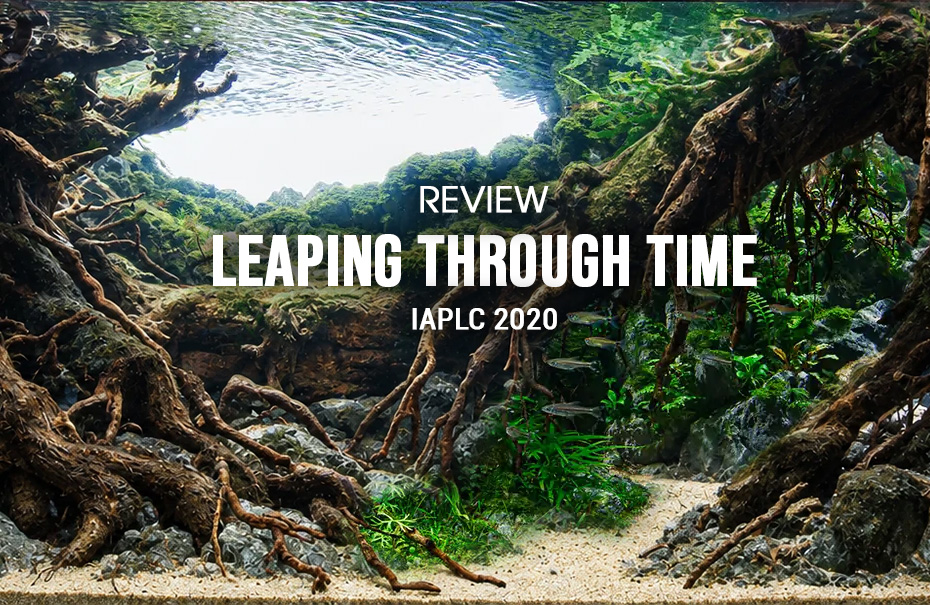
The image visibly presents a shaded planted stream environment with open central swimming space, cover along the margins, wood, rock, substrate, and a coordinated group of small fish. Exact species, behavior, and ecological compatibility cannot be verified from the image. Dense dark edges reduce habitat legibility in places.
Strengths: Convincing forest-stream atmosphere; Fish are integrated into the middle water rather than placed only at the front; Combination of cover and open swimming space; Plants and hardscape appear healthy in the photograph
Limitations: Species and long-term compatibility cannot be confirmed; Very dark side zones conceal some habitat detail; Overlapping growth makes parts of the environment difficult to read
Long-term maintenance of the layout
Judge's assessment
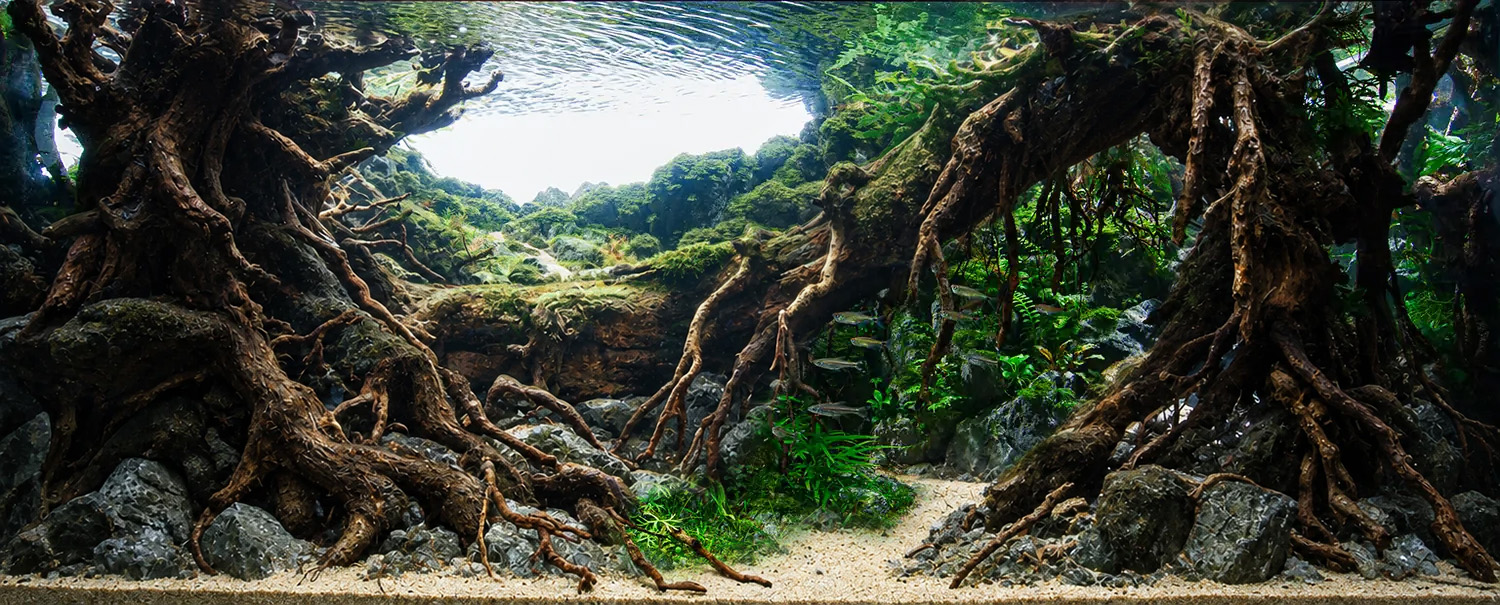
The planting appears controlled and the foreground remains open, but the photograph cannot verify maintenance history, pruning frequency, algae control, or access to deeply planted recesses. The extensive attached growth and dense framing would likely require disciplined upkeep.
Strengths: Clear foreground route remains available; Plant masses appear deliberately shaped rather than entirely overgrown; Hardscape and planting maintain a finished photographic appearance
Limitations: Dense side and canopy growth may be difficult to prune; Deep shaded pockets could complicate cleaning and debris removal; Sustainability cannot be established from one image
Creator's technical skills
Judge's assessment
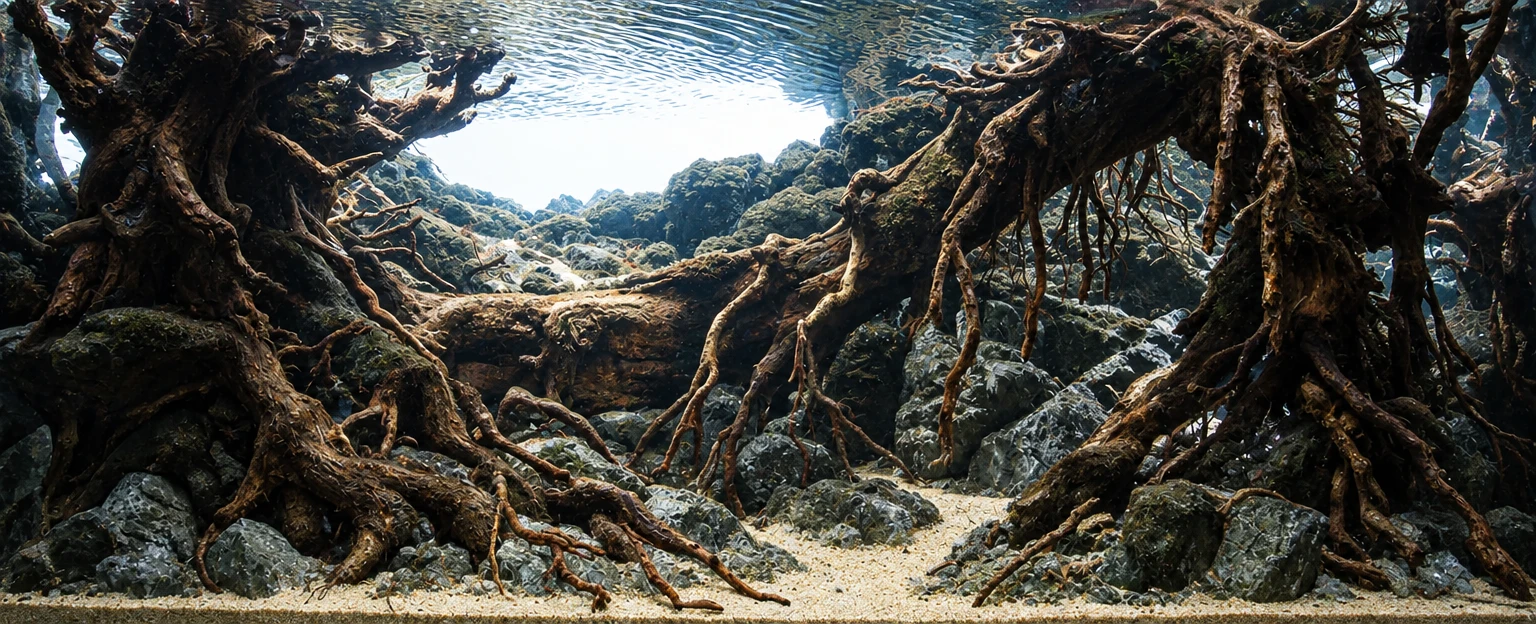
The image shows sophisticated depth management, layered hardscape, controlled planting on wood and rock, and a curved foreground route. The principal deduction reflects reduced structural readability where dark masses and dense plants merge.
Strengths: Strong foreground, middle-ground, and background separation; Natural-looking integration of plants with wood and rock; Effective control of a complex planting scheme; Clear use of a substrate path to create depth
Limitations: Some underlying structure disappears into shadow; Central overlaps make individual technical decisions harder to inspect
Originality and impression of the layout
Judge's assessment
The enclosed, canopy-like viewpoint and luminous rear opening produce a distinctive first impression. The fish give the composition movement and scale. The deduction reflects competition among the many details after the initial impact.
Strengths: Memorable immersive viewpoint; Strong contrast between dark framing and bright distance; Fish contribute narrative movement; Concept remains coherent across the full image
Limitations: High detail density can dilute the secondary focal hierarchy; A slightly clearer signature feature could make the concept even more individual
Presentation of natural atmosphere
Judge's assessment
The tonal gradient, layered vegetation, irregular wood and rock, and apparent maturity of the growth combine to create a convincing humid forest-stream atmosphere. This assessment is based on visible cues; no exact natural location or ecosystem is claimed.
Strengths: Excellent shaded-to-bright atmospheric transition; Mature-looking textures on wood and rock; Naturalistic layering and irregularity; Living fish prevent a static garden-like impression
Overall composition and planting balance
Judge's assessment
The bright opening, central fish school, and curved foreground route establish a strong hierarchy, while the dark side masses frame the scene effectively. One point is withheld because deep shadows and dense overlap reduce clarity in portions of the layout.
Strengths: Strong tunnel composition; Effective negative space through the central water and foreground route; Balanced distribution of framing vegetation; Clear depth cue from the pale substrate path
Limitations: Side shadows conceal compositional information; Some central forms compete for attention; Selective thinning or tonal separation could improve immediate readability
Judge's overall verdict
An exceptionally immersive and technically accomplished forest-stream composition. Its strongest qualities are habitat atmosphere, depth, integrated fish placement, and the powerful contrast between a dark planted enclosure and a bright central opening. The principal opportunities for improvement are not conceptual but editorial and practical: clarify the deepest shadows, reduce selected overlaps, and make long-term access and maintenance more evident. The 89/100 score is an image-based editorial estimate only and is not an official contest result.
Assessment limits: The assessment uses only the supplied image and trusted contest metadata. Plant species, fish species, tank dimensions, construction methods, maintenance history, equipment, camera conditions, author identity, and exact ecological reference cannot be verified. Text visible in the image was not used as evidence for authorship or other contest facts.
Habitat Recreation and Fish Integration
The strongest aspect of the layout is its convincing suggestion of a shaded tropical watercourse. The composition combines submerged greenery, irregular rock, branching wood, a pale gravel-like foreground, and a bright upper opening to imply water moving through a forested ravine. The fish are visible as a coordinated group in the central and middle-distance zones rather than appearing randomly scattered, which gives the scene life and scale. Their slender form and modest size appear visually compatible with the spacious central water, although exact species, behavior, and ecological suitability cannot be verified from the image. The planted margins provide cover, while the open center preserves swimming space. The main limitation is that the heavy darkness at the edges obscures some habitat detail and makes the underwater boundaries less legible. Editorial score: 45/50.
Long-Term Maintenance Potential
The image shows substantial control over a complex planted scene, but long-term sustainability is the criterion that can least be confirmed from a single finished photograph. The plants appear generally healthy and intentionally distributed, with compact growth on wood and rock and taller vegetation framing the upper and side areas. The clear foreground path also suggests that the layout has not been allowed to close completely across the viewing plane. However, the quantity of attached growth, narrow passages, overlapping stems, and deep shaded pockets would likely demand careful pruning and access management. The photograph cannot establish how stable the planting is, whether the fish load is appropriate over time, or how easily debris and algae could be removed from the recesses. A more open maintenance corridor or slightly clearer separation between plant masses could improve confidence. Editorial score: 7/10.
Technical Skills and Execution
The visible construction demonstrates advanced control of depth and visual layering. Dark wood and vegetation form a framing canopy, the central fish zone provides a middle plane, and the bright rear opening creates a strong sense of recession. Rocks and wood are interlocked visually rather than placed as isolated ornaments, while fine plants soften transitions around the hardscape. The foreground substrate is kept comparatively clear and follows a curved route into the scene, helping the eye travel inward. Planting is especially effective where moss-like textures and small-leaved growth cling to branches and rock faces. The principal technical weakness is density: some central and side structures merge into near-black masses, so the underlying hardscape is not always easy to distinguish. More controlled tonal separation would make the construction easier to evaluate. Editorial score: 9/10.
Originality and First Impression
The work makes a powerful first impression through its unusual scale of enclosure. Rather than presenting an exposed open valley or a simple island composition, it places the viewer inside a submerged forest corridor, with a canopy-like border on three sides and a luminous opening beyond. That viewpoint gives the school of fish a narrative role: they appear to be moving through a sheltered passage rather than simply decorating the foreground. The combination of intense greenery, exposed pale substrate, and dark framing also creates strong color and value contrast. The concept is coherent and memorable without relying on a single isolated focal stone. A higher score would require either a more distinctive visual signature or slightly clearer central storytelling; at present, the abundant details compete for attention after the initial impact. Editorial score: 9/10.
Natural Atmosphere and Sense of Time
The scene convincingly evokes a mature, humid forest stream. Brightness is concentrated in the distance and above the central planting, while the foreground and side margins remain shaded, producing a believable atmospheric gradient. The layered growth on wood and rock suggests a habitat that has developed over time rather than a newly arranged hardscape. Fine branching forms, mossy textures, and scattered stones reinforce the impression of a wet natural environment. The fish add movement and prevent the image from reading as a static botanical display. Because the photograph is highly composed and the water surface is not independently verifiable, the exact natural reference cannot be identified; the judgment rests on visible visual cues only. The darkest corners could be opened slightly to reveal more ecological detail without sacrificing the sheltered mood. Editorial score: 10/10.
Composition and Planting Balance
The composition has a clear visual hierarchy: the bright rear opening attracts the eye first, the central fish group supplies the principal living focus, and the pale foreground route leads into the distance. The left and right masses create a strong frame, while the open central corridor prevents the planting from becoming a uniformly solid wall. Plant distribution is rich and varied in texture, with growth extending from the base into the midground and canopy. The curved foreground line is particularly useful because it introduces direction and depth. Balance is slightly uneven in readability rather than in mass: the side shadows are so deep that their detail is lost, and the central region contains many overlapping forms. Selective thinning or increased tonal separation would make the focal route more immediate. Editorial score: 9/10.











Leave your comments