AquaLibs reviewed the original photographs of all 300 ranked entries and assigned each layout to one primary visual family. The result is a useful baseline for watching the 2026 reveal: forest and rootscape compositions formed the largest single group, while open wood-led scenes and rock landscapes offered distinct alternatives.
IAPLC 2025 attracted 1,533 entries from 77 countries and areas, according to the official results announcement. This review covers ranks 1–300, rather than the entire field. Keep the IAPLC 2025 results and photo gallery open as you read: the photographs make the differences between these approaches much easier to see.
How we classified the IAPLC 2025 TOP 300
These are AquaLibs editorial classifications, not official IAPLC style categories. Each photograph was assessed by its dominant visual structure. Mixed layouts are common, so the labels describe the main impression of a composition rather than certify adherence to a traditional school.
- Forest / rootscape: trunk, root or canopy structures create a wooded enclosure, dense root landscape or forest-like scene.
- Open wood-led Nature Aquarium: exposed wood organises a more open riverbank, island or flowing composition, with less enclosure.
- Rockscape / mountain & canyon: stones organise cliffs, ridges, terraces or detailed rocky terrain.
- Minimalist rock / Iwagumi-like: a restrained stone grouping, low or grass-like planting and substantial open water dominate. This label does not claim compliance with strict Iwagumi conventions.
- Plant-dominant garden: contrasting plant masses organise the scene, with hardscape playing a secondary role. This is broader than formal Dutch style.
- Hybrid / uncertain dominant family: wood and stone are difficult to separate, or plant coverage obscures the structure enough that a single confident assignment would be misleading.
“Nature Aquarium” is used here to name the open wood-led subgroup; it does not imply that forest or rock layouts fall outside the wider Nature Aquarium tradition. Photographs at ranks 1–300 were counted once each. The missing rank 018 image in the AquaLibs gallery was checked in the official IAPLC gallery; the separate AI hardscape reconstruction at rank 004 was excluded.
The accompanying audit records a visual reason and image source for every assignment. Borderline choices remain editorial judgements, and 16 layouts are retained in the hybrid or uncertain group. This is a transparent reading of the published images, rather than a measurement of the judging panel’s preferences.
Which aquascaping styles were most common?
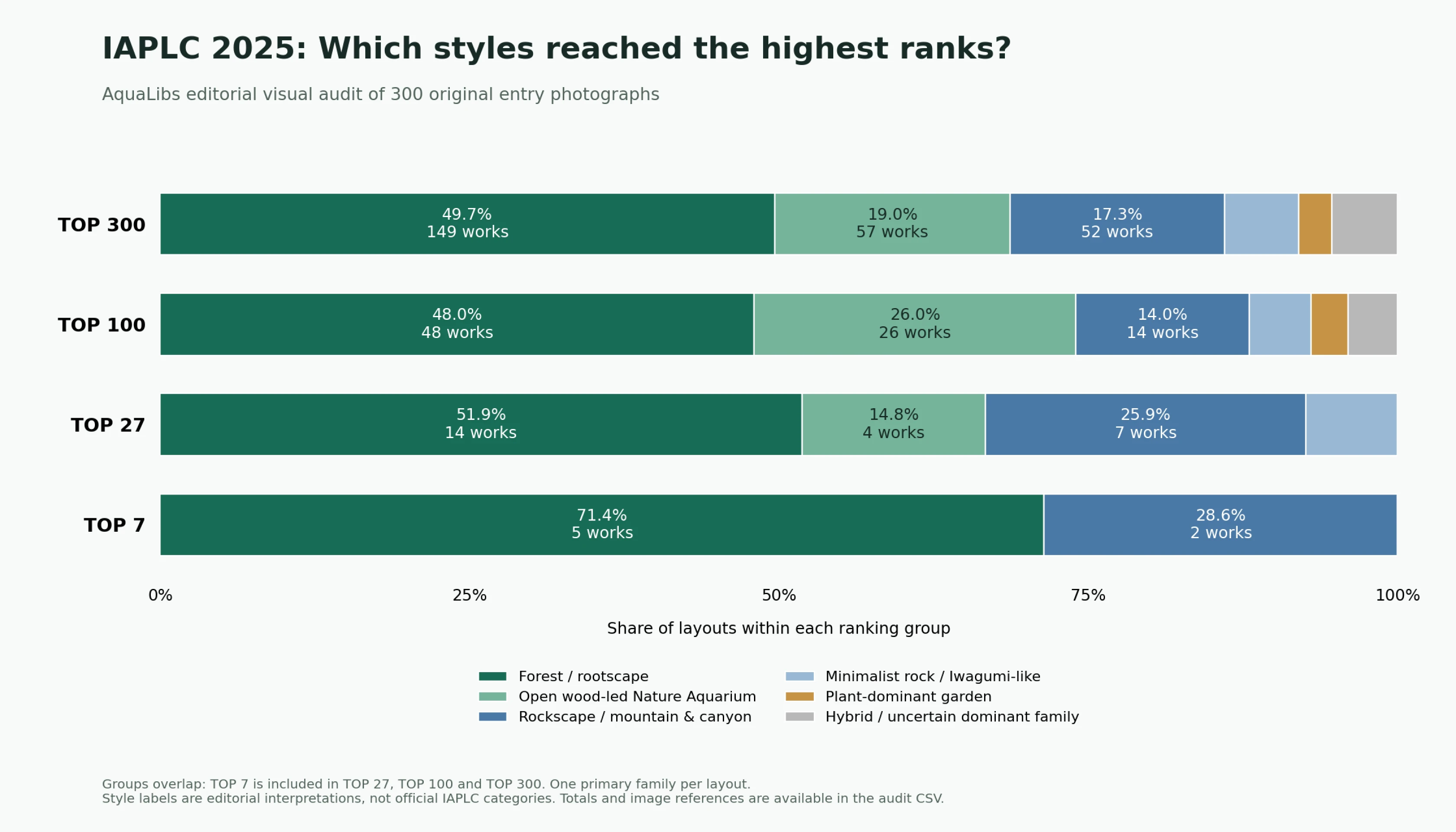
Forest/rootscape was the largest single family in the TOP 300: 149 layouts, or 49.7%. That is almost half, but not an absolute majority. Adding the 57 open wood-led layouts brings the combined wood-led share to 206 of 300, or 68.7%.
| Editorial visual family | TOP 300 | TOP 100 | TOP 27 | TOP 7 |
|---|---|---|---|---|
| Forest / rootscape | 149 (49.7%) | 48 (48.0%) | 14 (51.9%) | 5 (71.4%) |
| Open wood-led Nature Aquarium | 57 (19.0%) | 26 (26.0%) | 4 (14.8%) | 0 (0.0%) |
| Rockscape / mountain & canyon | 52 (17.3%) | 14 (14.0%) | 7 (25.9%) | 2 (28.6%) |
| Minimalist rock / Iwagumi-like | 18 (6.0%) | 5 (5.0%) | 2 (7.4%) | 0 (0.0%) |
| Plant-dominant garden | 8 (2.7%) | 3 (3.0%) | 0 (0.0%) | 0 (0.0%) |
| Hybrid / uncertain dominant family | 16 (5.3%) | 4 (4.0%) | 0 (0.0%) | 0 (0.0%) |
Read the columns as overlapping groups. TOP 7 is contained within TOP 27, TOP 100 and TOP 300. Percentages use each column’s own denominator and are rounded to one decimal place; rounded totals may differ slightly from 100%.
What changes in the TOP 100, TOP 27 and TOP 7?
The TOP 100 has a slightly lower forest/rootscape share than the TOP 300: 48.0% versus 49.7%. Open wood-led compositions account for 26.0% of the TOP 100, compared with 19.0% of the TOP 300. Together, the two wood-led families occupy 74 of the first 100 places.
Within the TOP 27, forest/rootscape rises to 14 layouts (51.9%), and detailed rockscapes account for 7 (25.9%). Four open wood-led scenes and two minimalist rock layouts complete that group. Compared with the TOP 100, the TOP 27 has a larger share of both enclosed wooded scenes and detailed rocky terrain.
The TOP 7 is more concentrated: five forest/rootscape layouts and two rockscapes. Those five wooded works belong to Josh Sim, Gang Zhao, Katsuki Tanaka, Kiat Fuil Yap and Qi Lin; the rock-led works belong to Hidekazu Tsukiji and Francesco Rampinelli.
There is no steady increase in forest share from TOP 300 through every higher group. And seven photographs are a small sample: one different assignment changes the TOP 7 share by 14.3 percentage points. The results describe the visual mix among highly ranked works; they do not establish that choosing a particular style caused a higher score.
Eight IAPLC 2025 layouts worth revisiting
These selections illustrate contrasting ways to organise a scene. They are not a second ranking: each offers a specific detail to examine in the gallery.
001 — Josh Sim, Malaysia: depth through overlapping wood
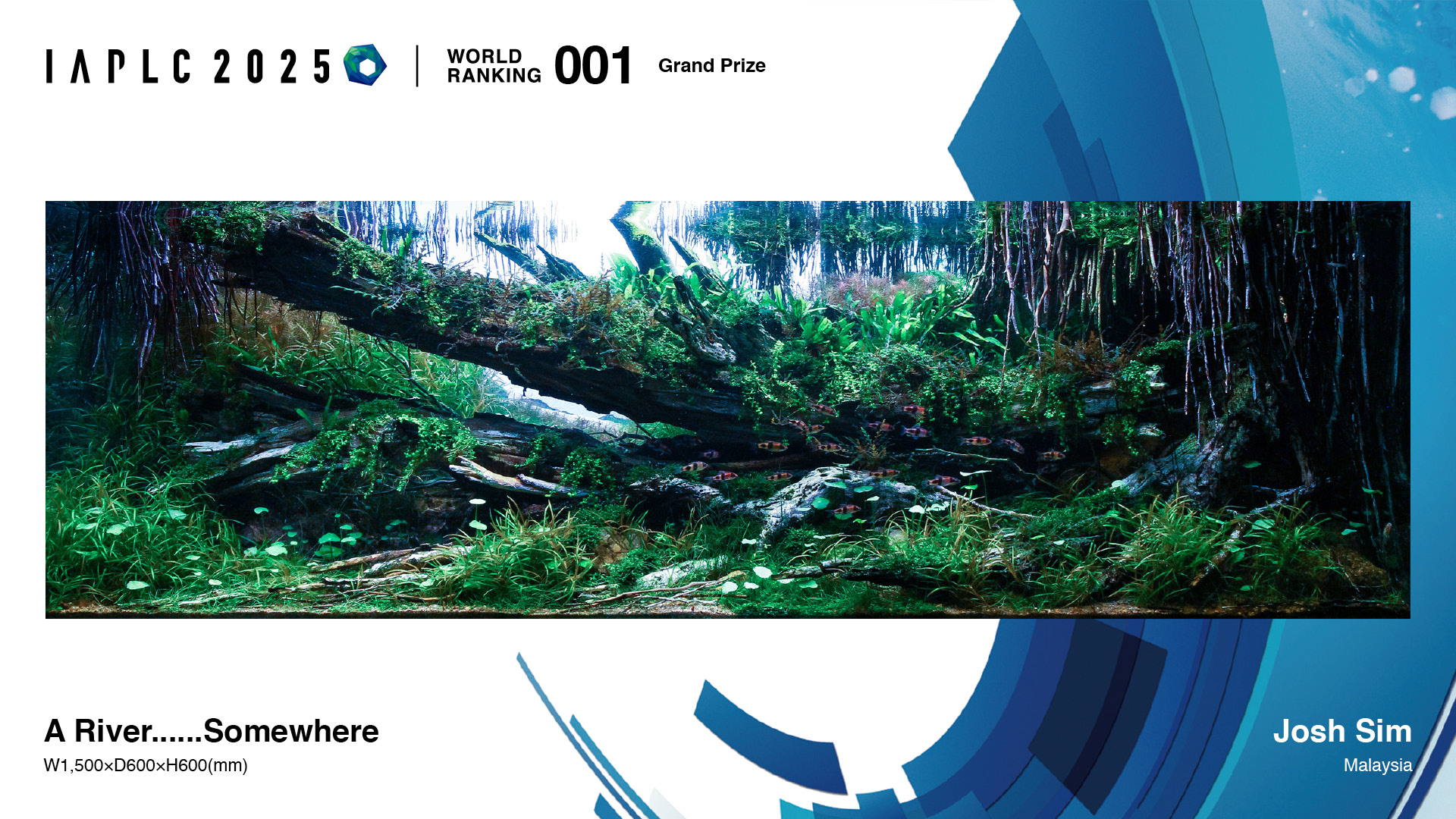 IAPLC 2025 — World Ranking 001. Josh Sim, Malaysia. “A River......Somewhere.” Original contest photograph; click to enlarge.
The Grand Prize layout layers a substantial fallen trunk across the foreground and middle distance, with upright tree forms and finer detail behind it. Overlap gives the viewer several distances to read before reaching the brighter rear of the scene. Dark wood, planted surfaces and a pale channel work together without making the whole aquarium equally bright.
When you revisit it, follow the space beneath and beyond the main trunk. The sense of depth depends as much on what remains visible between the masses as on the amount of hardscape. Explore Josh Sim’s AquaRank profile to place the 2025 winner alongside his wider contest record.
003 — Katsuki Tanaka, Japan: warm planting with a clear structural direction

Strong diagonal wood draws the eye across the scene, while warm red and orange planting creates a contrasting upper layer. The colour is memorable, but the exposed wood remains readable through it. This is a useful example of colour reinforcing a composition instead of obscuring its main lines.
Compare the direction of the wood with the brighter planting above it. A forest/rootscape label can contain very different moods: it does not require a uniformly dark or entirely green aquarium.
004 — Hidekazu Tsukiji, Japan: an open rockscape with room for movement

Angular rocks establish a low, extended terrain, with fine green planting and open water above. The lower visual centre gives the photograph a different rhythm from the enclosed root scenes around it in the rankings. Fish remain visible against the lighter spaces, adding movement without needing a dramatic forest tunnel.
Study the balance between exposed stone, planted surfaces and water. The photograph demonstrates that openness and detailed hardscape can coexist in a highly ranked layout.
006 — Francesco Rampinelli, Italy: rocks, warmth and a visible school

Rugged stone formations flank a pale passage, while warm planting and a conspicuous school of fish give the open upper area energy. The rocks provide scale and direction; the fish occupy a contrasting zone where their colour and movement are easy to read in the photograph.
Look at the space above the channel as well as the channel itself. Depth is supported by the relationship between the rocky banks, the bright rear opening and the fish suspended in front of that opening.
009 — Tom Ryan, Great Britain: light as part of the landscape

Warm yellow-green planting, exposed rocky forms and a bright rear opening give “Golden Hour” a luminous character. The winding pale route leads into the scene, while the fish stand out against the lighter upper background. Plant texture helps connect the larger formations rather than treating each rock as an isolated object.
Compare this photograph with “Aurora”: both are rock-led, yet their colour balance and distribution of planted surfaces produce different visual experiences.
010 — Thomas Gueguen, France: a woodland palette beyond green

Upright tree forms, exposed roots and warm reddish planting create a layered woodland scene. The colour sits within a recognisable forest structure, so the atmosphere changes without losing the sense of place. Small plants and root details near the foreground give the viewer a different scale from the taller forms behind them.
This is a useful counterpoint to the greener forest entries: the same broad visual family can use colour, texture and light very differently.
025 — Takahiro Ogawa, Japan: restraint within the TOP 27

A restrained stone grouping, grass-like planting and generous open water provide a quieter alternative to dense dioramas. Fine leaves and the distribution of fish become easier to notice because there are fewer competing hardscape masses. This is classified as Iwagumi-like for its visual restraint, without claiming that every traditional Iwagumi rule is met.
Its place in the TOP 27 is a reminder to examine compositions beyond the seven highest awards. The broader prize group contains approaches that the TOP 7 alone does not represent.
026 — Long Tran Hoang, Vietnam: a narrow passage between substantial banks

Two substantial planted rock banks are separated by a narrow, bright passage. The contrast between the dark side masses and the opening makes that small area carry considerable visual weight. Plants soften the hardscape while preserving the separation between the banks.
Move from the final photograph to the “Connecting” aquascaping process feature, then explore Long Tran Hoang’s AquaRank profile. Together, those pages connect the finished contest image with its construction and the creator’s competition history.
Three things to look for when browsing the 2025 gallery
Depth: follow the openings, overlaps and changes in scale
An obvious sand path is only one way to suggest distance. Josh Sim uses overlapping wood; the rock banks in “Connecting” give a narrow opening particular emphasis; other layouts repeat trunks, roots or ledges toward the rear. Look for foreground elements that partly conceal another layer, smaller details behind larger forms, and passages that narrow as they recede. These visual cues are more informative than simply counting how many objects a layout contains.
Plants: ask what the planting makes clearer
Planting can define a canopy, soften a bank, separate a foreground from a rear layer, or introduce a warm colour accent. “PRIMAL BURST” and “Autumn’s embrace” show how colour can change the mood of a wooded composition. “Golden Hour” shows how fine texture can connect rock forms. Species cannot always be identified reliably from a contest photograph; for this review, the useful evidence is the visible role of the plants, rather than a guessed plant list.
Fish: read the spaces they occupy
A school can make an opening feel alive, reveal the scale of the hardscape, or add a contrasting band of colour. In “Aurora”, fish are particularly legible against the bright upper water. In other scenes, darker hardscape gives lighter fish a contrasting background. Ask whether the fish clarify the main composition or draw attention elsewhere. A single photograph records one moment, so it cannot establish normal schooling behaviour, swimming comfort or long-term aquarium health.
What should we watch for in IAPLC 2026?
ADA has scheduled the IAPLC 2026 TOP 100 photograph and ranking reveal for October 10, 2026, at 1:00 PM JST on its official YouTube channel, ADA VIEW. That is 11:00 AM in Vietnam and 04:00 UTC. The complete ranking list is due on the official IAPLC website after the livestream. See the official announcement for details.
The 2025 photographs give us several questions to bring to that reveal:
- Will forest and rootscape scenes again form the largest visual family among the highest-ranked works?
- Will open wood-led compositions hold a strong place in the TOP 100, or will enclosed scenes become more prominent?
- Will rock-led terrain occupy a larger share of the top prizes?
- Will warm plant colours remain a visible part of woodland and rocky layouts?
- How will the new works use open water and fish placement to make complex scenes readable?
These are questions, not predictions based on unseen entries. The 2026 nominee list provides names and countries; it does not yet provide the final ranks or official layout photographs. The 2025 visual distribution is a comparison point for the new results, not evidence about the new designs.
Which IAPLC 2025 work do you keep returning to? Share its rank or creator’s name, and tell us what stands out: depth, planting, fish, atmosphere or a completely different detail.
Start with the full IAPLC 2025 gallery and results, then visit AquaRank to explore the creators and their contest records. For the upcoming season, browse our IAPLC 2026 TOP 300 country breakdown. The archive is most useful when we look beyond a single winning photograph and discover how many different ways a planted aquarium can be composed.





Leave your comments