Overview
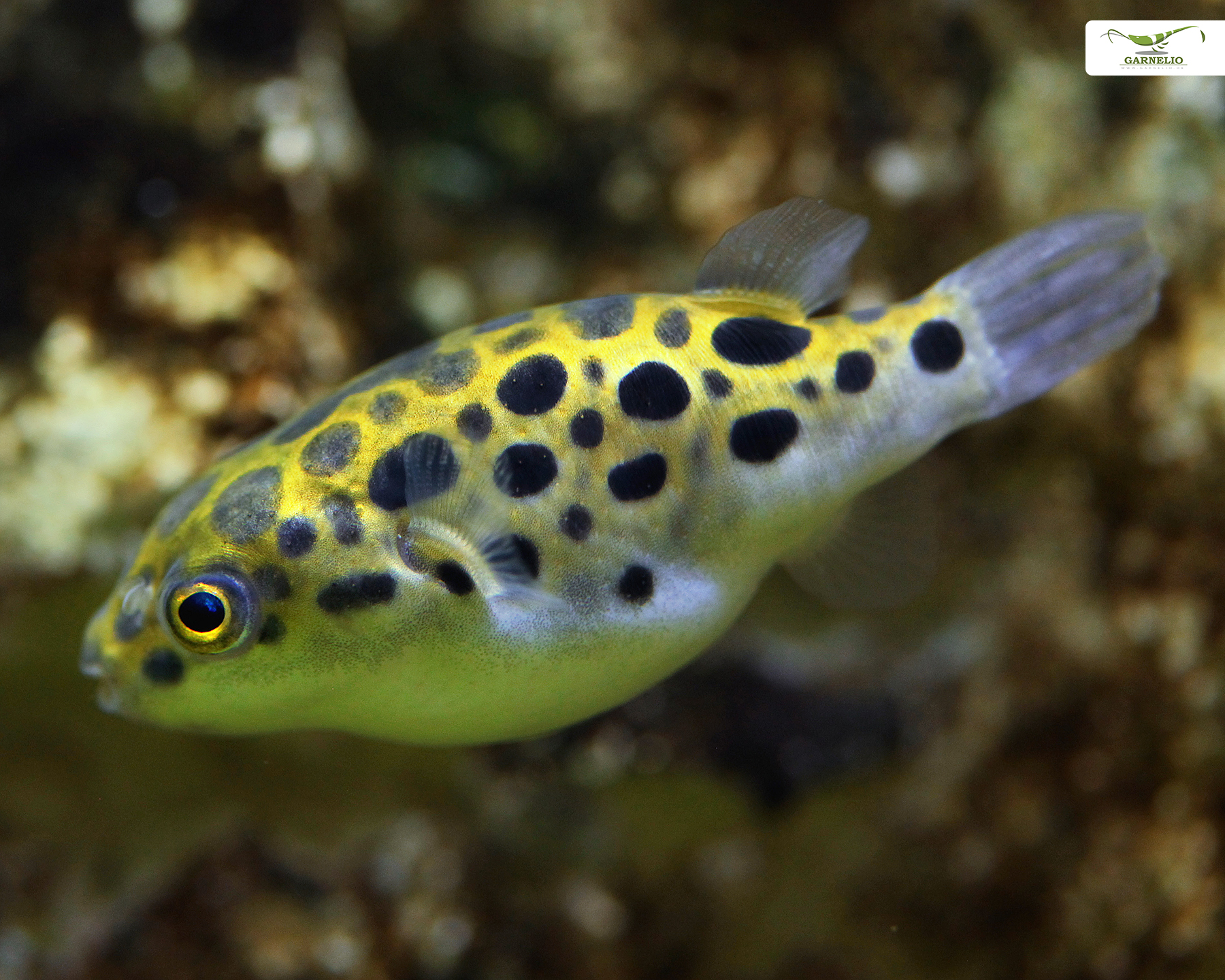
The Green Spotted Puffer (Tetraodon nigroviridis) is a highly charismatic and intelligent species that has captured the hearts of many aquarists. Often sold incorrectly as a purely freshwater fish, this species actually requires brackish water conditions to thrive, especially as it matures into adulthood. They are known for their helicopter-like swimming style and their ability to recognize their owners, often begging for food at the front of the glass.

Distribution and Habitat
This pufferfish is widely distributed across South and Southeast Asia, including countries like India, Sri Lanka, Myanmar, Thailand, Cambodia, Vietnam, Malaysia, Indonesia, and the Philippines. They naturally inhabit coastal areas, mangrove swamps, estuaries, and the lower reaches of rivers where freshwater mixes with seawater, creating a dynamic brackish environment.
Description of Green Spotted Puffer
Body shape:
They possess a robust, club-shaped body that is widest near the head and tapers toward the tail. Like other puffers, they lack traditional scales and instead have tough, leathery skin covered in tiny, barely visible spines.
Color:
The upper half of the body is a vibrant yellowish-green adorned with distinct, irregular black spots. The belly is a stark, bright white, though it can turn gray or black if the fish is stressed or ill.
Barbels:
This species does not possess barbels.
Snout:
The snout is relatively short and blunt, housing a powerful beak formed by four fused teeth (a hallmark of the Tetraodontidae family) used to crush hard-shelled prey.
Eyes:
They have large, expressive eyes that are highly mobile. Their eyes can move independently of one another, allowing them to scan their environment for prey and predators simultaneously.
Fins:
Their fins are relatively small and often transparent. They lack pelvic fins entirely, relying on their pectoral, dorsal, and anal fins for their unique, hovering style of locomotion.
The Tail:
The caudal fin (tail) is fan-shaped and acts primarily as a rudder for steering, though it can provide sudden bursts of speed when the fish is startled or striking at prey.
Temper
Green Spotted Puffers are known for their highly aggressive and territorial temperament. While they may seem peaceful as juveniles, their aggression increases significantly as they mature, making them notorious fin-nippers and predators of smaller fish.
Sociality
Due to their aggressive nature, they are generally not considered good community fish. They are best kept as single specimen pets or in a highly specialized species-only tank. If keeping more than one, a very large aquarium with numerous broken lines of sight is absolutely mandatory to prevent fatal territorial disputes.
Activity
They are incredibly active and inquisitive fish. When not sleeping, they are constantly patrolling the aquarium, exploring decorations, and hunting for small invertebrates. They are diurnal and will be highly active during daylight hours.
Keeping and Caring for Green Spotted Puffer
Tank size:
A minimum of 30 gallons is required for a single adult Green Spotted Puffer. If attempting to house a pair or a small group, a tank of 55 to 75 gallons or more is necessary.
Water Parameters:
Temperature
Maintain a stable temperature between 24-28°C (75-82°F).
pH
The pH should be kept alkaline, ideally between 7.8 and 8.5, which is easily achieved in a brackish setup.
Hardness
They require hard water, with a general hardness (GH) ranging from 10 to 20 dGH.
Ammonia, Nitrite, Nitrate
Puffers are scaleless and incredibly sensitive to poor water quality. Ammonia and Nitrite must always be at 0 ppm. Nitrates should be kept as low as possible, ideally below 20 ppm, through regular heavy water changes.
Lighting
Moderate lighting is sufficient. They do not have specific high-light requirements, but lighting should be bright enough to support any brackish-tolerant plants or macroalgae in the tank.
Water flow
A moderate water flow is appreciated, simulating the tidal movements of their natural estuarine habitats. Good filtration is also necessary due to their messy eating habits.
Decorations and Plants
Use a sandy substrate to prevent damage to their bellies. Decorate with smooth rocks, driftwood, and artificial plants to create caves and break up lines of sight. Live plants can be difficult to keep due to the brackish salinity, but hardy species like Java Fern or Mangrove propagules can be attempted.
Diet
They are strict carnivores with a specialized diet. In the wild, they feed on crustaceans, mollusks, and small fish. In captivity, their diet must consist primarily of hard-shelled foods to naturally file down their constantly growing beak.
Some Feeding Tips
Feed them pond snails, ramshorn snails, small crabs, clams, and mussels. Bloodworms and brine shrimp can be offered as occasional treats, but should not make up the staple diet. Never feed them standard fish flakes or pellets, as these do not provide the necessary dental wear.
Breeding
Breeding the Green Spotted Puffer in a home aquarium is extremely rare and poorly documented. In the wild, breeding is triggered by complex environmental changes related to the wet season and tidal shifts, which are nearly impossible to replicate in a standard home aquarium.
Conclusion
The Green Spotted Puffer is a spectacular, highly rewarding pet for the experienced aquarist willing to meet its specific needs. While their requirement for brackish water and a hard-shelled diet makes them unsuitable for beginners, those who provide the proper care will enjoy a long-lived, interactive, and truly fascinating aquatic companion.
 - pair - 1.webp)
Leave your comments