Follow the photographs into the wider country story with the new AquaRank Nations: explore Japan’s IAPLC 2026 results and the creators behind them.
This is part of AquaLibs’ IAPLC 2026 Country Studies, returning to our archived Japan introduction through this season’s photographs. The archive is historical commentary; the new observations are AquaLibs’ independent visual analysis, separate from official judging. The 6 selected works form an editorial comparison, not a census of national styles.
The 2026 result in context
| Published ranking range | Japan places |
|---|---|
| Ranks 1–7 | 1 |
| Ranks 1–27 | 4 |
| Ranks 1–100 | 22 |
| Ranks 1–300 | 68 |
Counts are calculated from the official final ranking, using the country-and-area label Japan. They count published places, not total submissions or participants. Rank 61 is vacant, so the global ranks 1–300 contain 299 published names.
From individual aquariums to the national view
Japan’s contributing five are not identical to the six photographs selected here. Rank 29 belongs to the national calculation, while the later examples broaden this article’s design discussion. Nations lets readers follow both routes: identify the results behind the national position, then use the gallery and creator histories to examine how different Japanese aquariums handle planted space.
| AquaRank Nations · IAPLC 2026 | Japan |
|---|---|
| AquaRank national position | #3 |
| Average of five contributing overall ranks | 17.6 |
| Contributing individual ranks | #3, #9, #21, #26, #29 |
| Published country results in the full edition | 451 |
These are AquaRank’s calculated national standings, not official IAPLC national awards. The average uses the five lowest overall ranks from five confirmed aquascapers; a lower average is better. The 2026 edition is marked as complete on Nations. This full-ranking view is broader than the Top 300 photo selection used in this article. Figures were checked on 16 October 2026.
Explore Japan at IAPLC 2026 on AquaRank Nations →
Open the contributing five, follow available artwork and creator profiles, then use the edition selector or Japan’s IAPLC history to explore other available seasons. Use the IAPLC 2026 nations comparison to see the same method applied across countries and regions.
Inspired by Josh Sim’s IAPLC Nations Challenge. Read the Nations methodology for coverage and ranking rules. The average describes results; it does not measure a design style or explain a judge’s decision.
Follow the country journey
Explore Japan through the years below. Switch between nation position and average rank, then open an edition or its contributing aquascapers to continue the journey.
Japan at IAPLC
Loading country history…
Returning to the archive
The archived Japan introduction, published in 2021, described a strong Nature Aquarium foundation alongside newer, more contemporary layouts. We retain that distinction as a question rather than a ranking of authenticity. The 2026 photographs can be read through visible space, planting and fish without deciding that one particular forest or rock arrangement is the only legitimate continuation of the tradition.
The photographs to study
| World rank | Creator | A detail to follow |
|---|---|---|
| #3 | Takashi Hosoda | A path seen through hanging roots |
| #9 | Katsuki Tanaka | The planted foreground has its own story |
| #21 | Mizuki Yasuda | Colour runs along exposed geological lines |
| #26 | Kenyu Sakai | Low timber layers create a broad scene |
| #50 | Kazuma Takeuchi | A sweeping foreground with colour on the higher slopes |
| #219 | Hidekazu Tsukiji | A rocky opening with the water in view |
Rank 3 — Takashi Hosoda
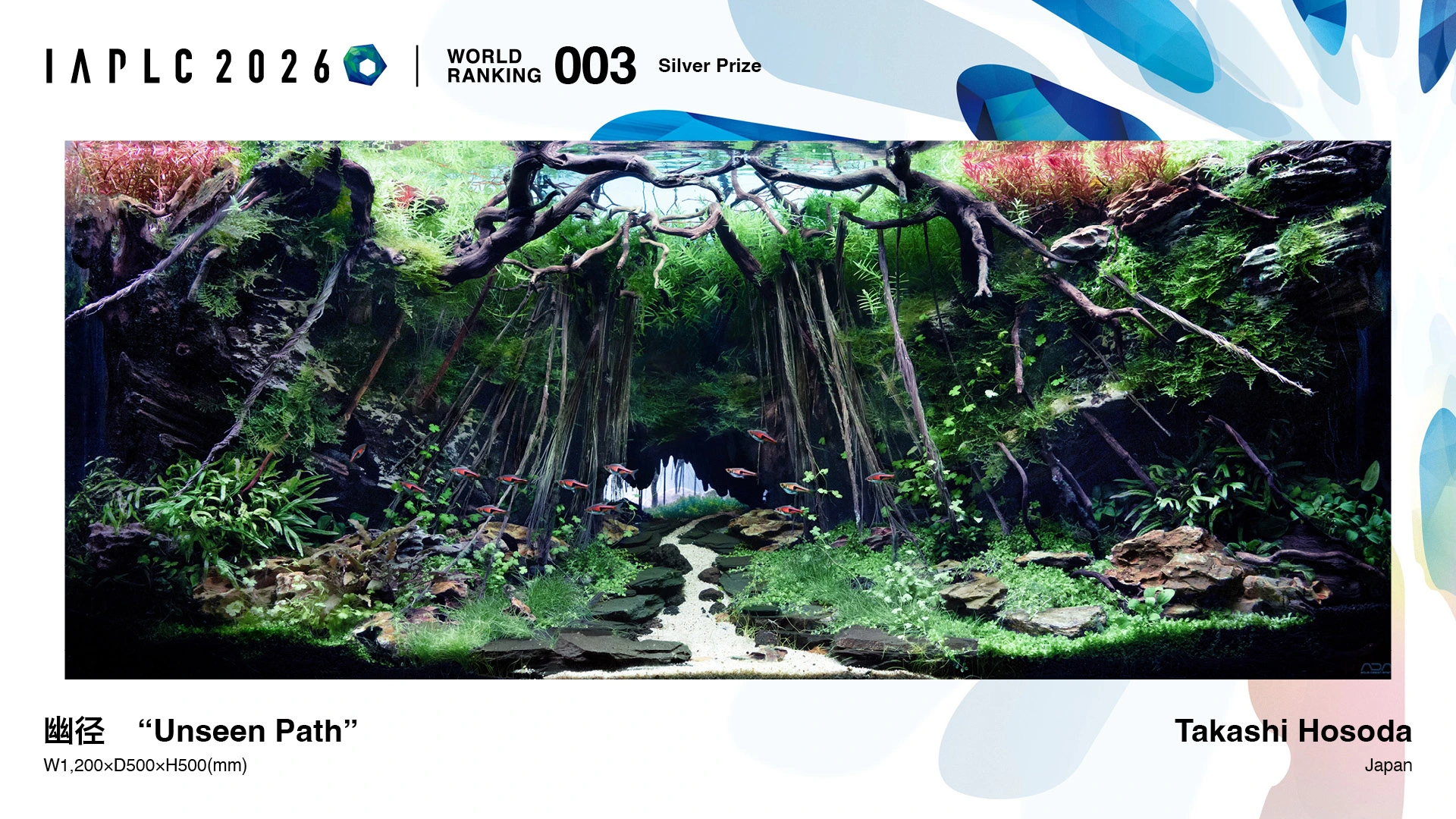
A path seen through hanging roots. A pale passage narrows between planted banks and continues beneath slender hanging forms. The upper branch arch and warmer planting frame a largely green lower scene. Dark rock and wood surfaces keep the vegetation from merging into one mass. The visible fish cross the middle, above the entrance to the path, so the photograph offers both an inhabited water column and a route into the distance.
Look closer: Compare the clear foreground entrance with the partly concealed end of the path.
Explore Takashi Hosoda’s recorded work on AquaRank · Back to the selected works
Rank 9 — Katsuki Tanaka
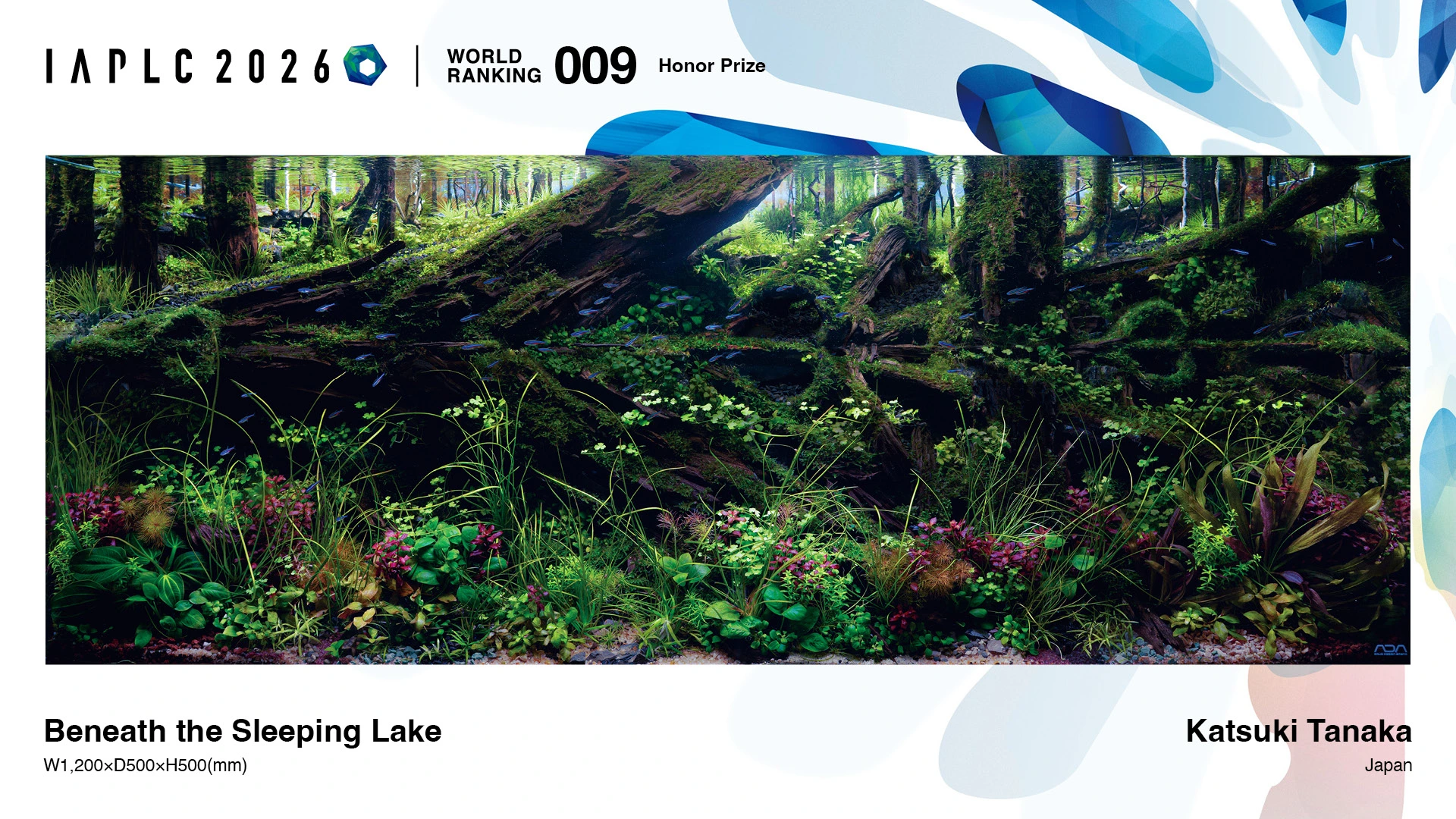
The planted foreground has its own story. A large diagonal trunk connects the scene above dark pockets of water. Slender upright forms and brighter greenery establish a forest behind it. In front, fine grass-like leaves, broad foliage and pink-red accents create a richly varied lower layer. The difference between that foreground and the distant trunks gives the photograph more than one scale of interest; its identity depends on planting as well as wood.
Look closer: Move from the foreground leaf shapes to the thinner trunks at the rear.
Explore Katsuki Tanaka’s recorded work on AquaRank · Back to the selected works
Rank 21 — Mizuki Yasuda
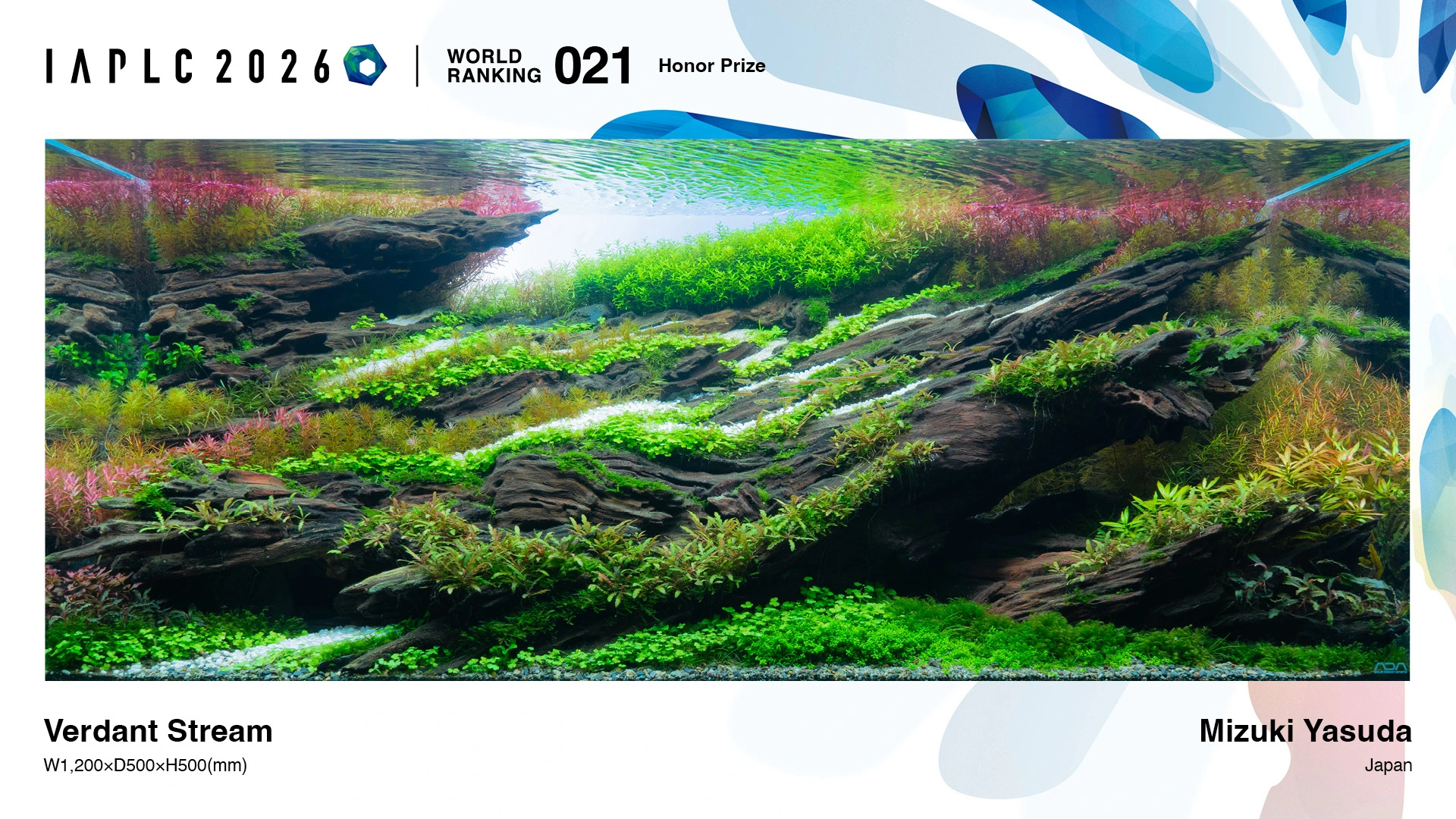
Colour runs along exposed geological lines. Long rock faces and planted slopes rise diagonally towards open water. Green growth traces their ledges, while reddish and warmer foliage gathers along the higher margins. Pale substrate appears in narrow breaks between the forms. The stone remains legible despite the rich planting, giving the photograph a balance between firm directional lines and soft coloured surfaces. It offers a different route into depth from the enclosed forests.
Look closer: Follow the exposed stone lines, then see where colour reinforces their direction.
Explore Mizuki Yasuda’s recorded work on AquaRank · Back to the selected works
Rank 26 — Kenyu Sakai
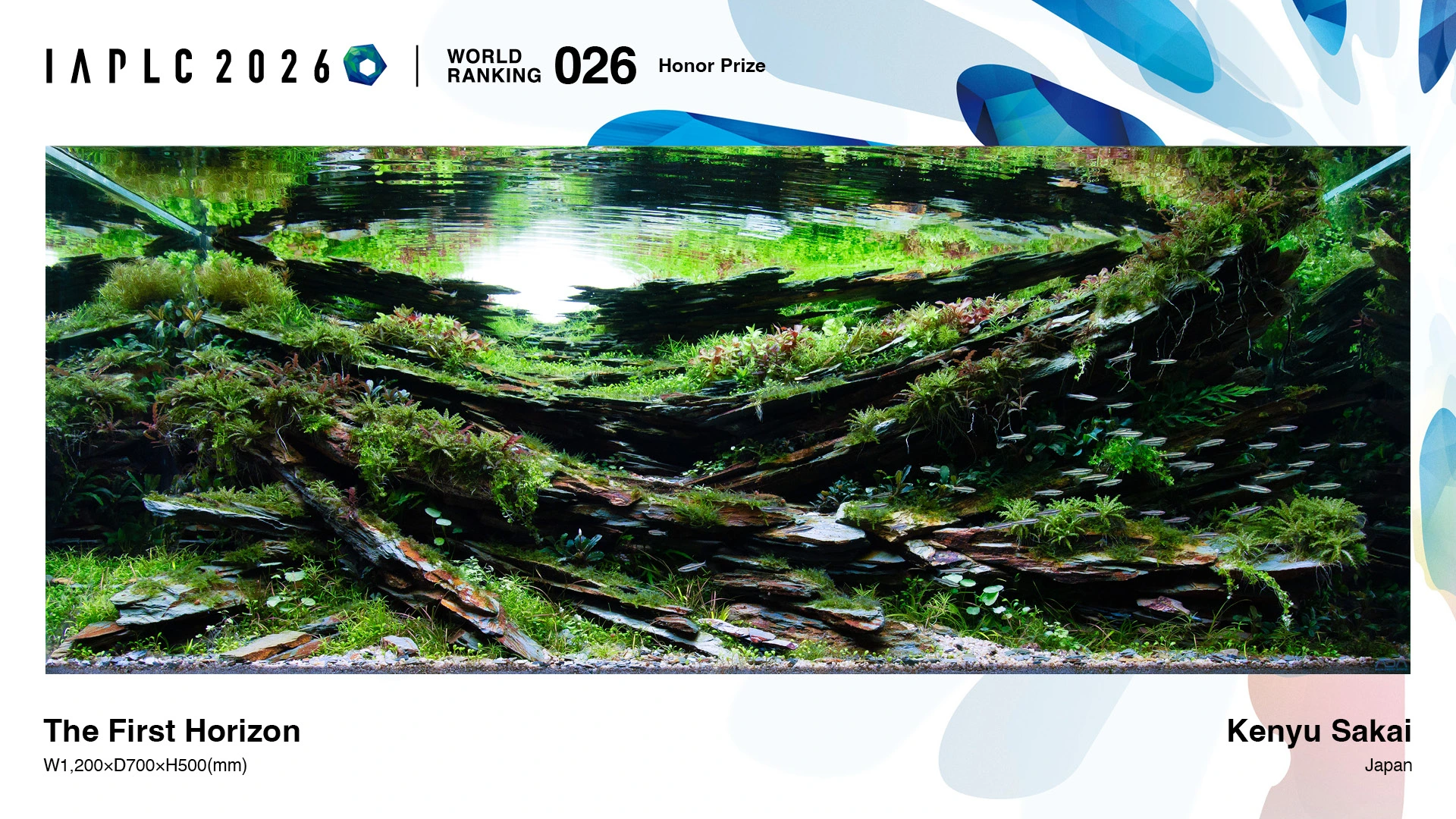
Low timber layers create a broad scene. Wood extends across the aquarium in relatively low horizontal planes. Small pale spaces and changing levels interrupt those planes, while finer greenery rises towards the back. Planting is distributed across the timber and surrounding ground, so the image feels connected without depending on a single monumental tree. Its strongest lesson is that depth can develop across a wide composition through overlap and broken ground.
Look closer: Look for where one low layer passes in front of the next.
Discover aquascapers on AquaRank · Back to the selected works
Rank 50 — Kazuma Takeuchi
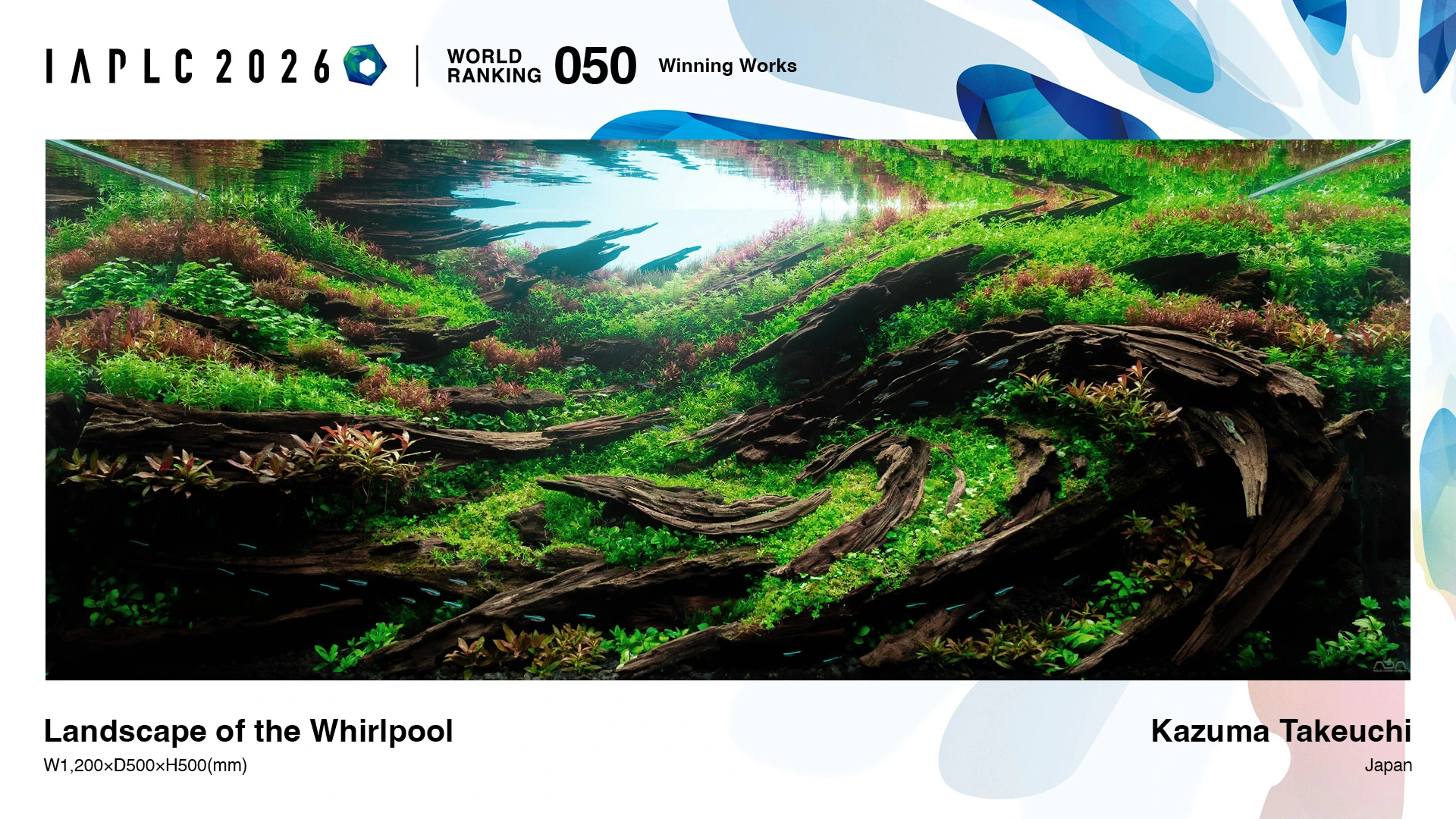
A sweeping foreground with colour on the higher slopes. A large curved timber form dominates the right foreground and leads towards greener, finer surfaces higher in the frame. Warm foliage follows portions of the upper slopes, while the bright rear water provides contrast with the heavier wood. Small planted textures soften the ground without obscuring the sweep. The scene is compelling because the principal curve remains readable through a wide range of plant colours and scales.
Look closer: Start with the large curve and note the smaller planting that follows it.
Explore Kazuma Takeuchi’s recorded work on AquaRank · Back to the selected works
Rank 219 — Hidekazu Tsukiji
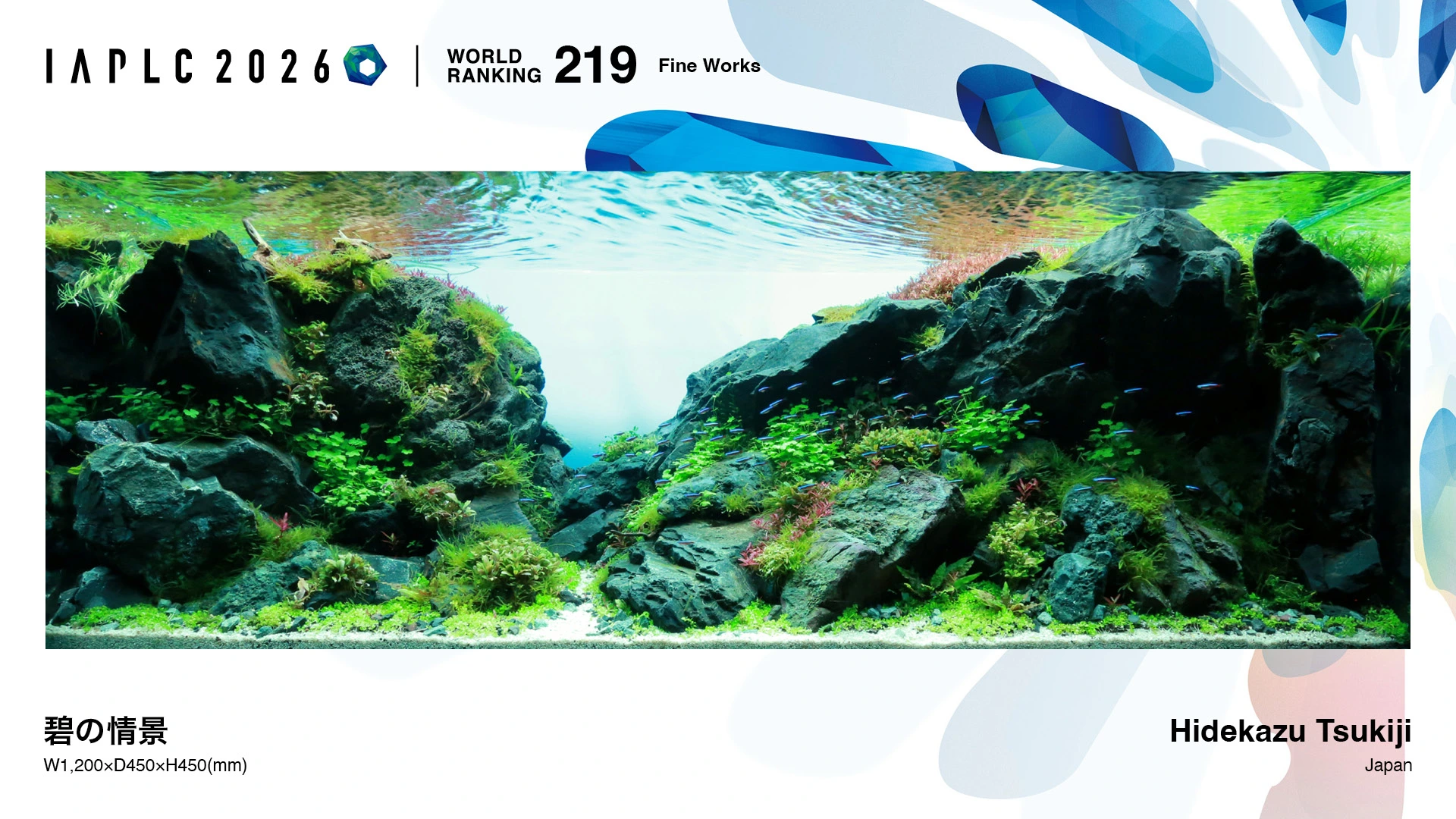
A rocky opening with the water in view. Dark exposed rock groups frame bright, pale-blue rear water. Green planting and smaller warm accents soften their bases, but leave the outlines and stone faces readable. Fish appear against both the darker side rock and the lighter middle. The scene is organised around a broad interval between geological masses, providing a useful contrast to the more densely enclosed Japanese woodland photographs.
Look closer: Compare the width of the water opening with the mass of the rocks around it.
Explore Hidekazu Tsukiji’s recorded work on AquaRank · Back to the selected works
What the comparison reveals
Hosoda gives the eye a clearly defined path, while Tanaka makes the planted foreground important in its own right. Yasuda uses exposed rock lines and a coloured upper ridge; Takeuchi gives a large wood curve a prominent directional role. Sakai develops depth through low, broad layers, and Tsukiji leaves a substantial interval of water between rock groups.
The selection therefore resists a simple equation between Japan and one visual style. It is more productive to ask how a scene communicates that it is underwater: readable fish, open water, fine plant texture and the water surface all contribute in different combinations. The archive’s idea of continuity and experimentation remains useful, but its older descriptions do not tell us what the judges preferred in 2026.
A design exercise to take away
Compare the open areas before the materials. A narrow path, a dark pocket and a broad water interval each establish a different relationship between the viewer and the planted scene.
All published places at ranks 1–300
| World rank | Published name | Country / area |
|---|---|---|
| 3 | Takashi Hosoda | Japan |
| 9 | Katsuki Tanaka | Japan |
| 21 | Mizuki Yasuda | Japan |
| 26 | Kenyu Sakai | Japan |
| 29 | Hiroyuki Matsui | Japan |
| 42 | Hayato Ochi | Japan |
| 50 | Kazuma Takeuchi | Japan |
| 64 | Masanori Hayakawa | Japan |
| 68 | Toshiya Fukushima | Japan |
| 69 | Yuki Nakata | Japan |
| 70 | Hironori Handa | Japan |
| 72 | Seiya Watanabe | Japan |
| 73 | Syuusuke Yamanaka | Japan |
| 77 | Masashi Ono | Japan |
| 81 | Yoshihiro Shiga | Japan |
| 82 | Takuya Maruyama | Japan |
| 85 | Takashi Takami | Japan |
| 89 | Kazuhiko Baba | Japan |
| 94 | Akihide Yamashita | Japan |
| 95 | Hisashi Nakagawa | Japan |
| 98 | Aya Aoki | Japan |
| 100 | Toshiya Takechi | Japan |
| 104 | Eri Tokusashi | Japan |
| 109 | Atsushi Suzuki | Japan |
| 110 | Takahiro Ogawa | Japan |
| 111 | Yuta Takahagi | Japan |
| 113 | Yusuke Setoguchi | Japan |
| 128 | Kazuyoshi Kawata | Japan |
| 138 | Atsushi Hayashi | Japan |
| 155 | Ryuji Endo | Japan |
| 167 | Ryo Yoshida | Japan |
| 177 | Tatsuya Yamagata | Japan |
| 180 | Mitsuru Fujii | Japan |
| 181 | Tomo Mitani | Japan |
| 182 | Tomoaki Ueno | Japan |
| 187 | Yoshihiro Ota | Japan |
| 191 | Tomoya Tashiro | Japan |
| 192 | Kazushi Izumi | Japan |
| 203 | Kenichi Kabashima | Japan |
| 215 | Tomomi Imai | Japan |
| 219 | Hidekazu Tsukiji | Japan |
| 221 | Hiroyuki Sakamoto | Japan |
| 223 | Takayuki Fukada | Japan |
| 228 | Ryo Watanabe | Japan |
| 229 | Yohei Fujimoto | Japan |
| 232 | Hayate Okitsu | Japan |
| 239 | Shin Yoshida | Japan |
| 242 | Takeshi Sadoshima | Japan |
| 245 | Koji Kogure | Japan |
| 247 | Masaysohi Tochimoto | Japan |
| 248 | Mahiro Bando | Japan |
| 249 | Yosinobu Yamaguchi | Japan |
| 254 | Toshinori Yanaka | Japan |
| 259 | Hiroki Kuwamura | Japan |
| 262 | Soichiro Komatu | Japan |
| 263 | Shinji Fujieda | Japan |
| 268 | Yorokobido Yamaguchi | Japan |
| 272 | Noriyuki Shito | Japan |
| 273 | Hiroyuki Yoshida | Japan |
| 275 | Syota Kuwabara | Japan |
| 276 | Hiroaki Yamada | Japan |
| 281 | Shotaro Narita | Japan |
| 282 | Kenshin Tsutsui | Japan |
| 283 | Taiki Nakano | Japan |
| 286 | Hiroaki Kanzaki | Japan |
| 287 | Hirotada Shinohara | Japan |
| 297 | Nobuyuki Hosokawa | Japan |
| 299 | Toshiyuki Mizuno | Japan |
Continue through the archive
Revisit the original Japan introduction, then open the IAPLC 2026 gallery to view the selected works at full size and keep browsing beyond them. For a related reading, explore the IAPLC 2026 Top 10 design guide.
Keep exploring with AquaRank Nations. Open Japan’s country overview to move from this season’s photographs to recorded results across available competitions and years. Start with the 2026 IAPLC result, choose an earlier available edition, and follow a creator whose work catches your attention. Country overviews keep competition and edition context visible; they do not combine raw ranks from different contests into one overall score.
Which Japanese creator would you follow across seasons to test the idea of a single national style?

Leave your comments