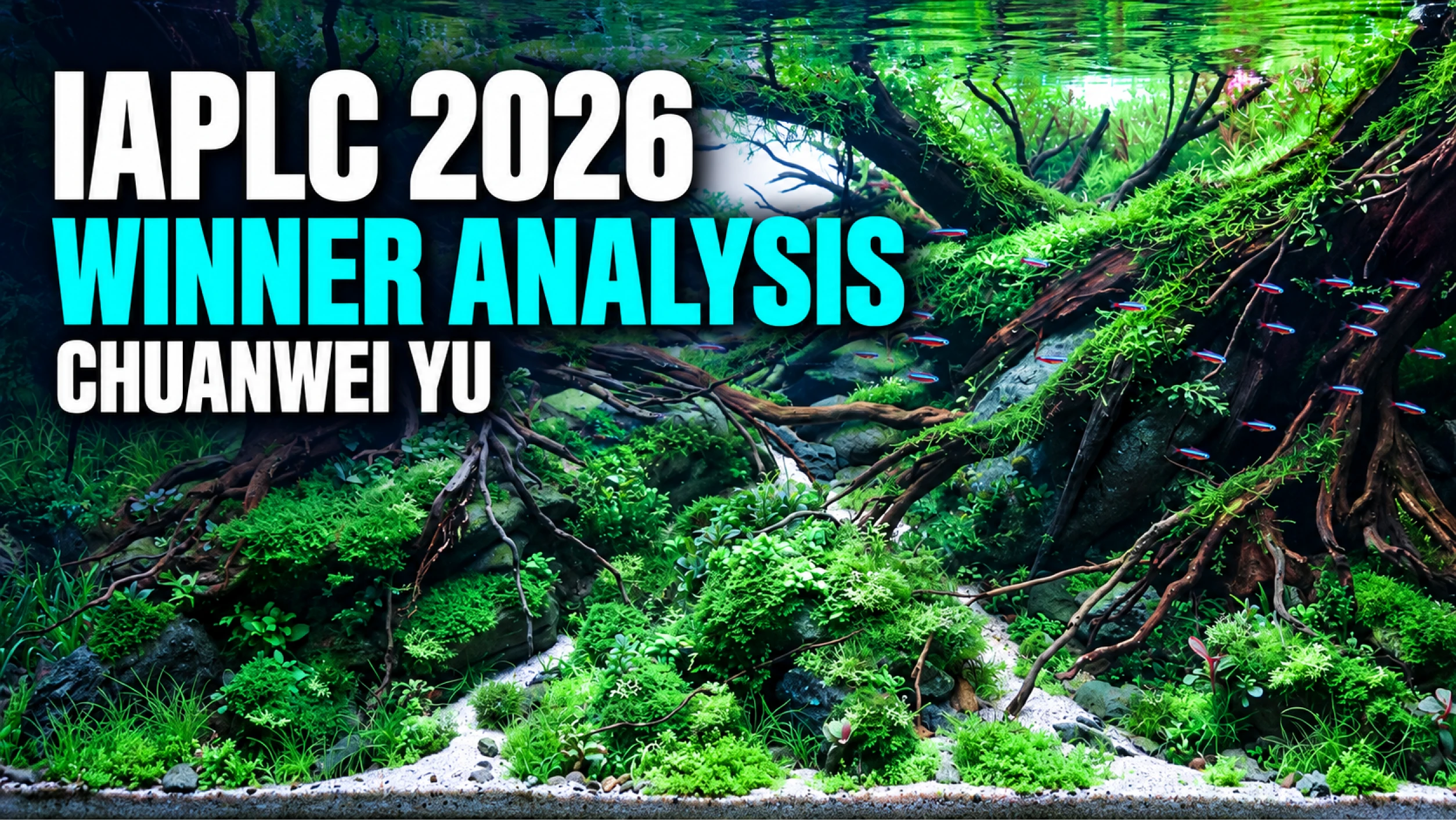
The ranking gives us the outcome. Looking closely at the photograph offers a different kind of understanding: how a densely arranged aquarium can remain readable, how depth develops through overlap, and how living elements contribute to the composition.
This AquaLibs analysis examines those relationships. It is intended as a reference for viewing and discussing the work long after the results announcement.
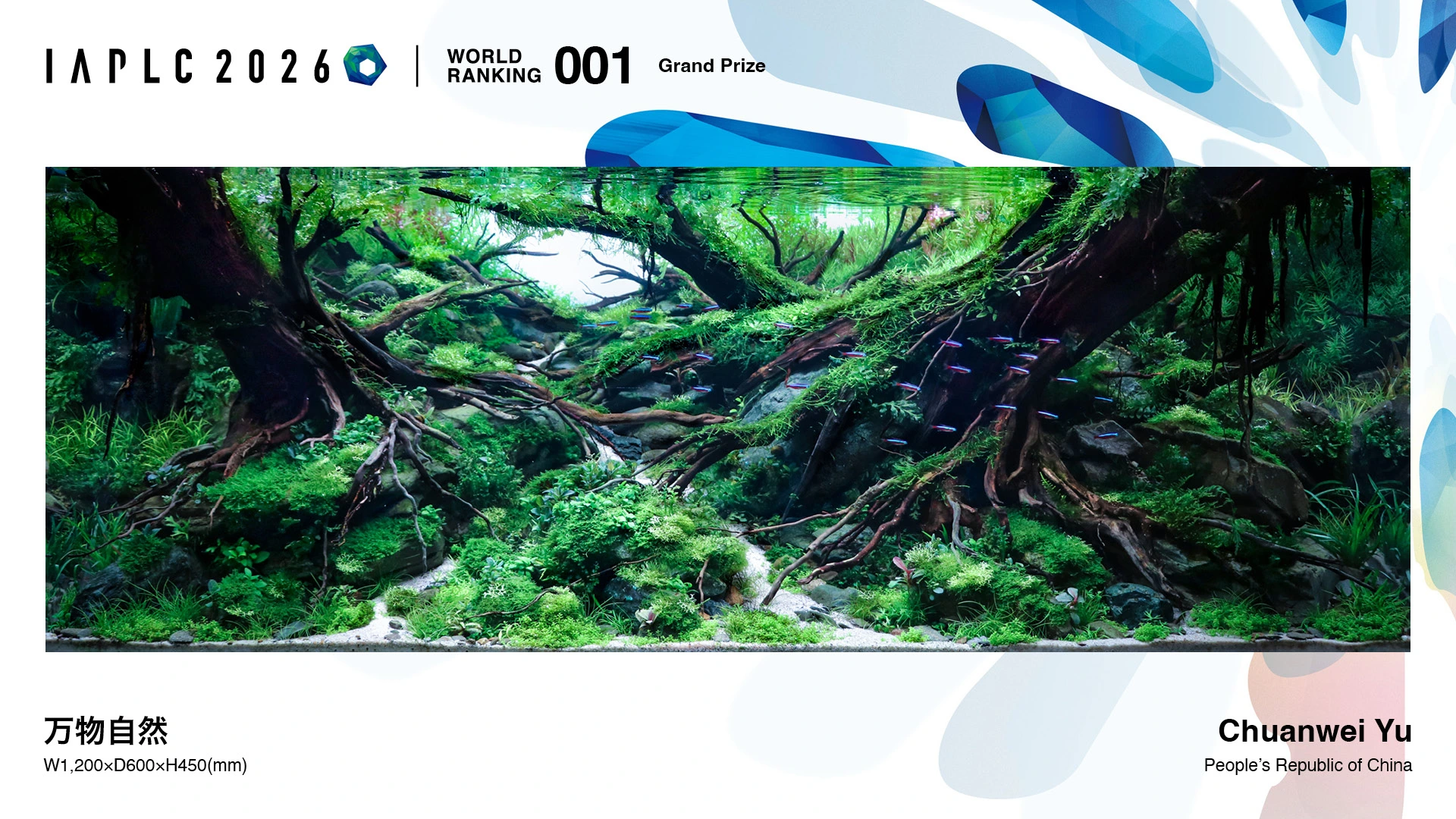
The winning work: the verified record
| Detail | Published information |
|---|---|
| Creator | Chuanwei Yu |
| Country | People’s Republic of China |
| Work title | 万物自然, as shown on the official image card |
| Contest result | IAPLC 2026, world rank 1, Grand Prize |
| Aquarium dimensions | W1,200 × D600 × H450 mm, as shown on the official image card |
The official IAPLC 2026 ranking confirms the first-place result; the official gallery supplies the award photograph and work details. We retain the published Chinese title rather than assign an unverified English title.
Meet Chuanwei Yu: a career beyond one result
Chuanwei Yu (余传威), the Chinese aquascaper named first in the official 2026 ranking, had already reached IAPLC’s Top 7 before winning the Grand Prize. In 2024, The Majestic Banyan finished fifth and received a Bronze Prize. AquaLibs’ archived feature on that work provides a useful companion to the 2026 photograph: another aquarium in which substantial wood gives a tree-like scene its identity.
The comparison offers a starting point for studying recurring interests across the creator’s work. It does not establish that both aquariums share the same construction, species list or maintenance routine.
Explore Chuanwei Yu’s AquaRank profile for the recorded competition history and available gallery. Following the creator across seasons adds context that a single award photograph cannot provide.
Official judging and AquaLibs analysis: the distinction
Official record: the work received the IAPLC 2026 Grand Prize. The contest also publishes a general judging framework that gives substantial weight to fish habitat, alongside durability, technical execution, originality, natural atmosphere and compositional balance.
Official commentary on this work: as of October 12, 2026, AquaLibs has not verified a work-specific juror assessment in the official sources reviewed for this article. The judges’ general messages for IAPLC 2026 are separate from an assessment of this aquarium.
AquaLibs editorial analysis: the observations below concern what is visible in the published photograph. They explain our reading of the design, without attributing motives or scores to the jury. Plant and fish species, equipment and maintenance methods are not identified without a verified 2026 work description.
AquaLibs analysis: a strong frame without mirror symmetry
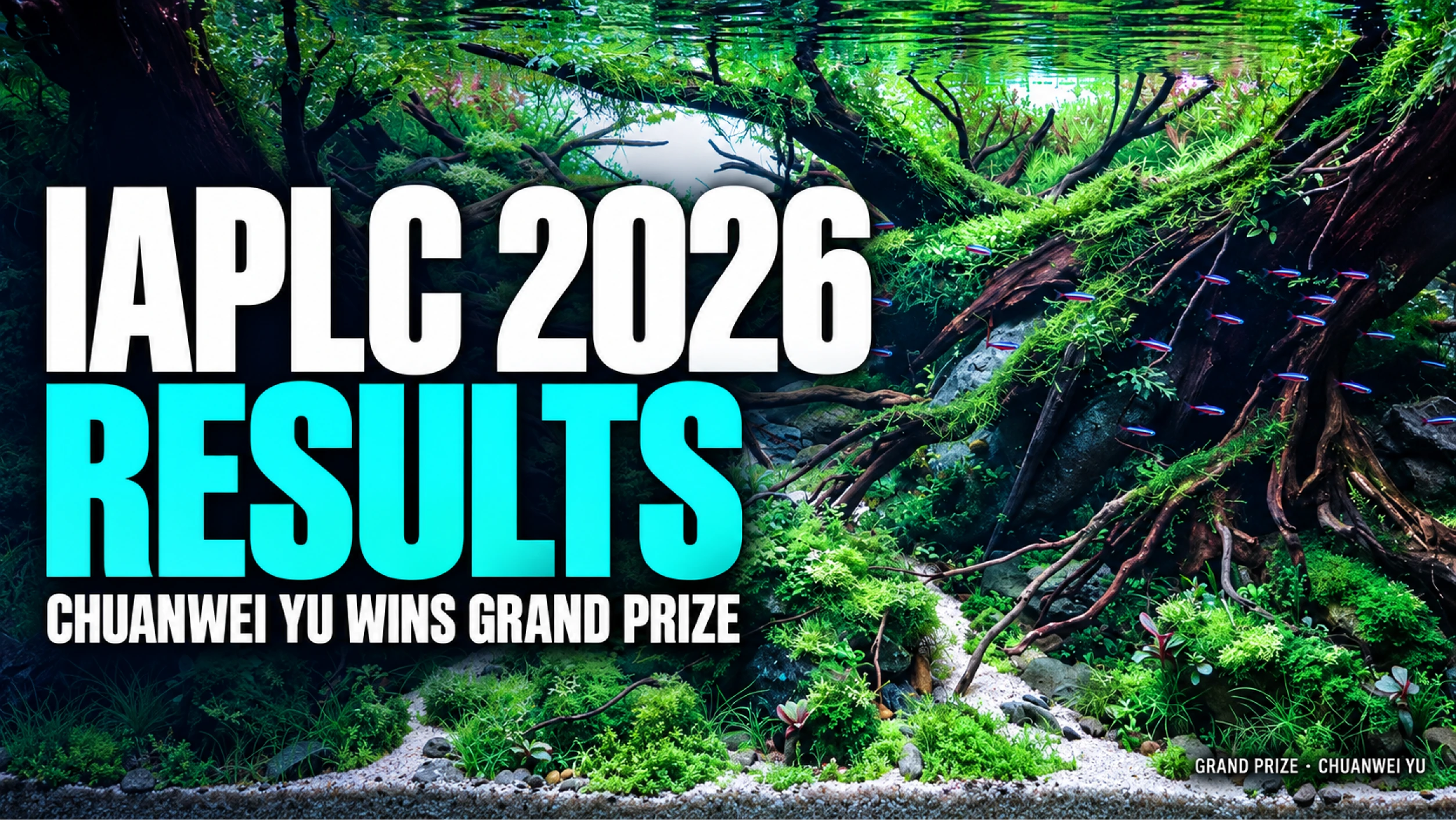
The first impression comes from two substantial tree-like structures. The left-hand mass establishes a dark vertical anchor; the heavier, sloping structure on the right sends roots and planted wood towards the middle. Their unequal shapes give the aquarium a clear frame without making its two sides look copied.
Between them, branches cross at different heights and angles. Some carry the eye across the width; others lead back towards the brighter opening. This variation makes the composition feel connected while allowing several smaller spaces to remain visible.
The strongest silhouettes are readable before the viewer notices individual plants. That hierarchy is useful in a photograph with so much detail: large forms establish orientation, then smaller forms reward closer inspection. The scene has a clear identity at a glance and a more complicated structure at full size.
The wood also appears to continue beyond the upper edge of the photograph. In our reading, this helps the aquarium suggest a fragment of a larger environment, rather than a set of isolated objects entirely contained within the frame.
AquaLibs analysis: depth through overlap and partial concealment
The brightest opening sits above and slightly left of the centre of the aquascape. It gives the eye a destination, but the route towards it passes through several layers of roots, planted wood and rock.
In the foreground, exposed root tips, pale substrate and small planted surfaces establish the nearest plane. Behind them, crossing branches conceal portions of other structures. Further back, finer wood surrounds the illuminated opening. These overlaps provide visual evidence of one object sitting in front of another.
Depth therefore develops through repeated interruptions. The viewer can follow enough of the space to imagine a route, while some of that route remains hidden. The design avoids depending on one uninterrupted sandy path to explain its perspective.
The published aquarium depth is 600 mm. The photograph creates an impression of distance within that physical space, but it cannot tell us exactly how far apart the visible elements were placed. The useful lesson is the relationship between layers, rather than a presumed construction formula.
AquaLibs analysis: light makes the density navigable
Dark timber gives the brighter background particular force. The opening is relatively small compared with the large planted masses, yet it remains easy to locate. It offers a visual pause within a busy arrangement.
Other lit surfaces prevent the eye from travelling straight to that opening and stopping. Green growth on the diagonals, pale areas near the base and reflections near the water surface create secondary places to look. The foreground stays connected to the background through changes in brightness and texture.
The visible shadows have a compositional role. They separate roots from adjacent planting and make the brighter fish markings easier to read. This is an observation about the photograph; it does not establish the lighting equipment, exposure settings or editing process used to produce it.
AquaLibs analysis: planting connects the hardscape
Green dominates the aquarium, but the planting is varied in texture. Fine, moss-like growth follows portions of the wood; small leafy clusters gather around lower surfaces; grass-like leaves appear near the edges. Different textures help distinguish surfaces without requiring strong changes of colour.
The distribution matters as much as the variety. Planting follows several of the principal wood lines, allowing the viewer to trace their direction. Elsewhere, it bridges transitions between roots, rock and substrate. Exposed dark wood remains visible, preserving contrast with the green growth around it.
That balance gives the scene a sense of continuity. The large structures still provide its framework, while smaller planted surfaces make the spaces around them feel related. Covering every surface equally would risk weakening those distinctions.
The photograph supports an analysis of leaf shape, texture and placement. A confirmed species list would be needed to assess the actual plants’ growth habits or the work’s maintenance demands; the plant list from Yu’s 2024 aquarium cannot be transferred to this one.
AquaLibs analysis: fish give the space scale and activity
The blue-red fish are particularly conspicuous against the darker wood on the right, with additional individuals visible across the middle and near the background opening. Their distribution connects several parts of the scene rather than forming a single decorative line.
Their scale relative to the trunks also contributes to the woodland illusion. The wood appears substantial when read beside the small fish, while the fish reveal usable-looking spaces between the structures. They help the viewer read this as an underwater environment, even though the hardscape strongly recalls a terrestrial forest.
The photograph captures positions and orientations at one instant. It suggests activity, but it cannot demonstrate sustained schooling behaviour, water quality, adequate circulation or long-term welfare. Those questions need information beyond the final image.
Within the image itself, the fish have a clear visual role: they add colour, suggest scale and keep attention within the shaded middle of the composition.
Read the photograph in five passes
| Look at | What to examine | AquaLibs’ interpretation |
|---|---|---|
| Main wood forms | The unequal left and right structures | A recognisable frame with variation across the scene |
| Background opening | The bright space above and left of centre | A destination for the eye beyond the nearest roots |
| Crossing roots | Places where one structure conceals another | Overlap establishes successive layers |
| Plant textures | Fine growth, leafy clusters and exposed wood | Texture connects surfaces while preserving their differences |
| Fish positions | Bright markings against shaded timber | Living elements contribute scale, contrast and activity |
Start with the whole photograph, then return to these details at full size. Finally, step back again and ask whether each detail strengthens the overall scene. This viewing exercise can be applied to other aquascapes without assuming that every successful layout needs the same woodland vocabulary.
A convincing scene, with a demanding level of detail
For AquaLibs, the work’s persuasiveness comes from the agreement between its parts. Heavy wood establishes scale, finer roots extend the structure, planting connects surfaces and the bright opening gives the layered space a destination. Fish make that space feel occupied.
The density also creates a challenge. Several thin branches overlap around the middle, and some details can merge when the photograph is reduced to a mobile thumbnail. The main trunks retain their impact, but the smaller routes through the scene need a larger view to become clear.
That distinction matters for aquascapers studying the work. Adding more branches or more plants will not automatically produce greater depth. Each addition needs to preserve a readable relationship between the nearest forms, the middle layers and the background.
The lesson worth carrying forward is how the components cooperate. Study the arrangement of space before copying individual details, and consider the visual role of fish alongside the hardscape and planting.
The judging framework provides context, not a scorecard
The published IAPLC criteria allocate up to 50 points in secondary screening to habitat-related considerations. Five further areas receive up to 10 points each: the work’s ability to endure, technical execution, originality and impact, its expression of nature, and compositional and planting balance.
That framework helps explain why looking only at wood geometry would be an incomplete way to discuss an IAPLC entry. It also highlights questions the photograph cannot resolve, especially maintenance over time and the conditions experienced by the fish.
These category maxima are not the scores awarded to Chuanwei Yu’s aquarium. A verified juror statement or official work-specific breakdown would be required to describe the panel’s reasoning. Our visual analysis remains a separate editorial assessment.
Explore the work, then follow the creator
Open the AquaLibs IAPLC 2026 gallery to view the season’s results, then follow Chuanwei Yu on AquaRank to place this Grand Prize within his recorded competition journey. You can also explore AquaRank to discover other creators through their competition records and available works.
For an earlier work by the same creator, revisit The Majestic Banyan, IAPLC 2024. Its archived judge comments concern that 2024 aquarium specifically. Comparing the two photographs offers a useful exercise in how substantial wood, planted surfaces and fish can support different scenes.
Which detail makes the 2026 work most convincing to you: its wood structure, depth, planting or fish? Open the photograph at full size and share what you notice.
Sources: official IAPLC 2026 ranking, gallery and judging criteria; AquaLibs’ 2024 work archive and the linked AquaRank profile. Editorial assessment: AquaLibs, based on the published 2026 photograph. Official-commentary status checked October 12, 2026. Original image copyright: Aqua Design Amano Co., Ltd.; aquascape creator: Chuanwei Yu.


Leave your comments