Overview

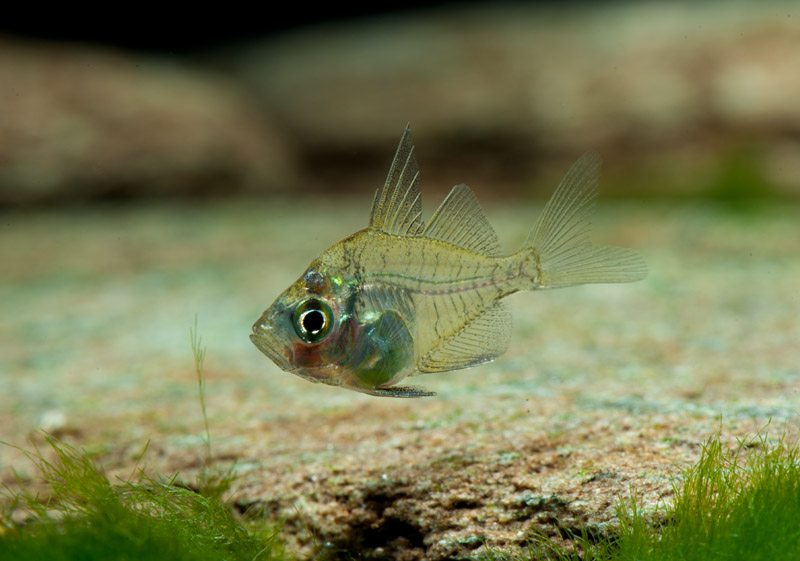
The Indian Glass Perch (Parambassis ranga), historically known as Chanda ranga, is a fascinating and highly unusual aquarium fish. Renowned for its lack of pigmentation, its transparent body allows observers to view its skeletal structure and internal organs. While they are often sold at around 4 cm, they can grow up to 8 cm in well-maintained aquariums. Unfortunately, they are sometimes subjected to artificial dyeing (creating "painted glassfish"), a cruel practice that aquarists should actively avoid by purchasing only natural, clear specimens.
Distribution and Habitat
Native to South and Southeast Asia, the Indian Glass Perch is found in countries such as India, Pakistan, Bangladesh, Myanmar, Thailand, and Malaysia. They inhabit both slow-moving freshwater streams and brackish estuaries. Their natural habitats are typically densely vegetated, providing plenty of cover from predators. The water in these regions is generally warm, slightly alkaline, and rich in oxygen.
Description of Indian Glass Perch
Body shape:
They possess a rhomboid, laterally compressed body that is somewhat deep, giving them a diamond-like profile when viewed from the side.
Color:
The body is almost entirely transparent or clear, with a subtle silvery-yellowish or greenish iridescence under proper lighting. The internal organs are contained within a visible silvery sac near the head.
Barbels:
This species does not possess any barbels.
Snout:
The snout is pointed with a slightly upturned mouth, adapted for feeding on small invertebrates in the water column.
Eyes:
They have relatively large, prominent eyes with a reflective silver rim, which help them hunt in dimly lit waters.
Fins:
The dorsal fin is divided into two parts: a spiky, rigid anterior section and a softer, taller posterior section. All fins are predominantly transparent, sometimes with a faint pale blue or yellow tint at the edges.
The Tail:
The caudal (tail) fin is deeply forked and completely transparent, providing quick bursts of speed when startled.
Temper
The Indian Glass Perch is a peaceful but easily frightened fish. They are non-aggressive towards other species but can be outcompeted for food by fast or boisterous tank mates. They rely on the safety of their school to feel secure.
Sociality
They are a highly social schooling species. To prevent stress and encourage natural behaviors, they must be kept in groups of at least 6 individuals. Solitary glassfish will become timid, stressed, and prone to disease.
Activity
These are mid-level swimmers that are active during the day. They spend most of their time hovering in the middle of the water column, darting into plant cover if they perceive a threat.
Keeping and Caring for Indian Glass Perch
Tank size:
A minimum tank size of 60 liters (15 gallons) is recommended for a small school, though larger tanks are preferable to provide ample swimming space and stable water conditions.
Water Parameters:
Temperature
They thrive in tropical temperatures ranging from 20-30°C (68-86°F).
pH
The ideal pH is slightly alkaline, between 7.0 and 8.5. They do not do well in acidic water.
Hardness
They prefer moderate to hard water, with a general hardness (GH) of 7-19 dGH.
Ammonia, Nitrite, Nitrate
Ammonia and Nitrite must be strictly maintained at 0 ppm. Nitrates should be kept below 20 ppm through regular water changes.
Lighting
Moderate to dim lighting is best. If the tank is brightly lit, floating plants should be used to diffuse the light and make the fish feel more secure.
Water flow
A gentle to moderate water flow mimics their natural sluggish stream and estuary habitats.
Decorations and Plants
The aquarium should be densely planted around the perimeter and background, leaving an open swimming space in the center. Driftwood and smooth rocks can be added to provide hiding spots and break up lines of sight.
Diet
In the wild, they are micro-predators feeding on small insects, crustaceans, and worms. In the aquarium, they can be picky eaters. They heavily favor live and frozen foods such as daphnia, brine shrimp, and bloodworms. While some may eventually accept high-quality micro-pellets or flakes, these should not be the staple of their diet.
Some Feeding Tips
Because they can be timid, ensure that food reaches the middle of the water column where they prefer to feed. If kept with faster fish, observe carefully at feeding time to ensure the glassfish are getting their share.
Breeding
Breeding the Indian Glass Perch in captivity is challenging but possible. They are egg scatterers that usually require a slight increase in temperature and a transition to slightly brackish water to trigger spawning. Females will scatter tiny eggs among fine-leaved plants like Java Moss. The parents will eat the eggs if not removed. The fry are exceptionally small and require microscopic foods like infusoria for the first week before they are large enough to eat baby brine shrimp.
Conclusion
The Indian Glass Perch is a mesmerizing addition to the home aquarium, offering a literally clear window into fish anatomy. While they require a bit more attention to diet and water parameters than standard beginner fish, a healthy school of naturally clear glassfish darting through a planted tank is a highly rewarding sight for any dedicated aquarist.
Leave your comments