It’s time to help contribute for biggest aquarium gallery online

SUBMIT HEREVIEW GALLERY

Nothobranchius guentheri (Günther's Killifish)

Overview

Nothobranchius guentheri, commonly known as Günther's Killifish or the Redtail Notho, is a stunningly beautiful freshwater fish. As an annual killifish, it has a unique and fascinating life cycle adapted to extreme environmental changes, making it a captivating subject for dedicated aquarium hobbyists.

Distribution and Habitat

This species is native to East Africa, specifically found in Zanzibar and the eastern coastal regions of mainland Tanzania. They inhabit temporary pools, swamps, and water-filled ditches that form during the rainy season. When the dry season arrives, these habitats completely dry up, and the adult fish perish, leaving their drought-resistant eggs buried in the mud to hatch when the rains return.

Description of Günther's Killifish

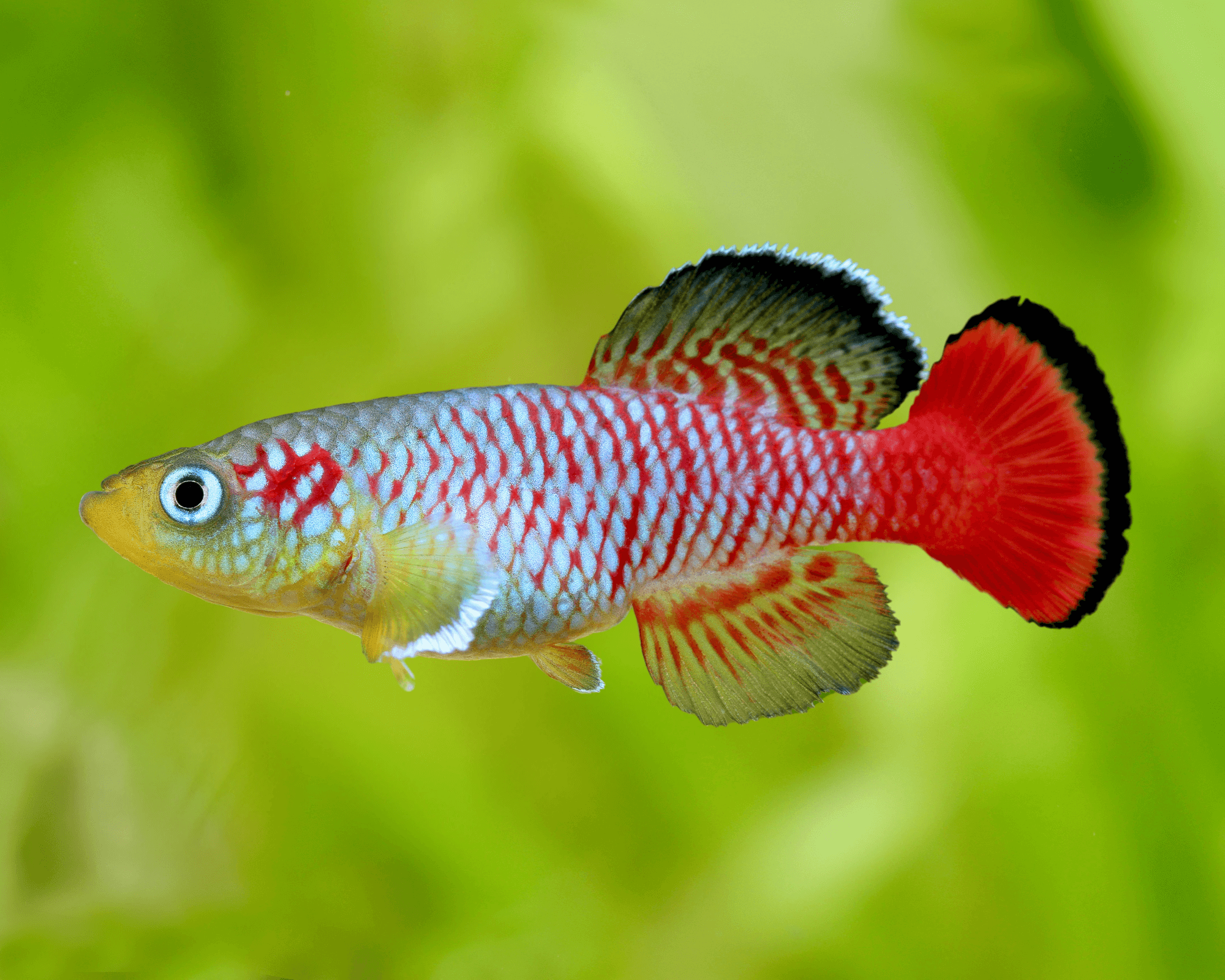
Image of 2x guenther s magnificent carp nothobranchius guentheri pair

The sexual dimorphism in this species is extreme. The descriptions below primarily refer to the spectacular males, as females are generally a drab, pale brown or grey.

Body shape:

They possess an elongated, somewhat cylindrical body typical of many killifish, designed for navigating shallow, heavily vegetated waters.

Color:

Males are breathtaking. The body is a brilliant light blue to turquoise, with each scale heavily margined in crimson red, creating a distinct reticulated or cross-hatched pattern. The lower jaw and throat area often display a yellowish hue.

Barbels:

This species does not possess barbels.

Snout:

They have a relatively short snout with an upturned mouth, adapted for feeding on insects and larvae at or near the water surface.

Eyes:

The eyes are large and prominent, often featuring a bright, iridescent blue ring around the pupil.

Fins:

The dorsal and anal fins are set far back on the body. The dorsal fin is typically blue-green with red streaks and spots, while the anal fin is yellowish-green, also heavily patterned with red markings.

The Tail:

The caudal fin (tail) is the most defining feature of the male. It is a vibrant, solid crimson red, boldly outlined with a distinct dark brown to black margin.

Temper

While generally peaceful towards other species, males are highly territorial and can be quite aggressive towards one another. It is highly recommended to keep them in a harem setup, with one male to two or three females, to disperse any aggressive courtship behavior.

Sociality

Due to their specific requirements, short lifespan, and the male's temperament, they are best kept in a species-only aquarium. If kept in a community, tank mates must be small, very peaceful, and able to tolerate the same water conditions.

Activity

They are active and inquisitive fish, constantly exploring their environment for food and engaging in courtship displays. They utilize all levels of the aquarium but are often seen in the mid-to-upper regions.

Keeping and Caring for Günther's Killifish

Image of 2x guenther s magnificent carp nothobranchius guentheri pair

Keeping annual killifish is a unique endeavor. While their daily care is not overly complex, managing their breeding cycle requires specific knowledge.

Tank size:

A small aquarium of 20 to 40 liters (5 to 10 gallons) is perfectly adequate for a single male and a small harem of females.

Water Parameters:

Temperature

Maintain the water between 20-24°C (68-75°F). Keeping them at the cooler end of this range can slightly extend their naturally short lifespan by slowing their metabolism.

pH

They prefer slightly acidic to neutral water, with a pH range of 6.0 to 7.0 being ideal.

Hardness

Soft to moderately hard water is preferred, around 4-10 dGH.

Ammonia, Nitrite, Nitrate

Water quality must be pristine. Ammonia and Nitrite must be 0 ppm, and Nitrate should be kept below 20 ppm through regular water changes.

Lighting

Dim to moderate lighting is best. Floating plants can be used to diffuse light and make the fish feel more secure, which also helps bring out their best colors.

Water flow

Gentle filtration, such as a sponge filter, is recommended. They originate from stagnant or slow-moving pools and do not appreciate strong currents.

Decorations and Plants

A substrate of peat moss or coconut coir is essential if you intend to breed them, as they dive into it to spawn. Provide hiding spots using driftwood, Indian almond leaves, and plants like Java Moss or Anubias.

Diet

In the wild, they are micro-predators. In the aquarium, they require a high-protein diet of live or frozen foods. They will eagerly consume bloodworms, daphnia, brine shrimp, and mosquito larvae. They rarely accept dry flakes or pellets.

Some Feeding Tips

Feed them small amounts once or twice a day. Since they have a fast metabolism and a short life, providing highly nutritious, varied live foods is crucial for their health and breeding success.

Breeding

Breeding is the most fascinating aspect of keeping Nothobranchius. They are substrate divers. The pair will dive into a container of peat moss placed in the tank to lay their eggs. Every few weeks, the peat must be removed, gently squeezed of excess water to a damp, tobacco-like consistency, sealed in a bag, and stored at room temperature for an incubation period of 2 to 3 months (simulating the dry season). After this diapause, immersing the peat in cool water will trigger the eggs to hatch within hours. The fry are tiny but grow incredibly fast.

Conclusion

Günther's Killifish is a jewel of the aquarium hobby. While their lifespan is fleeting, lasting only around a year, their intense coloration and the deeply rewarding process of breeding them make them a highly prized species for aquarists looking for a unique and engaging challenge.
Fish info

Care level: Moderate
Temperament: Semi-aggressive
Adult size: 5 cm
Life expectancy: 1 year
Fish type: Killifish
Temperature : 20-24°C
pH: 6.0-7.0
Color Form: Blue, Red, Turquoise, Yellow
Leave your comments
Lastest on Fishs
  • Ambystoma mexicanum (Albino Axolotl)

    Moderate
    Killifish
    The Albino Axolotl is a captivating, fully aquatic salamander originally from the high-altitude lakes of Mexico. Known as the "Mexican walking fish," this unique amphibian retains its larval features throughout its life. Its striking white body, vibrant pink gills, and fascinating regenerative abilities make it an incredibly popular pet.
  • Ambystoma mexicanum (Axolotl)

    Moderate
    Killifish
    The Axolotl, a fascinating neotenic salamander native to Mexico, has captivated aquarists worldwide with its unique appearance and regenerative abilities. Often referred to as the 'Mexican walking fish,' this fully aquatic amphibian retains its larval features, including striking external gills, throughout its entire lifespan, making it an extraordinary pet.
  • Fundulopanchax gardneri (Gardner's Killifish)

    Easy - Moderate
    Killifish
    Native to the freshwater streams and pools of Nigeria and Cameroon, Gardner's Killifish is a stunning, semi-annual species. Known for its vibrant blue body punctuated by striking red spots and yellow-fringed fins, this peaceful yet active fish is highly prized by aquarists for its beauty and relatively easy breeding.
  • Boraras urophthalmoides (Tail Stripe Rasbora)

    Moderate
    Killifish
    The Tail Stripe Rasbora (Boraras urophthalmoides) is a captivating, nano-sized cyprinid native to the blackwater swamps of Southeast Asia. Renowned for its striking lateral stripes and peaceful demeanor, this miniature jewel is highly popular among aquascapers looking to bring vibrant life and schooling behavior to heavily planted nano aquariums.
  • Hyphessobrycon amandae (Ember Tetra)

    Easy
    Killifish
    The Ember Tetra (Hyphessobrycon amandae) is a stunning, vividly orange micro-fish native to the Araguaia River basin in Brazil. Known for its peaceful schooling nature and striking fiery coloration, this tiny tetra is a highly popular choice for planted nano aquariums and peaceful community setups.
  • Hyphessobrycon flammeus (Flame Tetra)

    Easy
    Killifish
    The Flame Tetra, or Red of Rio, is a captivating freshwater fish originating from the coastal rivers of Brazil. Renowned for its fiery red posterior and peaceful nature, this hardy schooling fish is incredibly popular among both novice and experienced aquarists, bringing vibrant color and active movement to community aquariums.
  • Crossocheilus siamensis (Siamese Algae Eater)

    Easy - Moderate
    Killifish
    The Siamese Algae Eater (Crossocheilus siamensis) is a highly sought-after freshwater fish renowned for its insatiable appetite for nuisance algae, including the dreaded black beard algae. Originating from Southeast Asia, this active and relatively peaceful cyprinid is a staple in planted aquariums, offering both utility and energetic charm.
  • Paracheirodon innesi (Neon Tetra)

    Easy
    Killifish
    Native to the blackwater streams of the Amazon basin, the Neon Tetra is a dazzling, peaceful schooling fish. Renowned for its vibrant blue and red stripes, it brings incredible life and color to freshwater aquariums, making it an enduring favorite among both beginner and experienced aquarists.
  • Hyphessobrycon herbertaxelrodi (Black Neon Tetra)

    Easy
    Killifish
    The Black Neon Tetra is a captivating and hardy schooling fish native to the Paraguay basin in Brazil. Known for its striking black and iridescent greenish-white lateral stripes, this peaceful species is highly popular among aquarists for adding dynamic contrast and lively movement to planted community aquariums.
  • Hemigrammus erythrozonus (Glowlight Tetra)

    Easy
    Killifish
    The Glowlight Tetra (Hemigrammus erythrozonus) is a vibrant, peaceful schooling fish native to the Essequibo River in Guyana. Known for the striking iridescent red-orange stripe running along its translucent body, this hardy species is highly popular among aquarists of all levels for adding a luminous touch to community tanks.
  • Trigonostigma espei (Lambchop Rasbora)

    Easy
    Killifish
    The Lambchop Rasbora, scientifically known as Trigonostigma espei, is a captivating and peaceful schooling fish. Renowned for its brilliant copper-orange hues and distinctive black "lambchop" marking, this active cyprinid has become a favorite among aquascapers and nano-aquarium enthusiasts seeking a vibrant addition to their planted community tanks.
  • Boraras maculatus (Dwarf Rasbora)

    Moderate
    Killifish
    Hailing from the slow-moving, blackwater streams of Southeast Asia, the Dwarf Rasbora (Boraras maculatus) is a captivating micro-fish. Renowned for its vibrant red-orange hue and striking black spots, this peaceful, schooling species is incredibly popular among aquascapers and nano-tank enthusiasts seeking active, colorful additions to their planted aquariums.
  • Betta splendens (Yellow Dragon Halfmoon Betta)

    Easy - Moderate
    Killifish
    The Yellow Dragon Halfmoon Betta is a breathtaking freshwater fish celebrated for its striking contrast. Featuring thick, armor-like white dragon scales across its body and vibrant, sweeping yellow halfmoon fins, this labyrinth fish is a prized centerpiece. Its captivating beauty and bold personality make it a favorite among dedicated aquarists.
  • Betta splendens (Purple Gold Betta Male)

    Easy - Moderate
    Killifish
    The Purple Gold Betta Male is a stunning variant of Betta splendens, prized for its breathtaking metallic gold body and rich purple-hued fins. Originally from the shallow waters of Southeast Asia, this labyrinth fish is highly sought after by aquarists for its vibrant colors, bold personality, and captivating territorial displays.
  • Betta splendens (Platinum Crowntail Betta)

    Easy - Moderate
    Killifish
    The Platinum Crowntail Betta is a breathtaking freshwater fish celebrated for its pure, iridescent white coloration and dramatic, spike-like fin rays. Originating from Southeast Asia, these labyrinth fish are highly territorial but incredibly popular among aquarists for their striking, crown-like appearance and interactive personalities.
  • Betta splendens (Orange Crowntail Betta Male)

    Easy - Moderate
    Killifish
    The Orange Crowntail Betta is a striking variant of the beloved Betta splendens, renowned for its dramatic, spiky finnage and vibrant orange coloration. Originating from Southeast Asia, these labyrinth fish are highly popular among aquarists for their bold personalities, captivating displays, and relative ease of care in small setups.