
AGA 2016 World Ranking Announcement
As in years past, the success of the contest is dependent on the hard work of our esteemed panel of judges. Without their willingness to take time from their busy schedules to participate in our contest, our Aquascaping contest would not be the success it is today. For this year, we have the AGA’s own Karen Randall, André Longarco of Aquabase Brazil, Balbi Vaquero of Fish Corner from Spain, and Domenico Losciale of Anubias from Italy. We were also fortunate to again have Marco Aukes judge our Dutch category and we hope to continue to grow our Dutch category even more for next year. Phil Edwards assisted with the Biotope and Dutch categories. Thank you judges for taking time out of your busy schedule to judge the contest; they are truly appreciated by our contestants and the AGA.
Our contest would not be the success it is without our contest sponsors. We had some outstanding companies support this year's contest including Seachem Laboratories, Aqua Forest Aquarium, Florida Aquatic Nurseries, Dr. Tim’s Aquatics, Ista Products, Invertebrates by Msjinkzd, Green Aqua LLC, and the Chicago Aquatic Plant Society. We also received support from two individual sponsors, Ben Belton and Bernat Hosta. Thank you! Each contribution is greatly appreciated and ensures the continued success of our contest!
TOP 10 AGA 2016 Aquatic Garden, < 28L
There are some astoundingly beautiful aquascapes among these tiny tanks. However they ARE tiny tanks and I wish more people would take that into consideration before including fish in their layout. IF fish are used they need to be VERY carefully chosen. Most fish are just not suitable for this size tank.
— Karen Randall
Judging this category is both a joy and a challange.
Several of these tiny or super tiny tanks are really lovely. These layouts are small yet powerful and in many occasion I was really surprised to see the original size data after seeing the picture.
— Domenico Losciale
A big challenge for me to judge this category. Although I have liked the most of the layouts I think that we should have a consciousness about how small an aquarium can be. No matter how small should contain everything that is needed for a good biological balance.
— André Longarço
Great little category!!! There are many fantastic setups in many jobs it is practically impossible to detect the size of the tanks. Well done to all; congrats!
— Balbi Vaquero


TOP 10 AGA 2016 Aquatic Garden, 28L ~ 60L
Wow wow wow! What a nice class. It is wonderful to see such depth in these entries. Of course it makes it much harder for us to choose a winner!
— Karen Randall
In this category the level is very high and several layouts were nearly equal in skills remarkably creative and ingenious. Unique natural feeling is expressed in many layouts and the way of using drftwood stones and light sometimes is really original.
— Domenico Losciale
Absolutely fascinated with this category!!! I have looked many times at the aquariums' measurements... to verify what I saw there are exceptional works fully of details.
— Balbi Vaquero
For me one of the hardest categories to judge.
The work of these aquascapers should be highly valued because it is very difficult to work harmoniously the conception proportions of materials fish and plants in such small spaces.
Congratulations for the layouts presented demonstrating a very high technical level and deep knowledge of aquascaping.
— André Longarço


TOP 10 AGA 2016 Aquatic Garden, 60L ~ 120L
In this category many layouts lack in creativity and I found some aquariums with too big fish or wrong fish selection.
— Domenico Losciale
Probably this was the category with more faults and errors of proportion. I believe that the aquascapers have had difficulty because the proportions of the tanks. However great works were presented and perhaps the easier decision between the categories in this year's contest.
— André Longarço


TOP 10 AGA 2016 Aquatic Garden, 120L ~ 200L
Generally speaking the trend to use wood or driftwood in the layouts this year made it difficult our judgement work. However this category was the most balanced between rocks and logs. It was a difficult decision but very enjoyable to judge. Congratulations.
— André Longarço


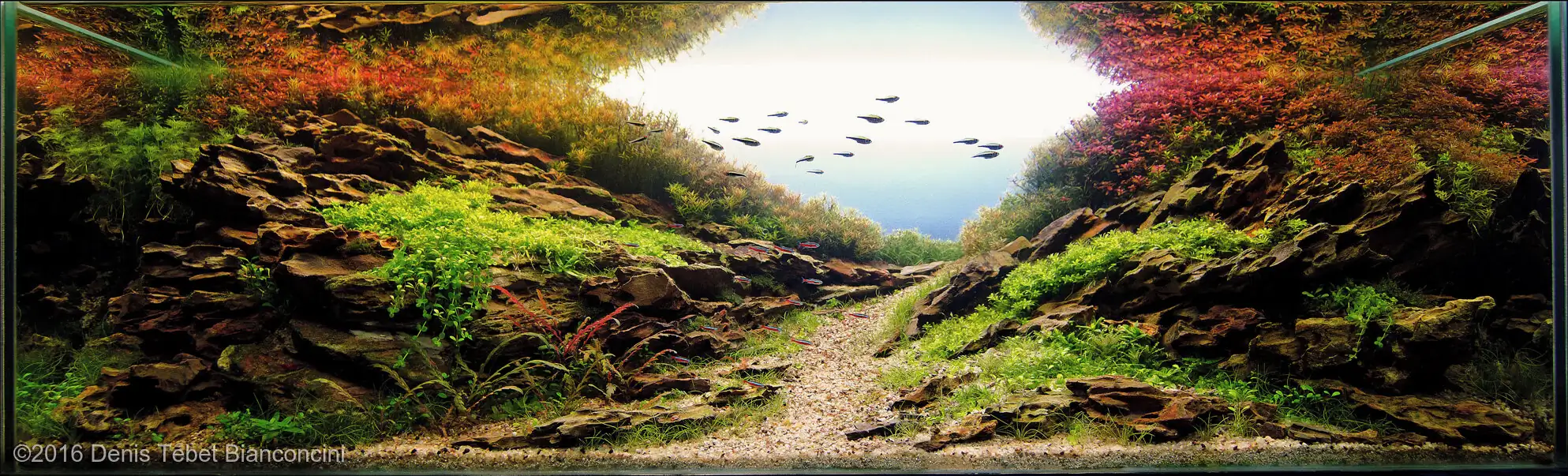
TOP 10 AGA 2016 Aquatic Garden, 200L ~ 320L
Certainly the most difficult category to judge. It was a great challenge for me to analyze carefully so many works with both technical and artistic refinement. A great year for the world aquascaping. We can clearly see the development of this art through the technical quality of these works. What a great privilege to judge such beautiful works.
Congratulations to everyone involved in this wonderful hobby.
— André Longarço
The aquascapers on this category created really cool and high skilled works. I found the use of driftwood and rocks really impressive and most of all I appreciated the selection of plants chosen. Overall the plants were placed in the appropriate layout and under the best condition for a healthy and long life. Congratulation!
— Domenico Losciale


TOP 10 AGA 2016 Aquatic Garden, > 320L
For me this is the most difficult category to vote; it is becoming more difficult considering the works of architecture that are made today. There are exceptionally created aquariums but these assemblies outshine certainly the most traditional setups. It is a clear example of the evolution of aquascaping!!! Congrats to all.
— Balbi Vaquero
Some people say that inside the small bottles are the best perfumes ... The same does not occur among large aquariuns !!! What a wonderful selection of works. I am in love at least with a dozen of them. High technical level and a lot of talent in this category. It is becoming undoubtedly the most disputed category in this contest !! Congratulations to the artists.
— André Longarço
The level reached in this category is awesome!
We all agree that it was really hard to evaluate several layouts because they are equal in skills and quality details.
— Domenico Losciale


TOP 10 AGA 2016 Biotope Aquascape
his category is very interesting and curious but is also too difficult to participate and to judge. I say that because the contestants need to explain very well what kind of biotope they want to represent. We need to research and study about the biotope chosen and evaluate if the entrant made a good job or not. Not only does the appearance matter but even more so the technical issues. So some works were difficult for me to judge because the author did not explain what kind of biotope was represented. But anyway I know very well the South American biotopes and I can tell you that some of them are very well represented.
— André Longarço
Valuing this category certainly has been for me all a big challenge it must have a great knowledge and talent to make a so faithful and real reproductions.
— Balbi Vaquero


TOP 03 AGA 2016 Dutch Aquascape
The entries of this year in this category really prove once again that we need to do a lot of promotional work to let people understand the basics of the Dutch Style. Where some tanks excel at really showing strong contrast they miss the real focal points. Others still use way to many species (maximum of 1 species per 10cm of tank) or are in their turn missing the contrasts.
Dutch Style is also about a consistent sense of depth that integrates foreground mid-ground and background plants. And whilst Dutch Style is famous for the usage of the "streets of plants" this only works when used in good limitations and in support of focus points.
However we do see that contestants are doing their best to understand these principles and work with them. We hope that they will continue their quests for the ultimate Dutch Style aquarium!
— Marco Aukes
This category is very important to recover the great Dutch style the very origin of aquascaping. Some layouts are in very good shape but another ones were misunderstood. The Dutch style is very defined and has direct rules to be judged. I hope that this category keep growing and people understand the real importance of it. Good job people.
— André Longarço
In this category not only values good health of plants or that have more varieties only those things does not make it a Dutch aquarium. I think there are many details that would have to redirect this mode and return to give the value it really has. All that today is our hobby was born here.
Thank you very much to all the participants to keep its essence alive.
— Balbi Vaquero


TOP 03 AGA 2016 Paludarium
This year's paludarium competition included some of the most beautiful innovative paludariums I've ever seen. Unfortunately it also included too many "terrariums with a little water in the bottom". A good paludarium has a significant amount of care and attention put into the aquatic section as well as the terrestrial part. Otherwise it does not belong in this contest.
— Karen Randall
Amazing works!!! Very interesting the way that the entrants resolved the both situations underwater and terrestrial scenes. Particulary I love this category. A diferent way to bring Nature to inside your house.
— André Longarço


From aquatic-gardeners.org



Leave your comments