Judge's scorecard
Judging basis: IAPLC Secondary Screening Judging Criteria. The score is an editorial assessment from the submitted image, not an official contest result.
Recreation of natural habitat for fish
Judge's assessment
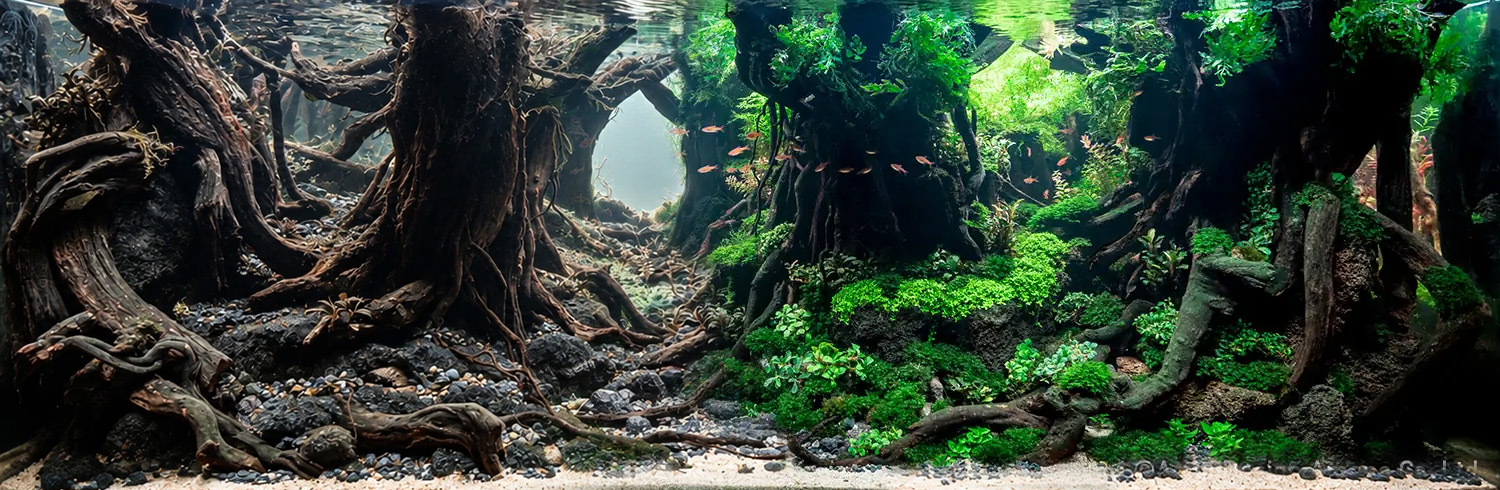
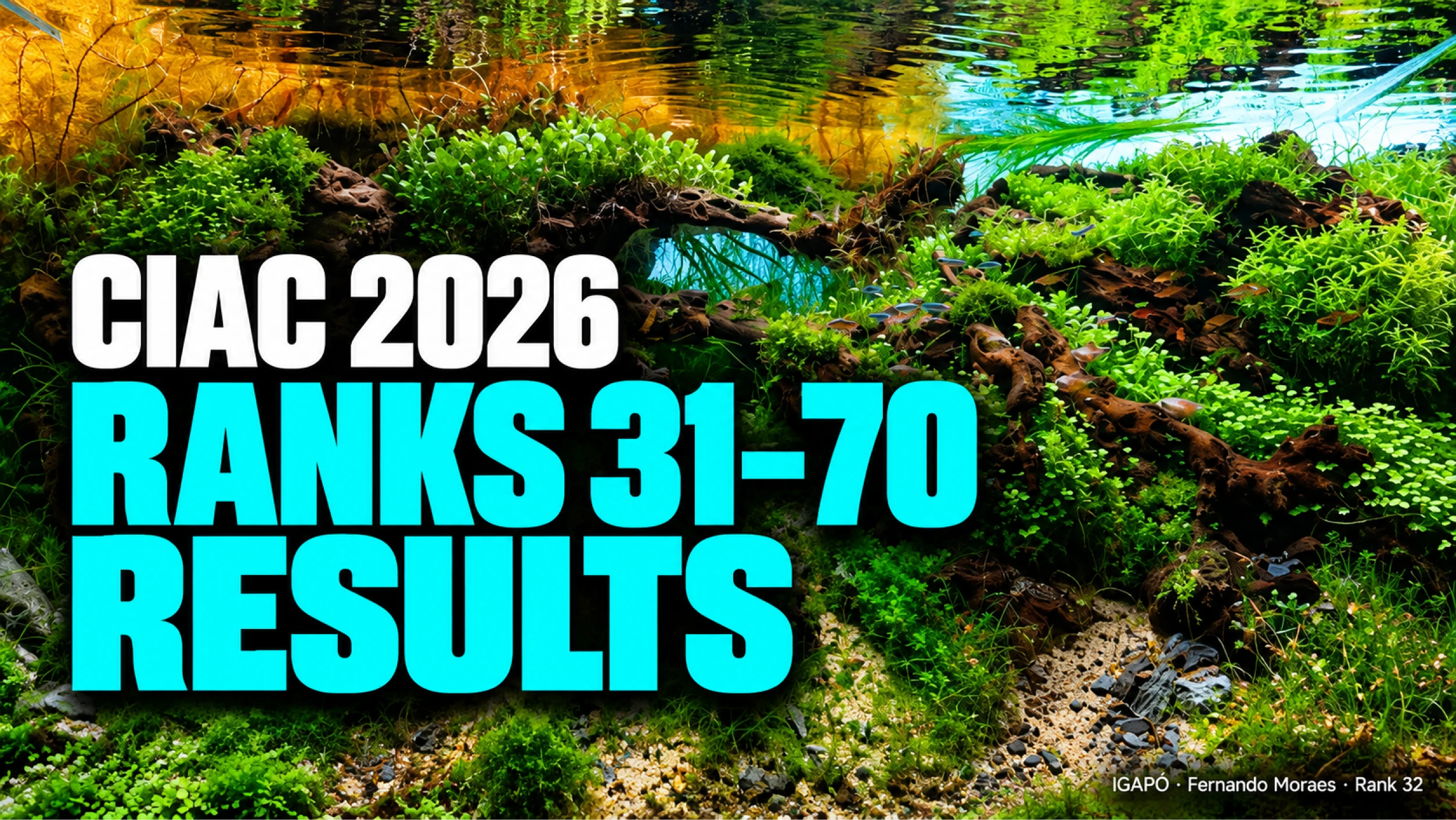
The photograph shows a healthy-looking, densely planted underwater forest with sheltered roots, open central water and small schooling fish. The fish appear visually compatible with the scale of the layout, but species, ecology and actual swimming conditions cannot be verified from one image.
Strengths: Strong combination of root cover, planted surfaces and open central water.; Fish provide scale and movement within the habitat.; Plants appear vigorous and integrated across the hardscape.
Limitations: Exact fish identity and ecological compatibility are unknown.; Dense peripheral planting makes total swimming space difficult to assess.; Photographic evidence cannot confirm long-term animal health.
Long-term maintenance of the layout
Judge's assessment
The mature, controlled presentation suggests substantial maintenance skill, but the many narrow root gaps, dense canopy and layered planting would be demanding to prune and clean. Maintenance history and stability cannot be confirmed.
Strengths: Growth appears intentionally shaped and visually controlled.; The foreground channel remains readable despite extensive planting.; Hardscape remains visible beneath the plant mass.
Limitations: Access to inner planting and root recesses may be difficult.; Dense growth could conceal algae or debris between maintenance sessions.; No image evidence establishes sustainability over time.
Creator's technical skills
Judge's assessment
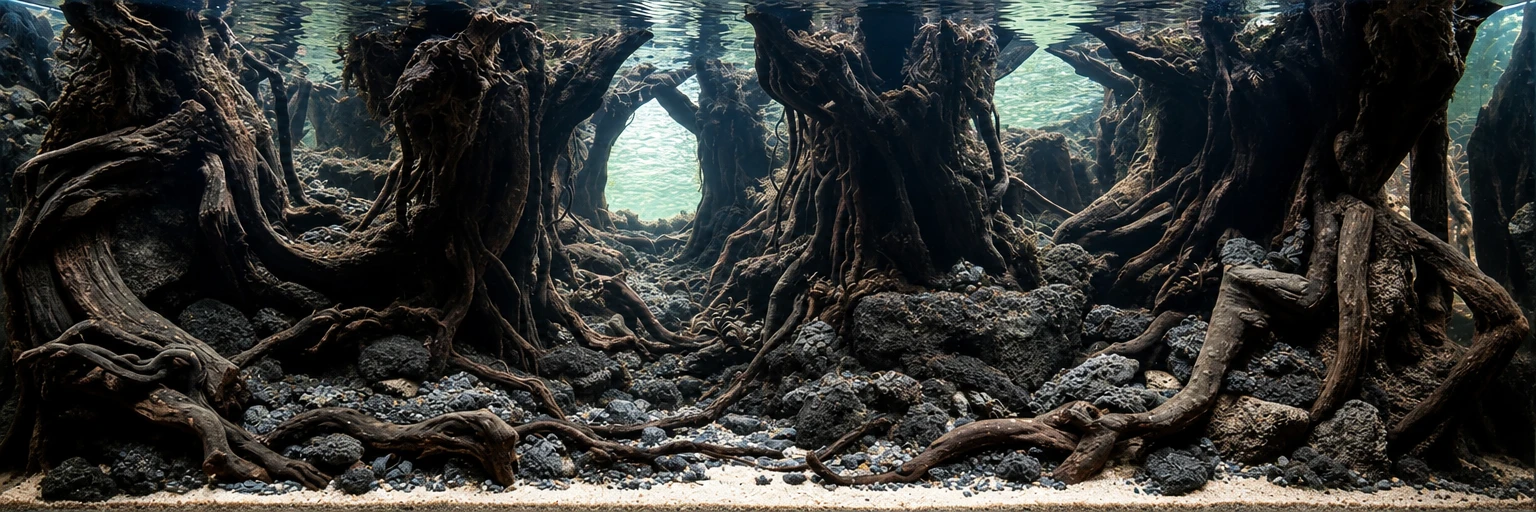
The work demonstrates excellent visible control of depth, root layering, planting attachment and focal-path construction. The main deduction reflects congestion in some side and upper areas, where overlapping forms are harder to read.
Strengths: Layered roots create convincing height and recession.; The pale channel directs the eye toward the central opening.; Planting softens hardscape while preserving major structural lines.
Limitations: Some peripheral overlaps obscure the exact hardscape structure.; The high density leaves little margin for compositional errors to remain visible.
Originality and impression of the layout
Judge's assessment
The rooted submerged-forest concept produces an immediate and memorable impression. Repeated trunks, the luminous center and schooling fish form a coherent visual identity, though the outer regions rely on a similarly dense treatment and lose some contrast.
Strengths: Distinctive forest-canopy concept with a strong central reveal.; Consistent root motif across the full visible layout.; Fish movement enriches the initial impression.
Limitations: Some repetition among the dense root and foliage masses.; The strong visual effect is slightly less nuanced at the crowded edges.
Presentation of natural atmosphere
Judge's assessment
Lighting contrast, root architecture, mature-looking growth and the pale channel create a convincing humid woodland atmosphere. The controlled central illumination is effective but somewhat theatrical compared with a less directed natural scene.
Strengths: Clear sense of shaded forest and filtered light.; Irregular plant coverage suggests time and ecological layering.; The open channel gives the dense scene a natural clearing.
Limitations: The bright central opening feels deliberately staged.; The image offers limited evidence of subtler, less composed natural variation.
Overall composition and planting balance
Judge's assessment
The composition has a strong focal route from the foreground channel to the central opening, with side roots acting as framing structures and plants distributed through multiple heights. A small deduction reflects near-saturation in the canopy and side zones.
Strengths: Excellent depth and visual hierarchy.; Foreground, middle ground and canopy are clearly differentiated.; Fish occupy the central open area without disrupting the main route.
Limitations: Upper and lateral regions contain many competing textures.; Additional negative space could improve visual rest and structural clarity.
Judge's overall verdict
This is an exceptionally accomplished forest aquascape whose strongest achievements are its immersive root architecture, luminous central passage, mature planting treatment and convincing sense of habitat. The estimated 88/100 reflects a highly complete image with only modest deductions for visual congestion, uncertain maintainability and the limits of judging fish compatibility from a single photograph. To move higher, the layout would benefit from slightly clearer peripheral sightlines, more accessible maintenance zones and a touch more negative space around the dominant root structures.
Assessment limits: The assessment uses only the supplied photograph. Plant and fish species, tank dimensions, filtration, lighting, maintenance history, construction methods and actual long-term animal welfare are not verifiable. The rank and contest metadata come from trusted application context, while the score is an editorial estimate and not an official contest score.
Habitat recreation and fish environment
The strongest feature is the convincing underwater forest environment. Dark, branching roots form a sheltered network of trunks, buttresses and low passages, while the central bright opening reads like a natural corridor or stream-fed clearing. The small schooling fish are distributed through the middle and upper water, giving the scene life and helping establish scale. Their apparent use of open water among dense cover supports the habitat impression, although their exact species, origin and ecological compatibility cannot be confirmed from the photograph. Plant growth appears healthy and richly textured, with mossy surfaces, compact foliage and layered greenery. A limitation is that the very dense planting leaves little visibly open habitat at the sides, so a judge cannot fully assess swimming space or long-term fish comfort. Editorial score: 45/50.
Long-term maintenance potential
The layout looks deliberately matured rather than sparsely assembled for a single snapshot. Plant masses are integrated across the roots and rocks, and the foreground substrate remains legible as a maintained path rather than being completely obscured by growth. This suggests strong control of plant placement and presentation. However, the same density that creates the forest atmosphere also creates maintenance risks. Numerous close-growing surfaces, narrow root gaps and high-contrast foliage would make algae removal, pruning and access to the substrate difficult. The image cannot establish how stable the growth is over time, whether the canopy requires frequent trimming, or whether hidden areas are accumulating debris. A higher score would require visible evidence of sustainable spacing and easier service access without weakening the composition. Editorial score: 7/10.
Technical skills and execution
The construction shows considerable technical ability. The roots are layered from foreground runners to tall central trunks, producing a strong sense of height and depth instead of a flat wall of wood. Fine branches and planted surfaces soften the hardscape, while rocks and dark substrate support the impression of a connected forest floor. The pale channel is particularly effective because it guides the eye from the lower edge toward the illuminated center. Planting is controlled enough that the roots remain readable despite heavy coverage. The main technical reservation is visual congestion: several dark masses overlap at the sides and upper edge, making some structural relationships difficult to distinguish. More carefully protected sightlines in the outer zones could clarify the construction further. Editorial score: 9/10.
Originality and visual impression
The first impression is powerful and highly specific: the viewer encounters a submerged woodland with a bright opening beyond a dense root system. The contrast between nearly black wood, saturated green growth and the pale foreground route gives the image a memorable visual identity. Repeated root forms do not feel accidental; they establish a consistent motif that carries from one side of the aquarium to the other. The schooling fish add a lively counterpoint to the still, monumental hardscape. The concept is not dependent on a single isolated centerpiece, but on the cumulative effect of many trunks, branches and planted ledges. Some repetition and extreme density reduce surprise in the outer corners, preventing the work from feeling completely effortless. Editorial score: 9/10.
Natural atmosphere and sense of time
The scene communicates a mature, humid woodland atmosphere through its canopy-like upper growth, exposed roots, shadowed recesses and bright watercourse. The central opening creates the impression of light filtering through vegetation, while the irregular spread of plants over wood and stone suggests gradual colonization rather than simple decoration. Fish movement reinforces the idea of an operating ecosystem rather than a static landscape. The image also benefits from restrained use of visible substrate: the pale lower path acts like a natural clearing and gives the dense vegetation somewhere to breathe. The atmosphere is slightly theatrical because the opening is strongly illuminated and the framing is exceptionally controlled. That stylization is effective, but it leaves less room for the accidental irregularity associated with an entirely untouched habitat. Editorial score: 9/10.
Composition and planting balance
The composition has a clear hierarchy. The pale foreground channel leads inward, the bright central gap becomes the principal focal point, and the large roots frame that opening like an arching woodland passage. Green planting is distributed across several levels, from low foreground cushions to elevated canopy masses, creating strong vertical depth. Dark side structures provide enclosure and keep attention toward the center. Fish are positioned across the open middle area, preventing the focal region from becoming visually empty. The principal weakness is that the composition approaches visual saturation: the upper canopy and side edges contain many competing textures, and the lower foreground is more continuous than open. Slightly clearer negative space or a gentler reduction of peripheral density could improve calmness without sacrificing the forest character. Editorial score: 9/10.














Leave your comments