Judge's scorecard
Judging basis: General Aquascaping Judge Review. The score is an editorial assessment from the submitted image, not an official contest result.
Overall impression and coherence: 23/25
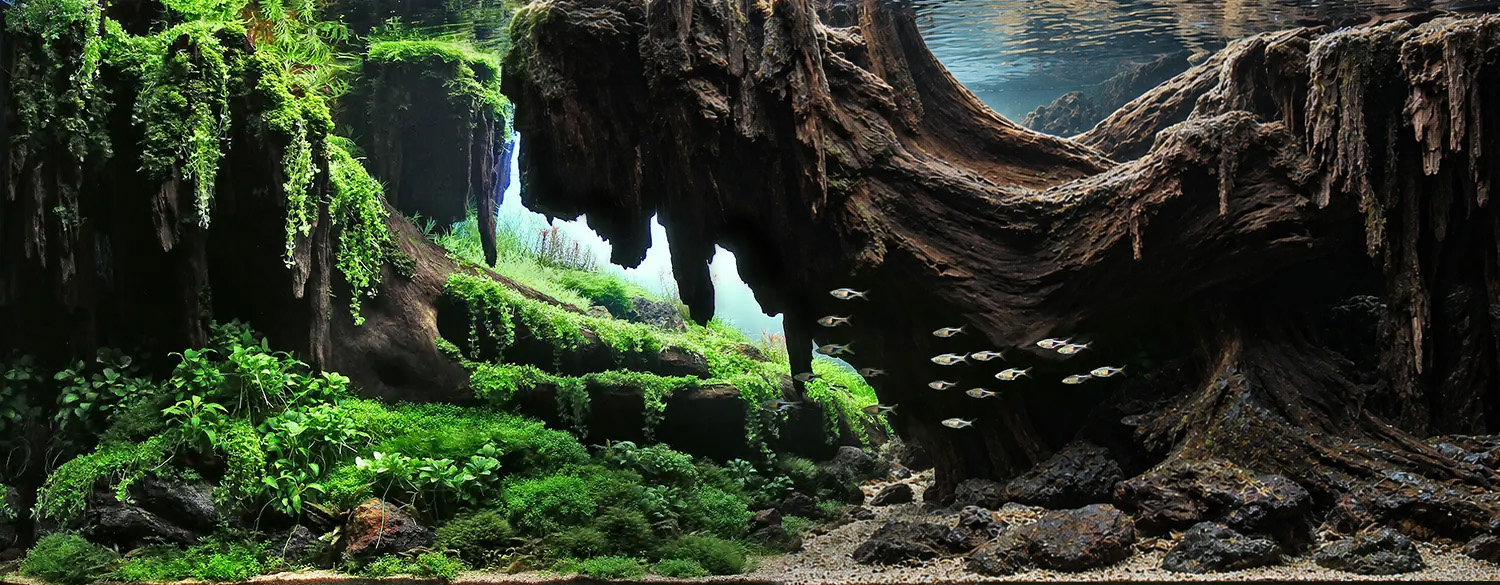
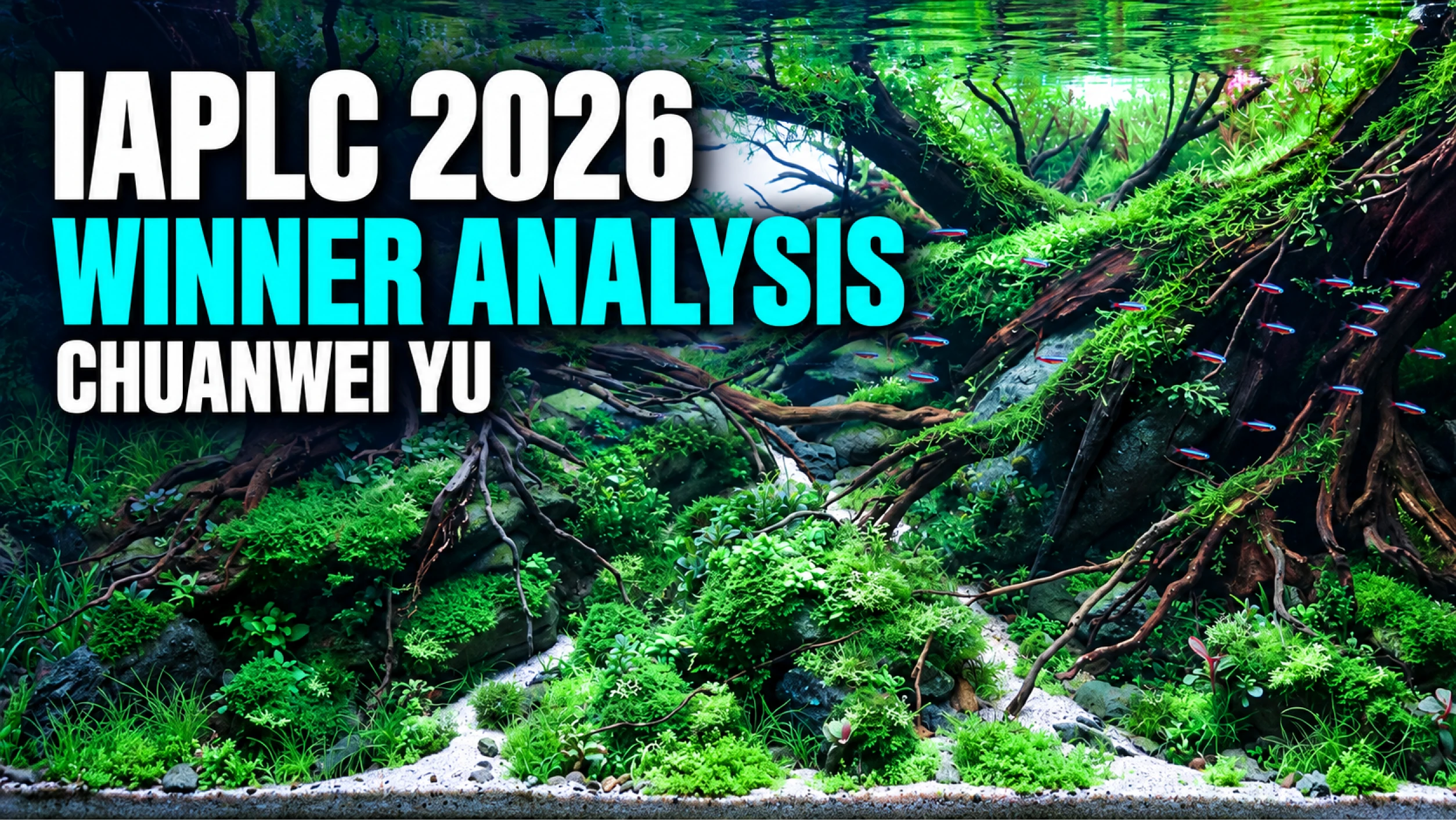
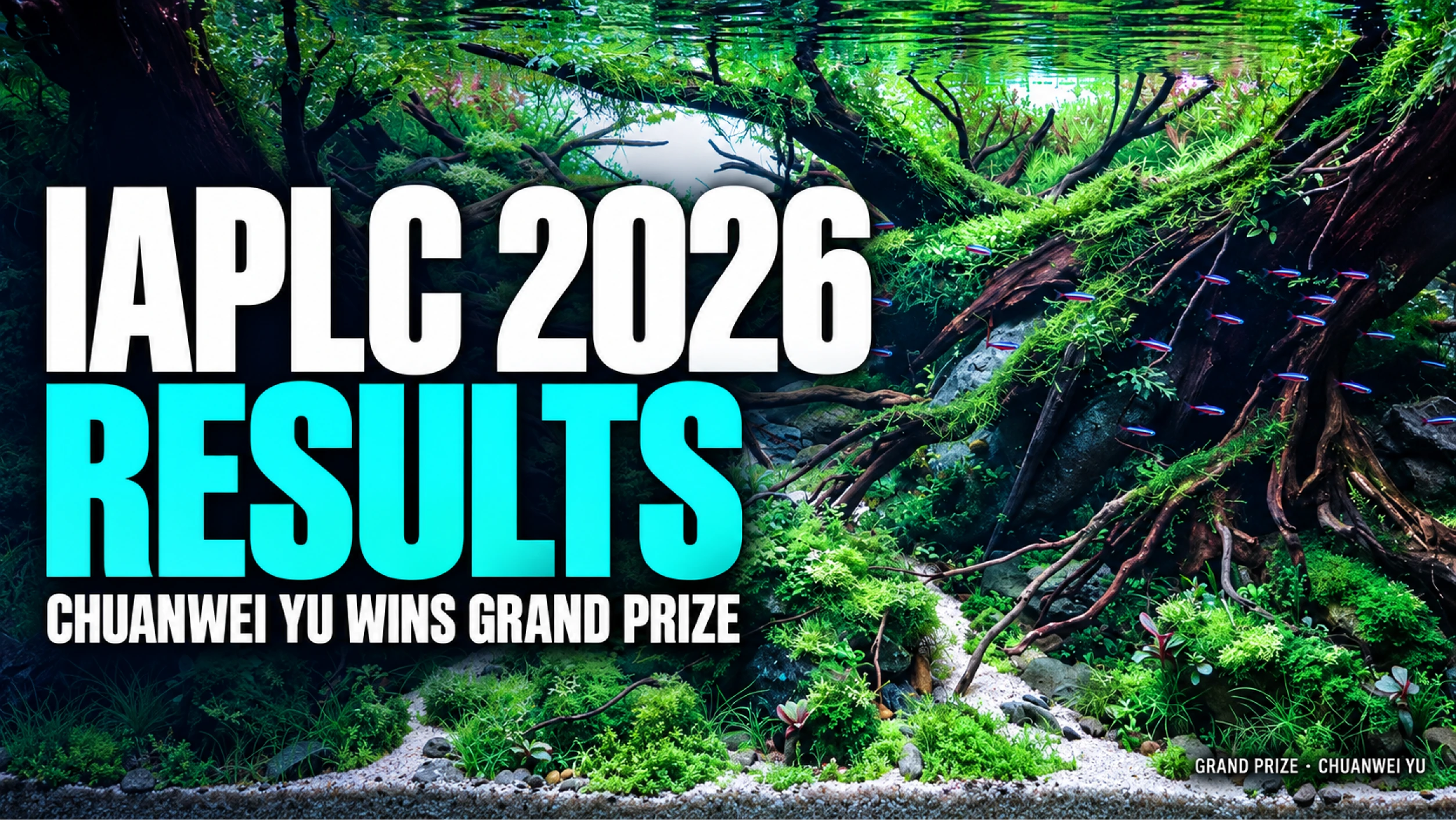
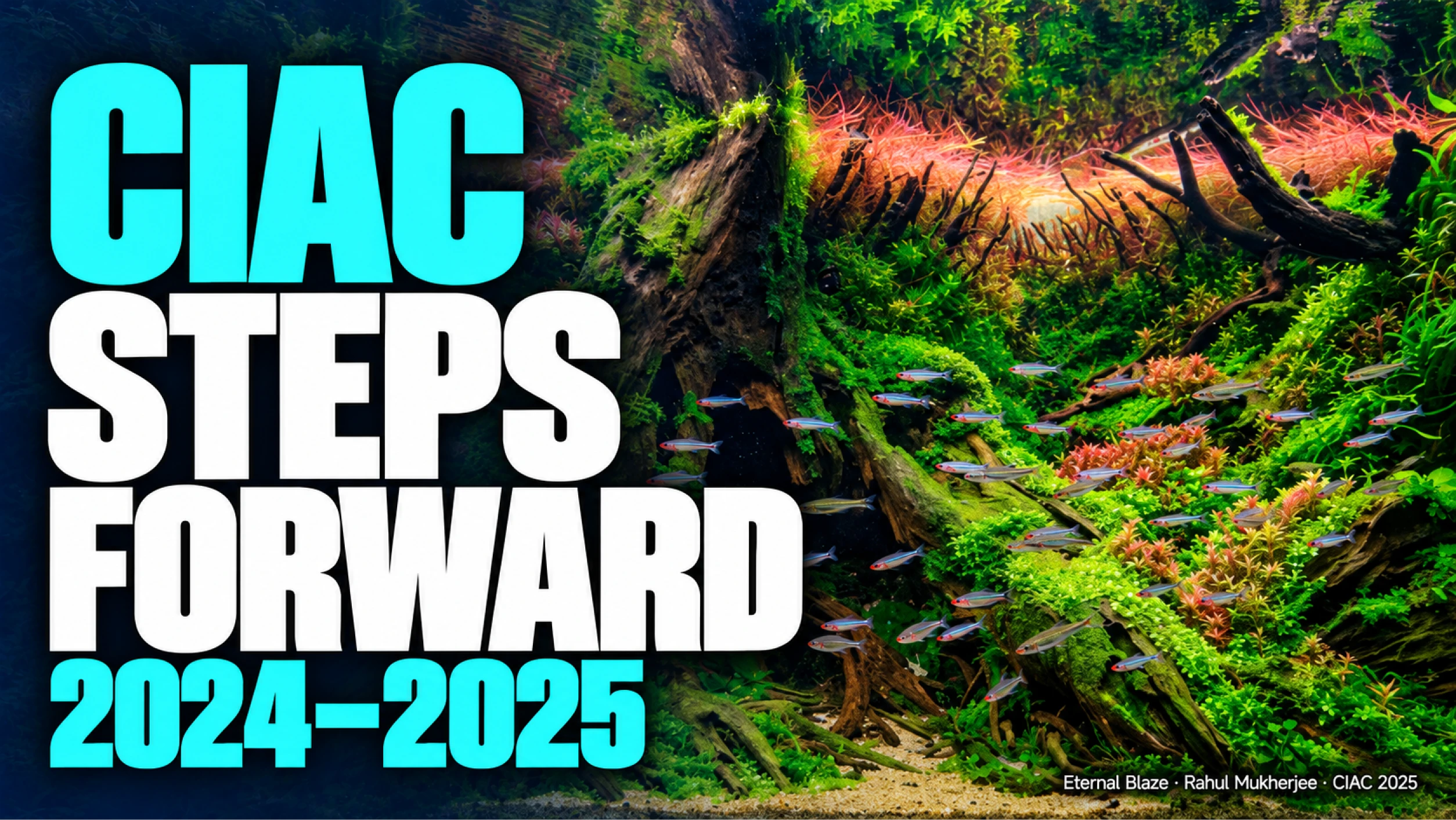
The image communicates one coherent submerged-forest idea through dark branching wood, moss-covered surfaces, layered greenery, a bright central opening and a restrained school of fish. The elements support one another and create a strong immediate impression. Two points are withheld because the dense upper and side planting sometimes merges with the hardscape, reducing visual clarity.
Strengths: Clear and consistent forest atmosphere.; Plants, wood, lighting and fish work toward the same visual narrative.; Strong contrast between the dark structure and the illuminated opening.
Limitations: Heavy density obscures some forms.; The dramatic darkness limits detail in several areas.
Composition, balance and use of space: 24/25
The central passage creates depth, while asymmetrical masses on the left and right produce a convincing balance. Foreground, middle ground and background are visibly layered, and the fish occupy useful open space without overwhelming the main composition. One point is withheld because overlapping branches and foliage occasionally weaken separation around the focal area.
Strengths: Effective central opening and receding perspective.; Good use of asymmetrical massing.; Fish provide movement and scale in an intentionally open zone.
Limitations: Some branch silhouettes overlap too heavily.; Negative space is strongest at the center but less apparent near the sides and top.
Planting, color and natural expression: 19/20
The visible planting appears lush and carefully integrated, with fine moss-like textures, trailing growth and broader leaves creating useful scale variation. The restrained green palette convincingly supports the woodland concept. The photograph cannot establish species, health over time or maintenance history, and the dense planting reduces separation between some groups, so one point is withheld.
Strengths: Natural-looking coverage over the hardscape.; Useful contrast between fine and broad leaf textures.; Consistent green palette with brighter growth around the opening.
Limitations: Plant groups can visually merge when viewed at image scale.; Long-term health and maintenance cannot be verified from the photograph.
Hardscape and technical execution: 19/20
The large wood arrangement creates vertical enclosure, overhangs, shelves and a central passage, with smaller elements and planting helping to integrate the structure into the substrate. The visible result shows strong craftsmanship and perspective control. One point is withheld because hidden construction, support and structural safety cannot be judged, while dark overlaps make a few transitions difficult to read.
Strengths: Ambitious and convincing three-dimensional wood architecture.; Strong integration of planting with hardscape surfaces.; Clear depth created by layered openings and overhangs.
Limitations: Some structural junctions are visually concealed.; Hidden construction and long-term stability are unverifiable.
Originality and long-term viability: 8/10
The combination of a cavernous woodland structure, suspended-looking wood forms, dense epiphytic-style growth and a bright natural opening gives the image a distinctive identity. The layout appears deliberately matured rather than sparsely assembled. Two points are withheld because the visual density suggests demanding trimming and access requirements, and a single photograph cannot confirm how the composition performs over time.
Strengths: Memorable, strongly committed visual identity.; Complex structure is made to feel biologically integrated.; The concept remains recognizable even with many details.
Limitations: Maintenance access may be challenging in the dense canopy and overhangs.; Long-term viability cannot be confirmed from the submitted image alone.
Total editorial assessment: 93 / 100
Judge's overall verdict
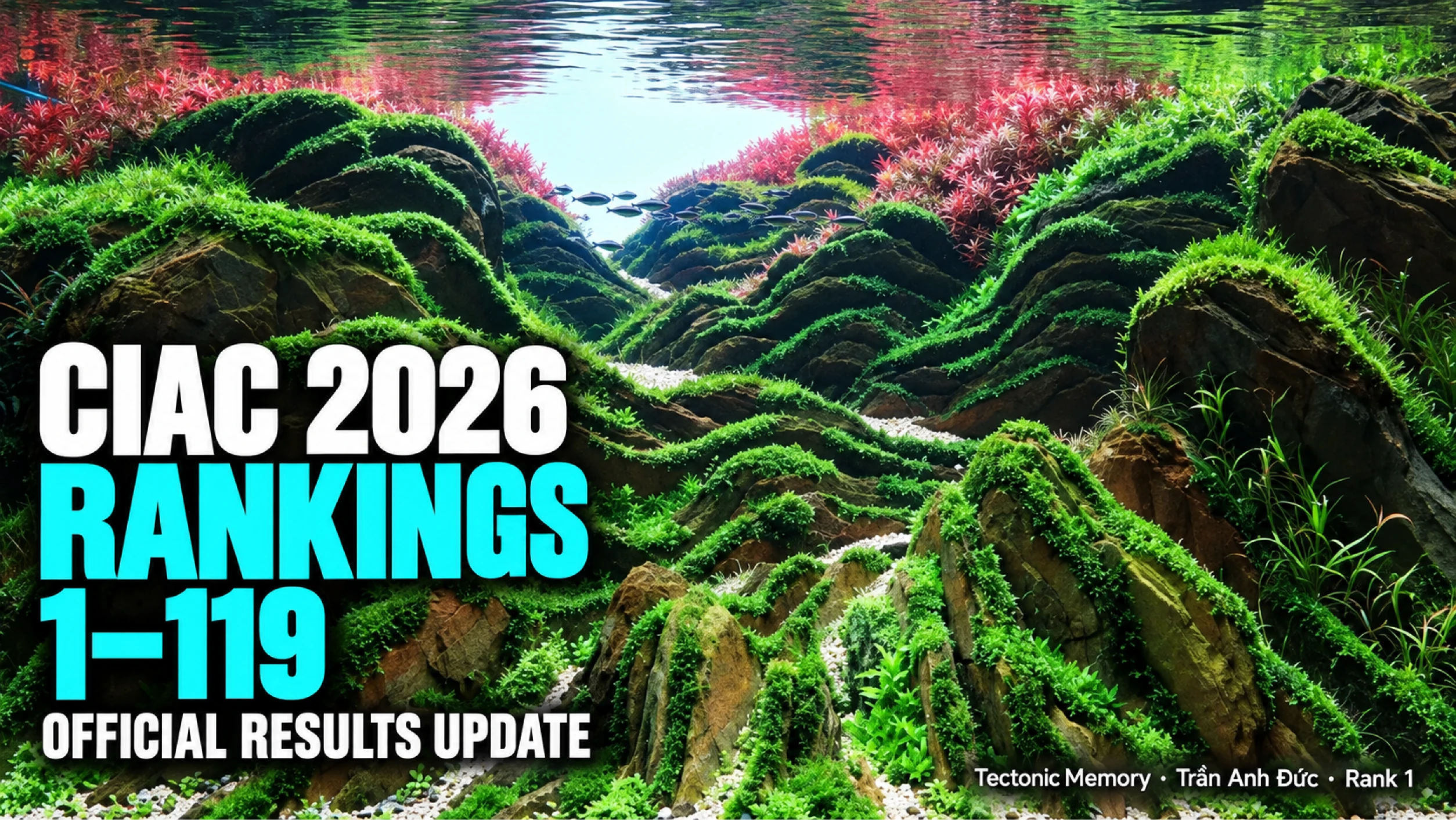
Editorial estimate: 93/100. This is a highly accomplished and coherent forest-style aquascape with exceptional atmosphere, depth and hardscape integration. Its principal limitation is not a lack of ambition but an excess of visual density and darkness, which occasionally conceals the precision of the work. The supplied rank is recorded as trusted contest context; it is not independently verified by this image review.
Assessment limits: The assessment is based on one submitted photograph. No reliable information is available here about the author, plant species, aquarium dimensions, construction methods, maintenance history, lighting equipment, livestock identification or long-term stability. Text visible in the image, including the watermark, was not treated as evidence of authorship or contest attribution.
Visual concept and first impression
The aquarium establishes a clear forest or submerged woodland impression almost immediately. Dark vertical and diagonal wood forms create the feeling of an enclosed ravine, while bright green growth spreads across ledges, trunks and the lower foreground. A pale opening behind the central structure supplies a strong atmospheric contrast and prevents the composition from becoming a uniformly black mass. The small group of fish adds life without displacing the hardscape as the main subject. This unity is the work’s greatest strength: plants, wood, lighting and livestock all support the same naturalistic idea. The main limitation is visual density. The upper and side regions are so heavily planted that some forms merge together, reducing the clarity that could make the concept even more immediately legible.
Composition, balance and use of space
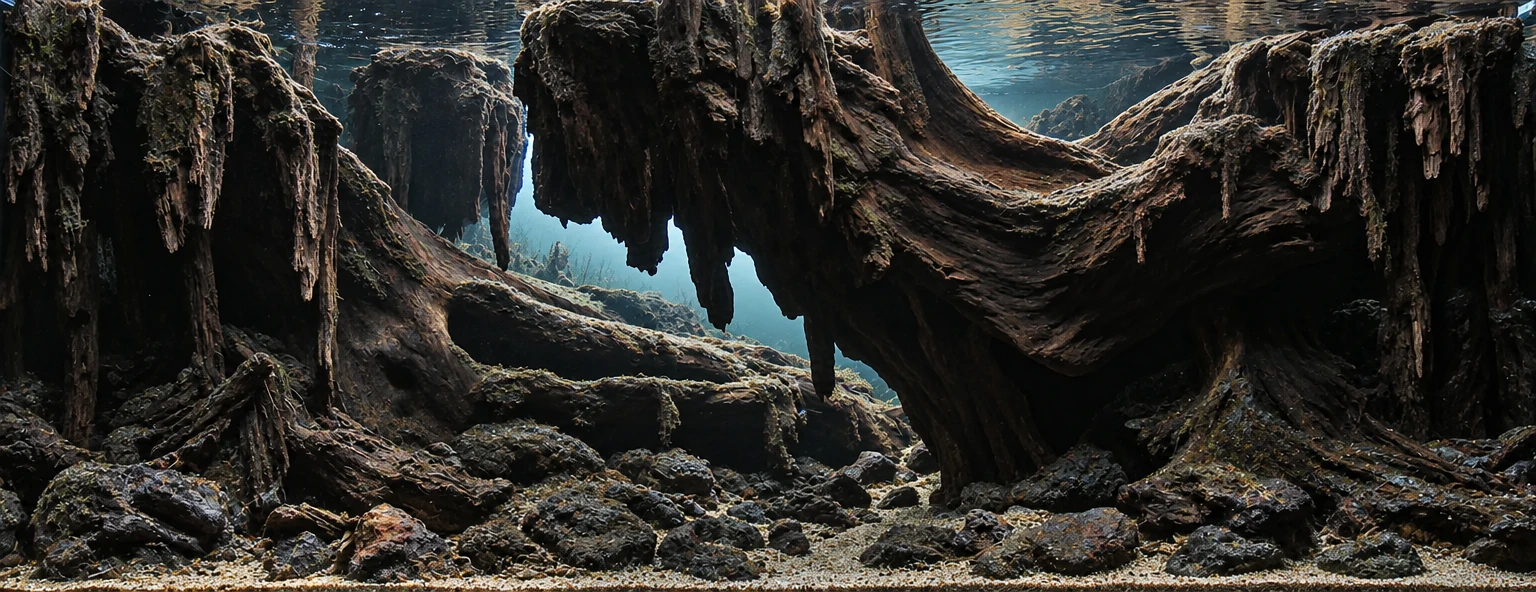
The composition uses a powerful central opening and a broad, irregular arch of wood to create depth. Receding layers are visible from the textured foreground through the middle ground and into the luminous background, giving the aquarium more than a flat garden-like arrangement. The fish occupy the open right-center area and provide a secondary directional cue, while the bright gap draws the eye through the hardscape rather than stopping it at the glass. Balance is achieved through asymmetrical masses: the left side rises and recedes, while the right side carries a large dark overhang and open swimming space. A higher score would require slightly clearer separation between some overlapping branches and plants. The dense canopy occasionally competes with the central passage instead of framing it cleanly.
Planting, color and natural expression
Planting is exceptionally effective at making the hardscape appear old, damp and biologically integrated. Fine-textured green growth covers the wood in varied thicknesses, and trailing strands descend from elevated areas to soften otherwise hard silhouettes. Lower plants with broader leaves add scale contrast against the mossy surfaces, while the mostly green palette maintains a convincing woodland atmosphere. The brighter foliage near the upper opening helps describe light filtering into the scene. The photograph shows vigorous-looking growth and careful placement, but it cannot verify species, maintenance history or long-term health. Some planting groups are so closely packed that their individual textures become difficult to distinguish. Selective thinning around key branch junctions and the central opening could improve definition without weakening the natural expression.
Hardscape and technical execution
The hardscape demonstrates a high level of planning and detail control. Large wood elements create vertical walls, suspended shelves, a central passage and deep overhangs, while smaller pieces and planted surfaces help connect the major forms to the substrate. The dark material is especially successful against the bright background, producing convincing depth and a strong sense of scale. The visible transitions between wood, moss and foreground planting are generally well integrated rather than appearing as isolated decorative objects. Because the image reveals only the finished front view, hidden supports, substrate construction and structural safety cannot be judged. From the visible result, the main technical weakness is not assembly but readability: the abundance of dark overlapping forms makes some connections ambiguous and slightly reduces the precision of the overall visual architecture.
Fish, atmosphere and photographic reading
The schooling fish are positioned in a relatively open zone beneath the right-hand overhang, where their pale bodies stand out against the dark background. Their grouping introduces movement and gives the scene a useful scale reference; they also lead the eye horizontally across the central space. The fish do not appear to dominate the image, which is appropriate for a hardscape-led contest composition. The strong contrast and deep shadows create a dramatic photograph, but they also conceal some detail in the side walls and upper wood. A judge assessing only this image would therefore give credit for atmosphere while remaining cautious about details that cannot be verified. Slightly more even illumination or a carefully opened planting window could preserve the mood while revealing additional craftsmanship.
What prevents a higher score
The entry is memorable because it commits fully to a single, mature woodland vision, and the supplied context identifies it as the rank-1 entry. Nevertheless, the highest possible evaluation would require greater control over visual congestion. The top canopy, side curtains and central wood overlap in several places, causing some silhouettes to lose definition. The composition also relies heavily on very dark tones, so the photograph offers less information about fine hardscape transitions than its complexity deserves. Long-term viability cannot be confirmed from one image, particularly in a heavily planted layout where trimming and access may be demanding. A judge would want to see the focal opening kept readable, a few branch edges selectively exposed, and enough negative space retained for the planting to mature without closing the composition.


Leave your comments