Overview
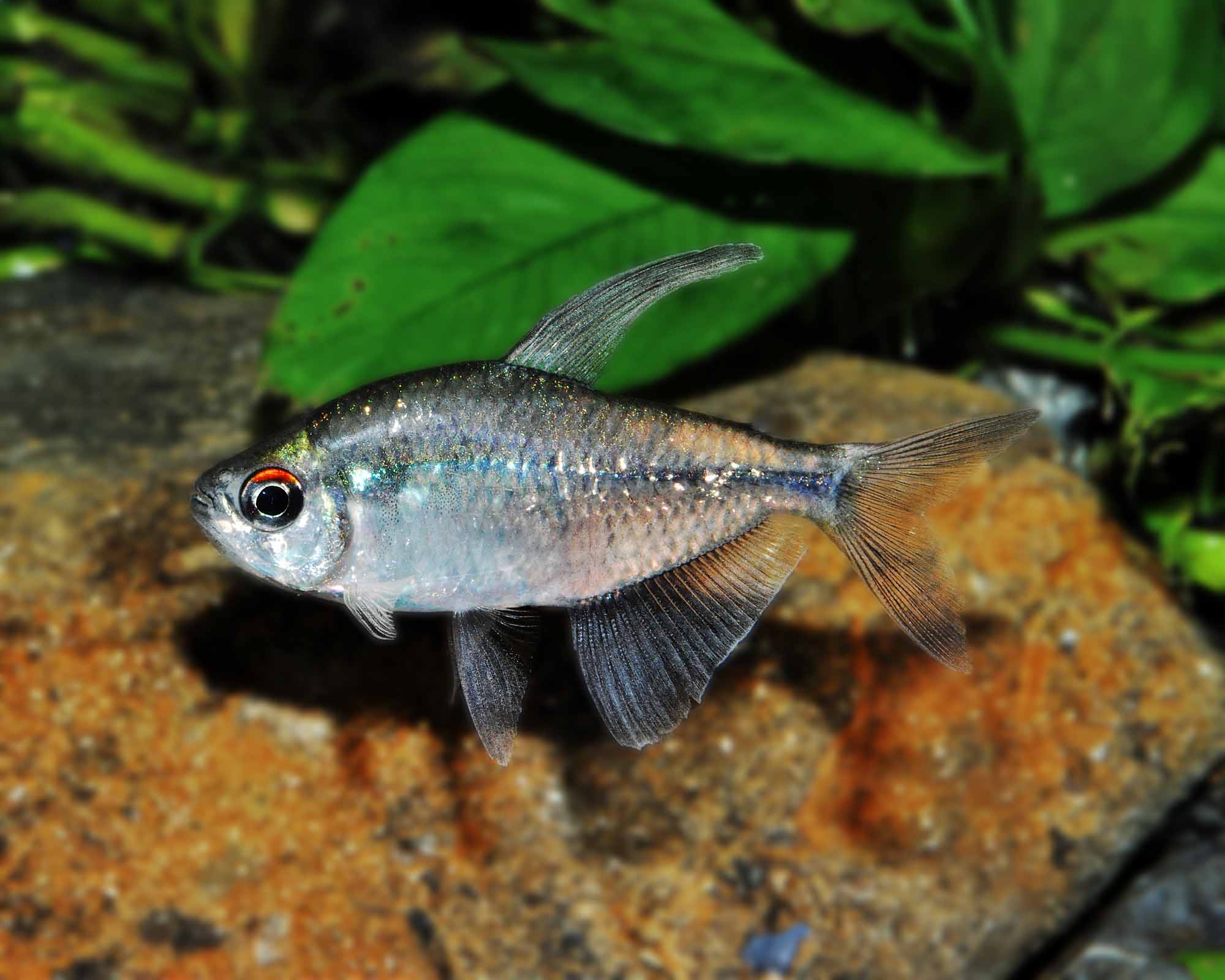
The Brilliant Tetra, scientifically known as Moenkhausia pittieri and frequently referred to as the Diamond Tetra, is a true gem of the freshwater aquarium hobby. As they mature, these fish develop highly reflective scales that catch the light, creating a sparkling effect reminiscent of scattered diamonds. They are robust, energetic, and make a fantastic addition to planted community tanks.

Distribution and Habitat
This species is endemic to the Lake Valencia basin and its surrounding tributaries in Venezuela. In their natural habitat, Brilliant Tetras inhabit slow-moving, heavily vegetated waters. The environment is typically characterized by leaf litter, submerged roots, and a canopy that diffuses sunlight, creating a dimly lit, tannin-rich aquatic landscape.
Description of Brilliant Tetra
The Brilliant Tetra is a visually striking fish, especially once it reaches adulthood and its full iridescent coloration develops.

Body shape:
They possess a classic tetra profile, featuring a laterally compressed, deep, and somewhat stocky body that allows for agile navigation through aquatic plants.
Color:
The base body color is a translucent silver. However, their defining feature is the array of specialized scales that reflect iridescent shades of gold, green, and blue, giving them their "brilliant" or "diamond" moniker.
Barbels:
Like other characins, the Brilliant Tetra does not possess barbels.
Snout:
They have a relatively short, blunt snout with an upward-facing mouth, adapted for feeding on small insects and crustaceans in the water column.
Eyes:
Their eyes are large and prominent, characterized by a striking, bright red pigmentation on the upper half of the iris.
Fins:
The fins are mostly translucent with a subtle violet or whitish sheen. Males develop significantly longer, flowing dorsal and anal fins as they mature, which often take on a sickle-like shape.
The Tail:
The caudal (tail) fin is deeply forked and clear, providing powerful propulsion for their active swimming habits.
Temper
Brilliant Tetras are generally peaceful and well-suited for community aquariums. However, like many tetras, they can occasionally become fin-nippers if kept in numbers that are too small, as they may feel stressed or insecure.
Sociality
They are highly social schooling fish. To ensure they feel secure and display their best natural behaviors and colors, they must be kept in groups of at least six individuals, though schools of eight to ten or more are highly recommended.
Activity
These tetras are very active mid-level swimmers. They spend the majority of their day darting through the middle strata of the aquarium, engaging in playful chasing within their school.
Keeping and Caring for Brilliant Tetra
Providing an environment that mimics their natural South American habitat is key to keeping Brilliant Tetras healthy and vibrant.

Tank size:
A minimum tank size of 20 gallons (75 liters) is required for a small school. However, a larger tank (30 gallons or more) is preferable to provide ample swimming space for these energetic fish.
Water Parameters:
Stability in water parameters is crucial for their long-term health and the development of their sparkling scales.
Temperature
Keep the water temperature between 24-28°C (75-82°F).
pH
They prefer slightly acidic to neutral water, with a pH range of 6.0 to 7.0.
Hardness
Soft to moderately hard water is ideal, ranging from 4 to 8 dGH.
Ammonia, Nitrite, Nitrate
Ammonia and Nitrite must always be at 0 ppm. Nitrates should be kept as low as possible, ideally below 20 ppm, through regular water changes.
Lighting
Dim to moderate lighting is best. Bright lights can wash out their colors and cause stress; floating plants can be used to diffuse intense aquarium lights.
Water flow
A gentle to moderate water flow mimics their natural slow-moving habitat without exhausting them.
Decorations and Plants
A dark substrate will beautifully contrast their sparkling scales. The tank should be densely planted around the perimeters with species like Amazon Swords and Java Fern, paired with driftwood and leaf litter, while leaving a spacious open swimming area in the center.
Diet
Brilliant Tetras are omnivores and are not picky eaters. A high-quality micro-pellet or flake food should form the staple of their diet. To enhance their coloration and health, supplement their diet with live or frozen foods such as daphnia, bloodworms, and brine shrimp.
Some Feeding Tips
Feed them small amounts 2 to 3 times a day, only offering what they can consume within a couple of minutes to prevent water pollution.
Breeding
Breeding the Brilliant Tetra is moderately easy. They are egg scatterers that exhibit no parental care. To breed them, set up a separate, dimly lit breeding tank with soft, slightly acidic water and fine-leaved plants like Java Moss. Condition the breeders with high-quality live foods. Spawning typically occurs in the morning, after which the adult fish must be immediately removed to prevent them from eating the eggs. The eggs will hatch in about 24 to 36 hours, and the fry can be fed infusoria until they are large enough to accept baby brine shrimp.
Conclusion
The Brilliant Tetra is an exceptionally beautiful, hardy, and active fish that rewards aquarists with a spectacular, shimmering display. Provided with a proper schooling group, a well-planted environment, and good water quality, they will thrive and become the sparkling centerpiece of any freshwater community aquarium.
 - pair - 1.webp)
Leave your comments