Overview
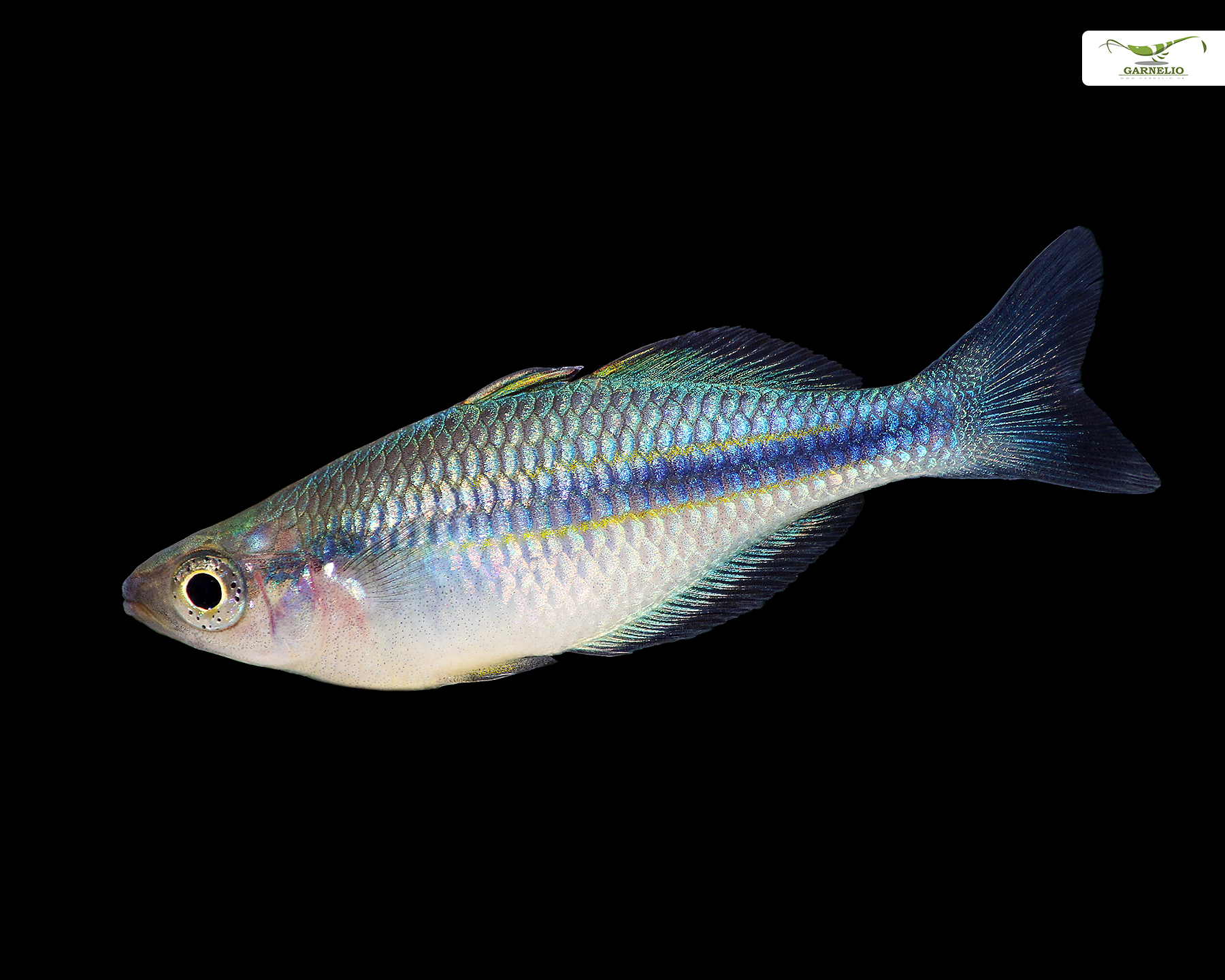
The Blue Rainbowfish (Melanotaenia lacustris) is a breathtaking freshwater species highly prized for its iridescent blue coloration. The 'DNZ' designation indicates these are German captive-bred specimens, which are known for being exceptionally hardy, disease-resistant, and well-adapted to standard aquarium conditions compared to wild-caught individuals.

Distribution and Habitat
In the wild, this species is strictly endemic to Lake Kutubu and its outlet, the Soro River, located in the Southern Highlands of Papua New Guinea. They inhabit clear, alkaline waters with abundant aquatic vegetation and submerged logs, where they school in the upper and middle water layers.
Description of Blue Rainbowfish
Body shape:
They possess a classic rainbowfish profile: a deep, laterally compressed body that becomes increasingly arched and deep as the fish, particularly the males, mature.
Color:
Their coloration is spectacular, featuring a cobalt blue or turquoise upper half that fades into a silver or white belly. A dark, mid-lateral stripe runs horizontally across the body, and their colors can shift in intensity based on mood and lighting.
Barbels:
They do not have barbels.
Snout:
The snout is relatively pointed, adapted for surface and mid-water feeding.
Eyes:
They have large, prominent eyes suited for spotting small insect prey in clear lake waters.
Fins:
They feature two dorsal fins. In males, the dorsal and anal fins are elongated and more pointed compared to the shorter, rounded fins of females.
The Tail:
The caudal fin is moderately forked, providing the powerful propulsion needed for their active swimming lifestyle.
Temper
They are known for their completely peaceful temperament, making them an ideal resident for community aquariums.
Sociality
Highly social, the Blue Rainbowfish is a schooling species. They should be kept in groups of at least six, which encourages natural behaviors, reduces stress, and promotes their most vibrant coloration.
Activity
They are extremely active swimmers that constantly dart around the middle and top levels of the aquarium, bringing a lot of dynamic energy and movement to the tank.
Keeping and Caring for Blue Rainbowfish
Tank size:
Due to their active swimming habits, a minimum tank size of 120 liters (approx. 30 gallons) is required, but a longer tank (at least 4 feet in length) is highly recommended to give them ample sprinting room.
Water Parameters:
Temperature
They prefer slightly cooler tropical water, ideally between 21-25°C (70-77°F).
pH
The water should be neutral to alkaline, with a pH range of 7.0-8.5.
Hardness
They thrive in moderately hard to hard water, roughly 8-15 dGH.
Ammonia, Nitrite, Nitrate
Pristine water conditions are essential. Ammonia and Nitrite must be exactly 0 ppm, and Nitrates should be kept strictly below 20 ppm through regular, generous water changes.
Lighting
Moderate to bright lighting is recommended. Good lighting, especially full-spectrum light that hits the fish from the front, highlights their incredible iridescent blue scales.
Water flow
A moderate water flow mimics their natural lake environment and provides a comfortable current for them to swim against.
Decorations and Plants
Provide dense plantings along the back and sides of the tank to offer hiding spots, but ensure a large, unobstructed swimming area in the center. Darker substrates and backgrounds will make their blue colors pop dramatically.
Diet
They are omnivorous and generally unfussy eaters. In the aquarium, they will readily accept high-quality flake foods, micro-pellets, and a variety of live or frozen foods such as daphnia, bloodworms, and brine shrimp.
Some Feeding Tips
Feed them small amounts twice a day. Incorporating color-enhancing foods rich in astaxanthin or spirulina will help maintain and intensify their brilliant blue and turquoise hues.
Breeding
Breeding is relatively straightforward. They are egg scatterers that spawn continuously over several days. Provide a separate breeding tank with a spawning mop or dense fine-leaved plants like Java Moss. Condition the breeders with live foods. Once eggs are laid in the mops or plants, remove the parents to prevent predation. Fry hatch in about 7-10 days and require infusoria or liquid fry food until they are large enough to take newly hatched brine shrimp.
Conclusion
The Blue Rainbowfish is a stunning, energetic addition to any sufficiently sized community aquarium. Their peaceful nature, combined with their breathtaking, shifting blue colors, makes them an incredibly rewarding species for both intermediate and experienced aquarists.
 - pair - 1.webp)
Leave your comments