These plants have delicate, frilly foliage and provide a calming presence. Not only do they add beauty to your aquarium, but they also help balance out the environment inside the tank by providing oxygen. In turn, helping reduce nitrate levels, and providing much-needed organic matter for natural decomposition. Aquarium ferns can come in many different varieties, ranging from smaller slow-growing midground plants to tall background ornamental plants. So mix and match the types available to bring a unique and vibrant look to your tank. There are a few things to consider when keeping ferns. Among those are proper lighting, nutrition, and substrate, but with the help of this guide, these plants will thrive and add a natural, living element to your aquatic paradise.
Table of contents
What Are Aquarium Ferns?
Common Aquatic Ferns
- Java Fern (Microsorum pteropus)
- Trident Fern (Microsorum tridentatum)
- Bolbitis Fern (Bolbitis heudelotii)
- Water Lace Fern (Ceratopteris pteridoides)
- Trichomanes Javanicum Borneo Fern
- Salvinia Natans/ Floating Fern
- Crepidomanes sp. Brevipes
- Microsorum Pteropus 'Needle Leaf'
- Bolbitis Heteroclita
- Microsorum pteropus 'philippine'
- Crepidomanes minutum
Care guide
What Are Aquarium Ferns?
Aquarium ferns are a type of aquatic plant specifically adapted to thrive in submerged environments. They are popular choices for freshwater aquariums due to several reasons:
Beauty: Ferns come in a wide variety of shapes, sizes, and colors, adding a touch of elegance and natural charm to your tank. From the classic broad leaves of the Java Fern to the feathery fronds of the Water Sprite, there's a fern to suit any aesthetic preference.
Ease of Care: Compared to some other aquarium plants, ferns are generally low-maintenance. They don't require strong lighting or complicated fertilization regimes.
Water Quality: Ferns help improve water quality by absorbing nitrates and other nutrients that can contribute to algae growth. They also add oxygen to the water, benefiting your fish.
Peaceful Environment: Ferns provide hiding spots and cooler temperatures, creating a more peaceful environment for your fish.
Versatility: Ferns can be used in various ways within an aquascape. They can serve as background plants, midground fillers, or even carpet plants (certain species like Microsorum pteropus 'Mini').
Origin: Most aquarium ferns hail from Southeast Asia.
Lighting: While they can tolerate lower light conditions, most ferns prefer indirect or medium lighting.
Propagation: Ferns reproduce through spores located on the undersides of their fronds. However, the easiest way to propagate them in a home aquarium is through division, where you separate a section of a mature rhizome (rootstock) to create a new plant.
Common Aquatic Ferns
There are literally hundreds if not thousands, of aquatic ferns one could consider for an aquarium, riparium, and/or paludarium. I’ve taken the time to curate a list of the most common types of ferns currently popular in the fish tank hobby. These are popular for many reasons including ease of maintenance, benefits, and aesthetics.
Java Fern (Microsorum pteropus)
The Java fern is native to the tropical jungles of Southeast Asia, where it grows on rocks and near waterfalls, and is often submerged partially or entirely underwater.

Scientific name: Microsorum pteropus
Common names: Java fern
Origin: Southeast Asia
Height: 12–14 inches
Growth rate: Slow (1 inch per month)
Color: Green
Aquarium placement: Midground
Water type: Freshwater
Temperature: 68–80°F (20–26°C)
pH: 6.0–7.5
The Java fern is a green, leafy plant made up of two main components — the rhizome and the leaves. A rhizome is a group of thin brown stalks that act as a stem for the fern by attaching themselves to surfaces.
This plant’s main attraction is its lush green leaves, which come in several shapes and colors. The leaves are long, slender, and can grow thickly, giving the fern a bushy appearance. These plants grow slowly, at a rate of around one inch per month. When fully grown, you can expect your fern to reach a height of 13–14 inches. As it matures, its leaves sometimes develop dark brown bumps.
There are some rare types of Java fern that differ in appearance from the most common variant:
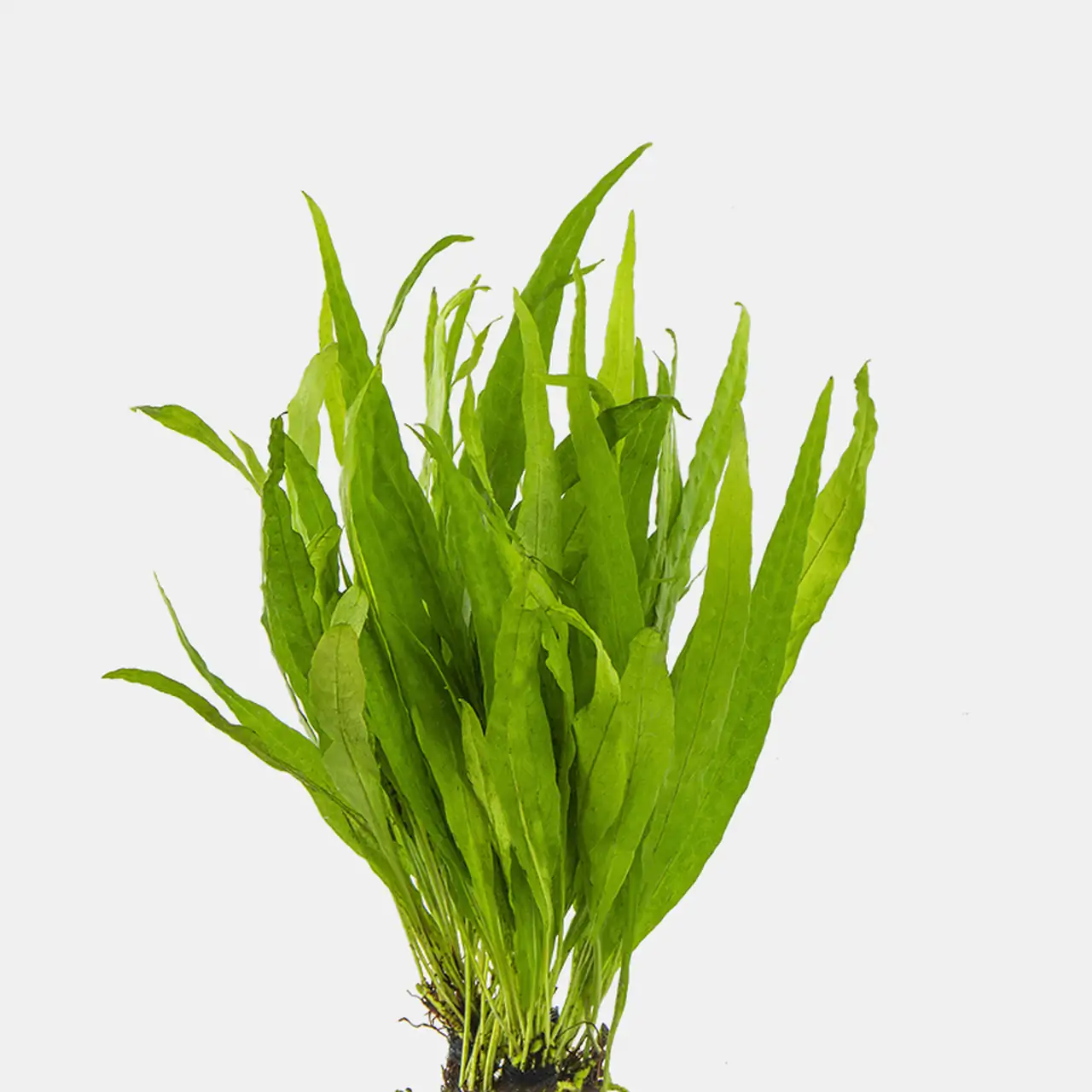
Narrow-leaf Java fern — This variant has narrow leaves which grow at a steep angle. Narrow-leaf Java ferns typically grow to be 12 inches tall.

Windelov Java fern — With a typical height of 8 inches, Windelov Java ferns are smaller than the common variant. The leaves of this variant split into three smaller leaves, creating a fork-like effect.

Needle leaf Java fern — The needle leaf fern has even thinner leaves than the narrow leaf variety. This rare variant grows to be only 6 inches tall.
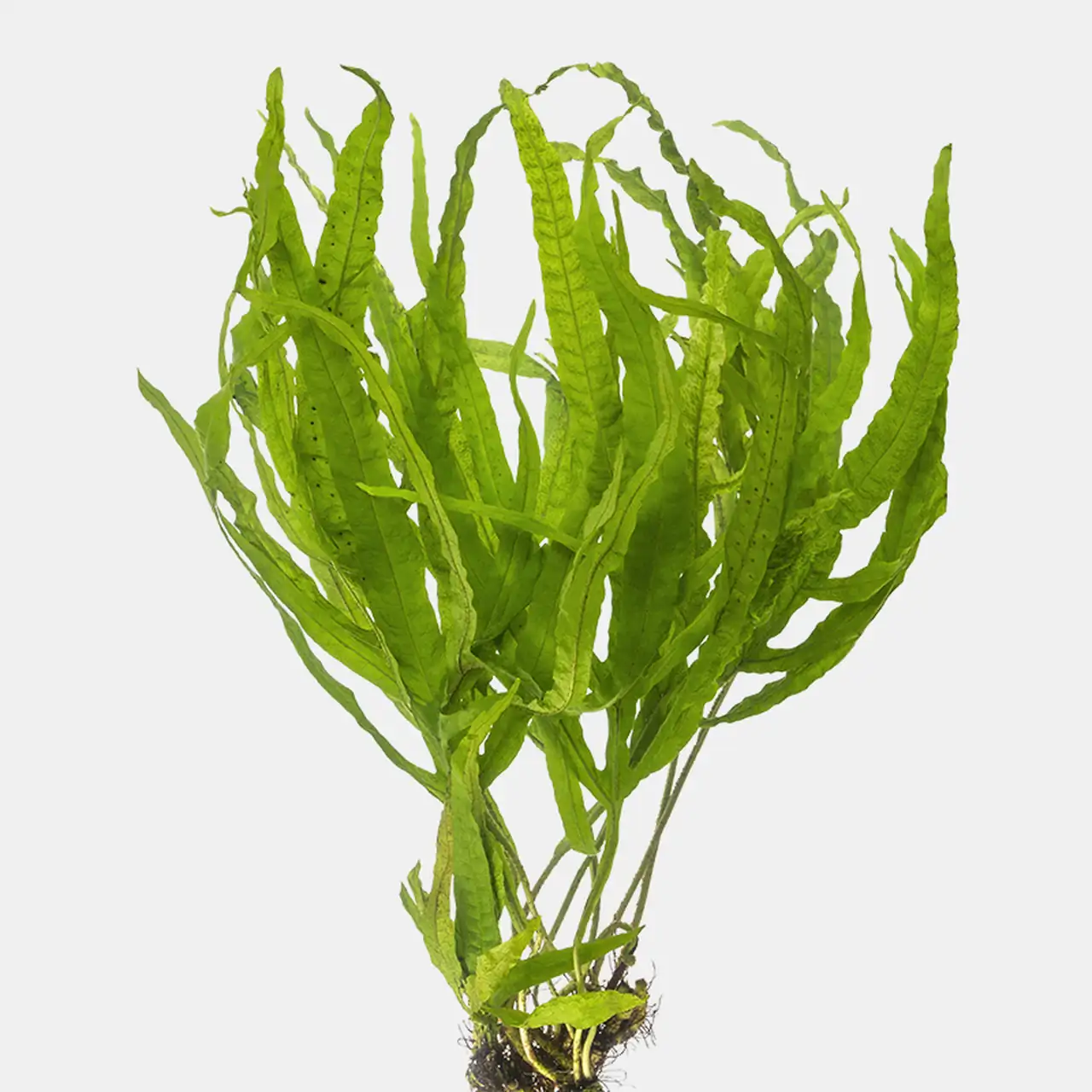
Trident Java fern — This is one of the rarer variants with its unique feathery, lobed leaves. This variant is shorter than the narrow leaf fern, but it grows more quickly.
Java ferns absorb carbon dioxide from the water, making them a beneficial addition to any tank. This plant also requires minimal lighting, which reduces the likelihood of algae growing in the tank, and the plant’s leaves provide a great hiding place for small shy fish.
Java ferns are easy to care for because they have minimal requirements and are resilient in nature. In the wild, you’ll typically find them in shady areas, so the plants require similar low-lighting conditions in the tank.
They don’t require substrates such as gravel or sand, making them ideal for bare-bottom tanks. If you include substrate in the tank, don’t bury your fern in it, because doing so will rot the plant. Instead, grow your fern on a rock or piece of driftwood.
In order to safely introduce a Java fern to your aquarium, you must first quarantine the plant to ensure it is free of any pests and chemicals that could harm your fish.
Follow these steps to quarantine the plant:
- Remove any dead or dying leaves.
- Wear disposable gloves and mix one part unscented bleach with twenty parts water, then submerge your plant into the mix for up to 150 seconds.
- Rinse the plant thoroughly for a couple of minutes before introducing it to a quarantine tank.
- Your fern should stay in the quarantine tank for three to four weeks before being moved to the aquarium with other fish and plants.
- To plant your Java fern in the main tank, put the plant near driftwood or rocks so it can attach itself to its preferred location. If you want to plant the fern on a particular rock or piece of wood, tie the plant there using a cable tie until it attaches itself.
Alternatively, simply place the fern in the tank and it will eventually find its own piece of wood or rock to attach to. Avoid burying the fern’s rhizome under sand or gravel because it will rot.
Java ferns’ hardy nature makes them easy to care for and virtually unkillable when kept in the right conditions.
Nutrition
The Java fern’s ability to draw nutrients from the water through its leaves means it doesn’t require fertilizer. However, if you want to encourage quicker growth, introduce a liquid fertilizer to the tank during water changes.
While CO2 isn’t necessary for Java fern growth, adding it to the tank will speed up the plant’s growth.
Maintenance
Avoid planting a Java fern in substrates such as gravel and rocks because doing so will rot the rhizome. You can tell if the rhizome is rotting when the Java fern turns brown.
Aquarists sometimes mistake black spots on the fern’s leaves as a disease when in fact, this is where the fern’s sprouts bud. However, if the black spots don’t grow new ferns after a few weeks, the black spots could indicate burns, so reduce the lighting level in the tank.
Java fern melt is another common problem that these plants face. Symptoms of melt include large brown spots that cause the fern to turn mushy. Melt typically occurs as a result of too much light or excessive algae in the tank. To treat melt, snip off the affected leaves and improve the tank lighting and algae conditions until the plant’s health improves. Fertilizer can help, too.
These plants don’t require regular pruning, but you can trim the fern occasionally if it grows too large for the tank.
To trim your fern, start by lowering the water level so you can reach the plant. Then remove any dead leaves using sharp scissors. You can then trim larger leaves and any small shoots to manage the fern’s growth.
How to Propagate Java Fern
Java fern propagation is relatively simple and doesn’t require special conditions.
Propagate your fern with one of the following two methods:
Cut off a section of the rhizome with a few plants attached, and replant it. The separate plants will then grow if tied down to a spot in the tank
Wait for the plant to develop tiny black spots on its leaves. These are tiny java ferns. Once they start to sprout, cut the tiny ferns off the leaves and plant them elsewhere in the tank
Trident Fern (Microsorum tridentatum)
Growth Rate: Slow
Aquaria Placement: Midground or on hardscapes
Light Requirements: Low
Fertilizer Requirements: Light
Special Requirements: N/A
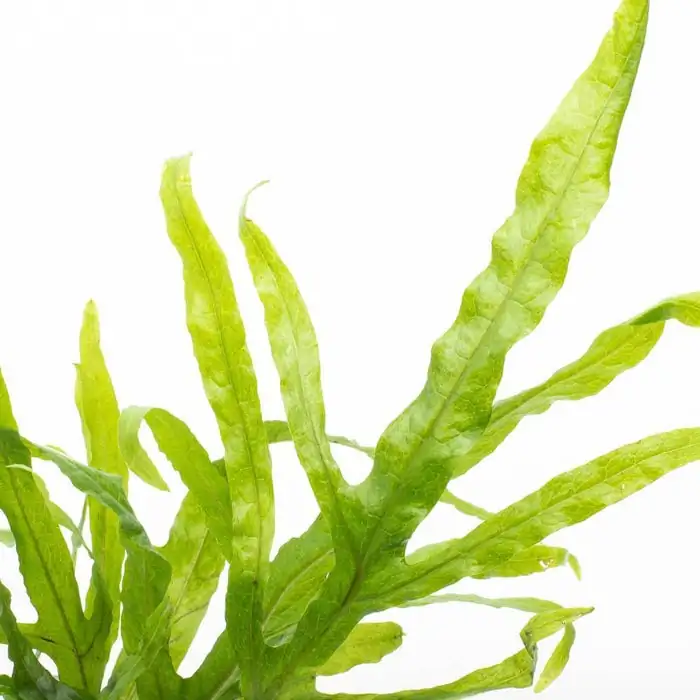
Microsorum Pteropus "Trident", also known as Trident Fern is a beautiful variant of the standard Java Fern and share similar demands and characteristics, and like the name suggests, it has distinct trident shaped foliage. Very popular plant for Nature style aquascapes, but still fairly uncommon.
Trident Ferns have lime green mature foliage and usually a very dense growth pattern. Each frond is around ~6" long by ~2.5" wide, but can vary depending on the parameters; becoming largest in lower light and more compact in higher light. Trident Ferns are rhizome plants, so the rhizome must be above the substrate, as with most rhizome species, attaching it to hardscapes (e.g: stones, driftwood, and branches) can be easily done and is usually the best way to grow this species. Trident Ferns require very little maintenance, which make it perfect for low maintenance aquascapes, however, some trimming is recommended to thin out mature plants to create more growing growing space and to encourage new rhizome growth.
Trident Ferns are very adaptable regarding environments, they can be grown in almost any aquarium. They are not demanding in regards to lighting, co2, or even fertilization, however, with optimal additions of each, you would achieve best growth. Like the standard Java Fern, most herbivores would leave the hardy leaves alone, however, certain it's ideal most aquarium plants aren't kept with large true herbivores.
A great species for attaching to hardscapes, so great throughout the layout, however, it also works well as a midground for small aquariums and a foreground in larger aquariums. Trident Ferns also work great in high flow, not only can it withstand high flow, it seems to grow even better in areas of high flow.
Propagation of this species is easy, rhizome division is often times the simplest way. However, Microsorum sp. will sometimes develop plantlets on the underside of the leaves, which can be separated and planted as an individual plant.
Portions sold are 3-4" rhizomes with several fronds, plants attached to stones are also available. All grown submersed in Canada.

Java Fern Trident Mini is a unique variant belonging to the well-known family species, Microsorum. As its name states, Java Fern Trident Mini is a smaller form of Java Fern Trident that features narrow, fork-like leaves. This bright green aquatic plant is a wonderful choice for novice hobbyists and does a good job of filling in open space in a planted aquarium tank. This particular variant works well in all sizes of aquariums and is highly adaptable to different water parameters. Java Fern Trident Mini is also versatile with placement and can be used for a variety of looks such as small bushes of green or acting as leaves on a unique piece of aquarium driftwood. This aquatic plant can also be tied to stones or left free floating.
Bolbitis Fern (Bolbitis heudelotii)

Scientific Name
Bolbitis heudelotii
Common Name
African Water Fern, Congo Fern
Placement
Attached to driftwood, stone, or decoration
CO2
Not required
Growth Rates
Medium
Difficulty Level
Easy
Nutrient Substrate
Not required
Can it grow emerged?
Yes
Lighting Requirements
Low - High
Submerged water plants that work in the warm liquid of a fish tank are few and far between. Some of the tropical fern species, such as Bolbitis water fern and Java fern, are commonly used as greenery in tank situations. African water fern grows from a rhizome which can easily be attached to a rock or other surface. They are easy to manage in soft water with either fertilizer or no fertilizer. Below you will find some African water fern info so you can use this lovely plant to aquascape your tanks.
What is an African Water Fern?
Fish keepers will know the Bolbitis water fern, or African fern (Bolbitis heudelotii). It is a tropical shade epiphyte found around bodies of water and boggy regions. The fern is a robust specimen and useful as a natural plant in fish tanks. It will grow on a rock or piece of wood, which helps anchor the plant to the floor of the tank or even the wall. Bolbitis is found in fast-moving tropical waters. It is an epiphyte and anchors itself to rough rocks or pieces of wood. Also known as Congo fern, the plant is dark green with delicately cut leaves. It is slow growing, but can get tall and is most useful as a bottom plant. The rhizome should not be buried in the substrate but rather tethered to an appropriate piece of lava rock, bark or other medium. The fern can grow 6 to 8 inches (15 to 20 cm.) wide and as tall as 16 inches (40 cm.). This is accomplished at a snail pace since growing African water fern leaves can take up to 2 months.

Growing African Water Ferns
In order to grow the fern in water, it must first be attached to a medium. Release the plant from its nursery pot and clean off the rhizomes. Hold the rhizomes in place on the chosen medium and wrap them onto it with fishing line. Over time the plant will self attach and you can remove the line. The fern prefers slightly acidic to soft water with gentle current and medium light, although it can adjust to brighter light levels. Keep the plant looking its best by removing dying fronds at the base of the rhizome. Propagation of Bolbitis water ferns is through rhizome division. Use a sharp, clean blade to ensure a sterile cut and then tie the new rhizome to a rock or piece of bark. The plant will eventually fill in and produce another thickly fronded fern. Use a diluted liquid fertilizer at start time that is consistent with aquatic use. The best growth is achieved by plants situated near the bubbler or current source.
African Water Fern Care
These are fairly easy plants to maintain as long as the tank and water health is good. They do not do well in brackish or salty water, and should be grown in fresh water only. If you wish to fertilize after its initial planting, use a balanced liquid fertilizer once per week and infuse the water with CO2. Fertilizer is not necessary in a low maintenance tank where fish waste will provide nutrients. Keep temperatures between 68 and 80 degrees Fahrenheit/20 to 26 degrees Celsius. African water fern care is minimal and this easy-to-grow plant will decorate your natural tanks for years to come.
Water Lace Fern (Ceratopteris pteridoides)

| Synonyms | Parkeria pteridoides Hooker, Ceratopteris lockhartii (Hook. & Grev.) Kunze |
| Misapplied names | Ceratopteris cornuta, Ceratopteris froesii |
| Complete botanical name | Ceratópteris pteridoídes (Hooker) Hieronymus |
| Family | Pteridaceae |
| Genus | Ceratopteris |
| Difficulty | easy |
| Usage | Plant for spawning, Water surface |
| Growth | very fast |
| pH value | 5 - 8 |
| Temperature tolerance | 18 - 30°C |
| Carbonate hardness | 0 - 21°dKH |
| General hardness | 0 - 30°dGH |
| Propagation | Proliferating leaves, Spores |
| Can grow emersed? | yes |
The Floating antler-fern is very different from its relatives Ceratopteris thalictroides and C. pteridoides. This conspicuous, large floating fern occurs from the southeastern U.S. to South America and is also reported from Southeast Asia. Ceratopteris pteridoides grows in rivers and standing waters, either free-floating with water roots or as swamp plant, rooting in mud. It does not thrive under water. In the aquarium hobby this species is often confused with Ceratopteris cornuta that is able to grow submerged.
The triangular to lobed floating leaves may exceed 13 cm in length. With much light and nutrients, this fern may develop its very different fertile, spore-bearing leaves that are emersed, finely divided and have a very thick, inflated stalk. Many young plantlets (adventitious plantlets) form on older floating leaves.

As a floating aquarium plant, Ceratopteris pteridoides needs above all a plentiful nutrient supply and good lighting. The favourable temperatures lie between about 18 and 30 °C. Nutrient deficiency or imbalance may lead to pale new leaves and poor growth. Under favourable conditions this fern may get large within a quite short period. If the leaf rosettes have become too large for the tank, they can be replaced by some of the many young plantlets that develop on old, also detached leaves.
Young plants from tissue culture are often entangled and not easy to separate from each other. However the latter is actually not necessary. After rinsing off the tissue culture gel, they can be put on the water surface as whole clumps of several plants and separated later, if desired. The leaves broke off easily but may develop adventitious plantlets when they are left floating.
This large, decorative water sprite species looks best in open tanks. It provides shelter for the aquarium inhabitants and is well accepted by labyrinth fishes for their foam nests. Ceratopteris pteridoides is also interesting for South America-themed biotope aquariums, together with other floating plants from this region such as Phyllanthus fluitans, Azolla and Salvinia species.
Floating antlerfern, or Ceratopteris pteridoides, is distrubuted from the American subtropicst and tropics from Florida and Louisiana on southward and has also been found in Vietnam.
It does not grow submersed, but only floating on water and as bog plant on muddy ground. Form and size vary, depending on the conditions of the location it grows in.
The floating leaves of young plants are entire, those of older, larger plants have broad lobes. Their outline is a wide triangle. On older leaves, many young plants form from bulblets in the deep crevices of the lobes.
The leaf stalks are thick and widen even more towards the leaf blade; they consist of spongiform tissue and serve as buoys. (The leaf stalks of Ceratopteris cornuta and C. thalictroides, however, are relatively thin and of an even width.) The leaf lobes of C. pteridoides are mostly oppsite, whereas those of C. cornuta and C. thalictroides are alternate.
Spore-carrying fronds have up to four pinna, and upright growth habit, and they are segemented. They form only rarely in tanks. When the plant is cultivated emersed on nutrient-rich substrate and high light intensities the probability is higher.
Trichomanes Javanicum Borneo Fern
Borneo Fern is a slow-growing terrarium plant that originates from South East Asia. This is a terrarium plant that does not do well when kept submerged long term

Family Name: Hymenophyllaceae
Origin: South East Asia
Height: 4-8”
pH: 6-7.5
Care: Easy
Light: Low
Co2: Not Required
Propagation: Cut along the rhizome
Growth rate: Slow

Salvinia Natans/ Floating Fern
The floating Fern (Salvinia natans) is an ideal aquarium fern for a thriving enclosure. There are a number of benefits this fern is great for when it comes to planted tanks.
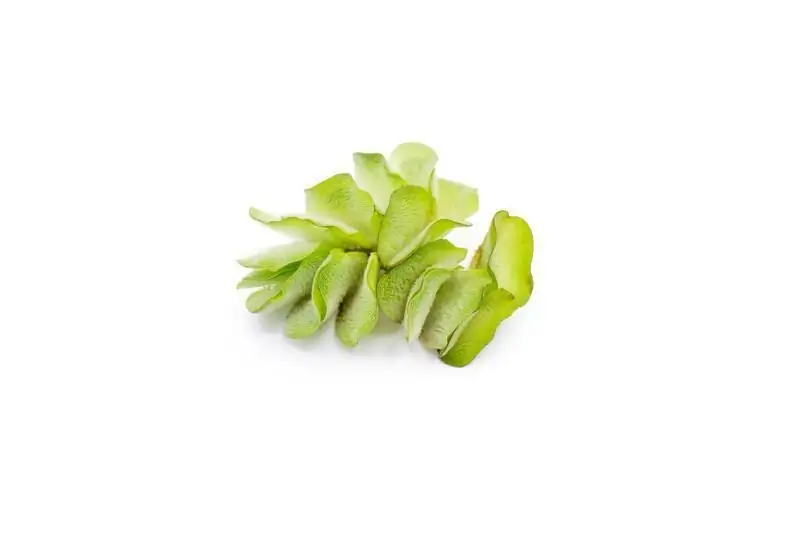
If you are looking for an easy-to-care-for fern that is fully aquatic, Salvinia is a really affordable option to consider. This article will provide an in-depth guide to understanding floating ferns as well as some tips to help care for them.
| Scientific Name | Salvinia natans |
| Common Name | Floating Fern, Water Butterfly Wing, Floating Watermoss |
| Family Name | Salviniaceae |
| Habitat | Freshwater |
| Temperature | 60°F to 70°F |
| Height | 2 to 3 inches |
| pH | 6.5 to 7.5 |
| Lighting | Bright |
Salvinia natans is a species of fern in the Salviniaceae family. Commonly referred to as floating fern, this plant is one of the few fully aquatic ferns sold in the aquarium market. The unusual aspect of this flora is its uncanny ability to float.
Furthermore, this fern doesn’t grow long roots like most other floating plants… Something to keep in mind when scaping a vivarium that might have limited space within the aquatic portion of the enclosure.
Besides Floating Fern, Salvinia natans are also referred to as Floating Watermoss and Water Butterfly Wings. These types of ferns are excellent for supplying shade over large areas of water. Providing both a refuge for small fish to take shelter and a natural filter from sunlight reducing the spread of algae.
Floating ferns are very often confused with other common floating mosses. Though similar in appearance, the floating fern is a very different plant and has a few recognizable qualities that can help correctly identify the fern. Separating it from other floating plants.
Crepidomanes sp. Brevipes
updating...
Microsorum Pteropus 'Needle Leaf'
Microsorum pteropus is an uncommon Java fern variant probably originating from Sarawak (Borneo). It has feathery lobed leaves with approx. 2-5 lobes on each side. The central and the lateral lobes are very narrow, much like those of “Needle Leaf”.

It should be grown on a root or stone, attached with fishing line until it has gained a hold. If it is planted in the bottom, do not cover the rhizome because it will rot. Easy to propagate by splitting the horizontal rhizome. A hardy plant which grows in all conditions. The black spots under the leaves are sporangia (reproductive organs), not signs of disease as many believe.
True "Needle Leaf" Java fern is relatively rare in the hobby and very hard to come by in trade. It has extremely narrow strap-shaped leaves that are only 3-5 mm wide and approx. 5-20(-30) cm long. It is a relatively slow grower, which makes it highly suitable for nano aquaria. Often Microsorum pteropus "Taiwan Narrow" is called "Needle Leaf" in the hobby, but it has wider, longer leaves than the true "Needle Leaf".
The vernacular name "needle leaf" obviously is used for (at least) two similar Java fern forms growing to different sizes. However, both forms alike have exceedingly narrow, band-like leaves of a medium to dark green colour with an undulate margin. The midrib is rather thick in comparison with leaf width, and on the underside of the leaf there are dark brown hirsute scales. The distance between the leaves on the rhizome is rather brief, and the roots remain relatively short.
The larger variety is also known under the name M. pteropus "Taiwan" and (erroneously) as "Narrow Leaf" (not identical with M. pteropus "Narrow" from the aquatic plant nursery Tropica). The leaves of adult plants are usually over 5 mm wide and reach a maximum width of around 2 cm and a length of 30 cm.
The smaller variety, also in trade under the name Microsorum spec. "Mini", has leaves of only 3 to 5 mm in width. This form is an overall slower grower than the first one. Over a long time, the leaves of younger plants will stay around 10 cm long, whereas the leaves of older populations can develop up to 30 cm long leaves.
It cannot be ruled out that there are even more Java fern varieties of the needle-leaf type.
| Synonyms | Microsorum pteropus ''True Needle Leaf'', Microsorum sp. ''Mini'' |
| Misapplied names | Microsorum brassii |
| Complete botanical name | Microsórum ptéropus (Blume) Copeland |
| Family | Polypodiaceae |
| Genus | Microsorum |
| Difficulty | very easy |
| Usage | Epiphyte (growing on hardscape), Midground, Nano tanks, Foreground, group |
| Growth | slow |
| pH value | 5 - 7 |
| Temperature tolerance | 4 - 30°C |
| Carbonate hardness | 0 - 12°dKH |
| General hardness | 0 - 30°dGH |
| Propagation | Proliferating leaves, Proliferating roots, Rhizomteilung, Splitting, cutting off daughter plants |
| Can grow emersed? | yes |
Bolbitis Heteroclita
Bolbitis heteroclita is a fern considered as an aquatic plant that is widely distributed in Southeast Asia for a long time. Of course, it is possible to grow it underwater, but its submerged leaves tend to become small and grow very slowly. And it is easy for algae to grow on the plant. Those are the shortcomings of Bolbitis heteroclita. Additionally, although its submerged leaves become beautiful translucent, they are hard and tend to prefer to be emersed with high humidity than being submerged.
Family Name: Dryopteridaceae
Origin: South East Asia
Height: 2-4”
pH: 6-7.5
Care: Easy
Light: Low
Co2: Not necessary
Propagation: Cut along the rhizome
Growth rate: Slow
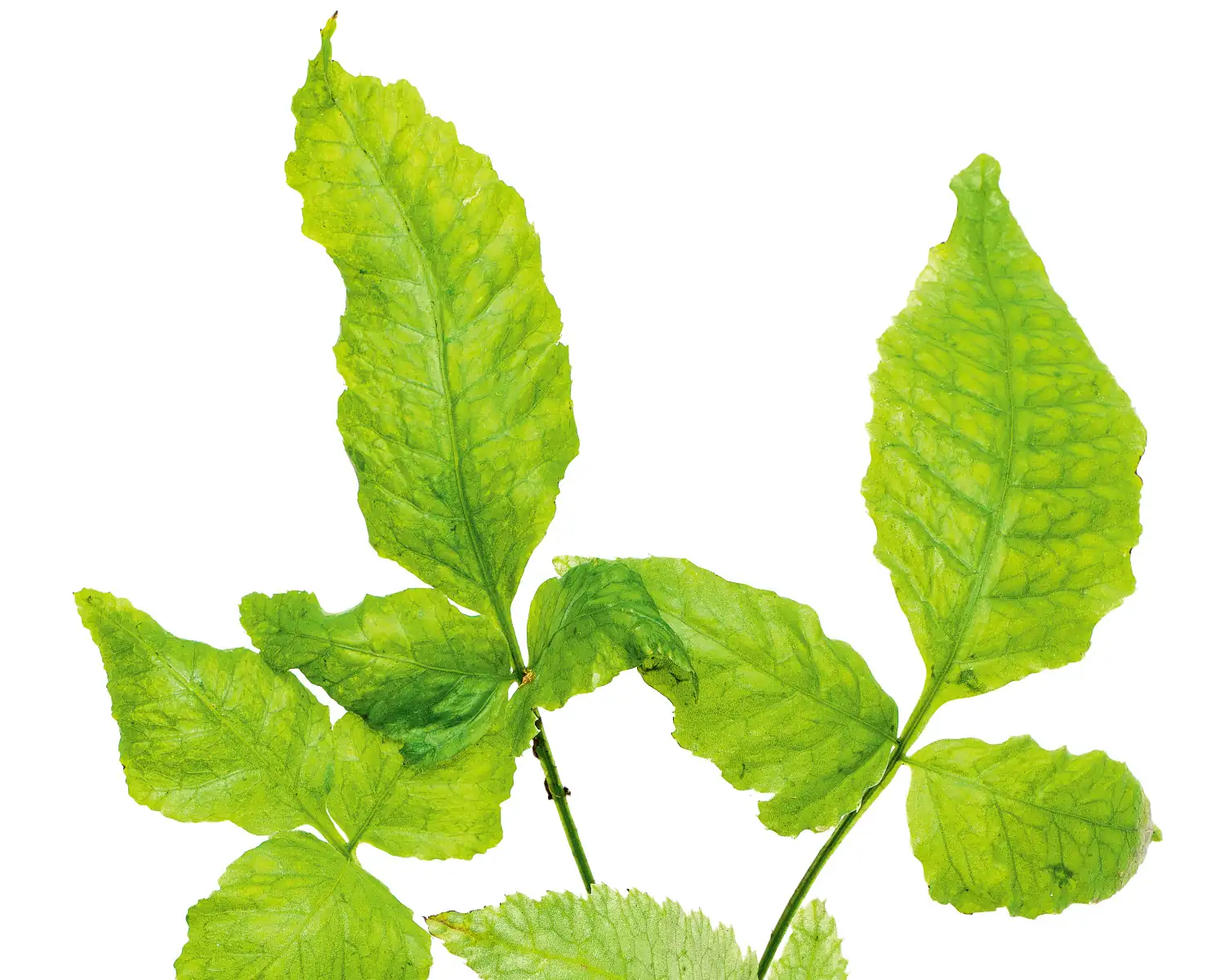
Transparent and miniaturized submerged leaves of Bolbitis heteroclita. Fresh water and CO2 are essential.

In order to enjoy the wildness of Bolbitis heteroclita, we recommend that you grow it in DOOA System Terra 30 or DOOA System Paluda 30/60. If you grow it on Wabi-Kusa Mat and add it to a wall, it gives a distinctive atmosphere to the layout. It prefers humidity. So, we suggest that you have Mistflow generate mist occasionally to the extent that its leaves not to get water drops. By planting Bolbitis heteroclite only in key areas of a highly unique jungle plant layout, sharpness can be created. That’s one of the features of Bolbitis heteroclita.
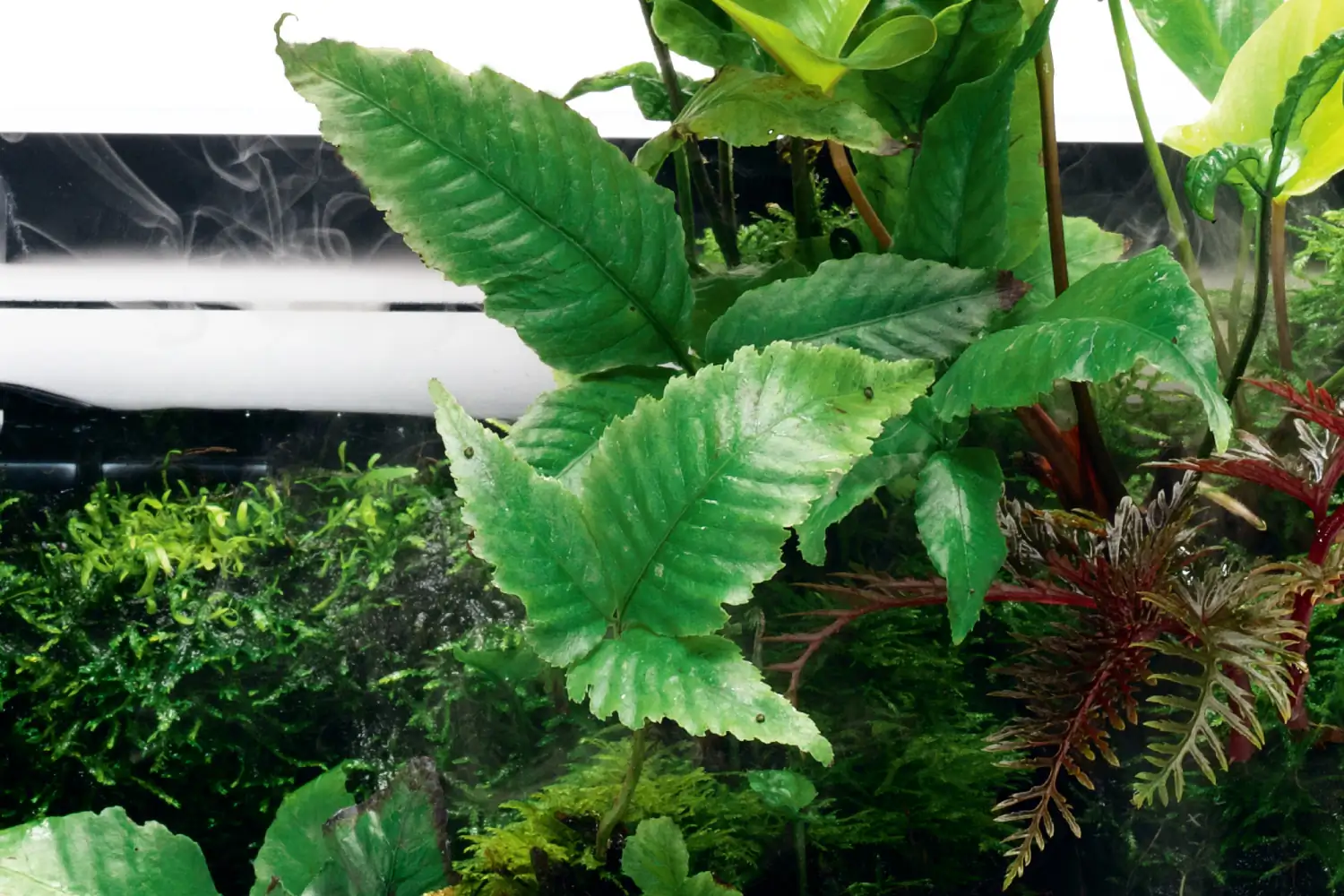
It is easy to grow in Terrarium and Paludarium, and it can become a great accent in a layout with jungle plants.
Dwarf type of Bolbitis heteroclita
Bolbitis heteroclita cuspidata and Bolbitis heteroclita difformis (mini Bolbitis) from the Philippines are considered as dwarf types of Bolbitis heteroclita. Since they look different and can be mistaken as different species, they used to be classified as a genus Edanyoa. Although you can grow them underwater, they will be miniaturized and grow significantly slower. They are also the family of Bolbitis heteroclite suitable for small Paludarium which you want to take time to finish with epiphytic orchids and moss.
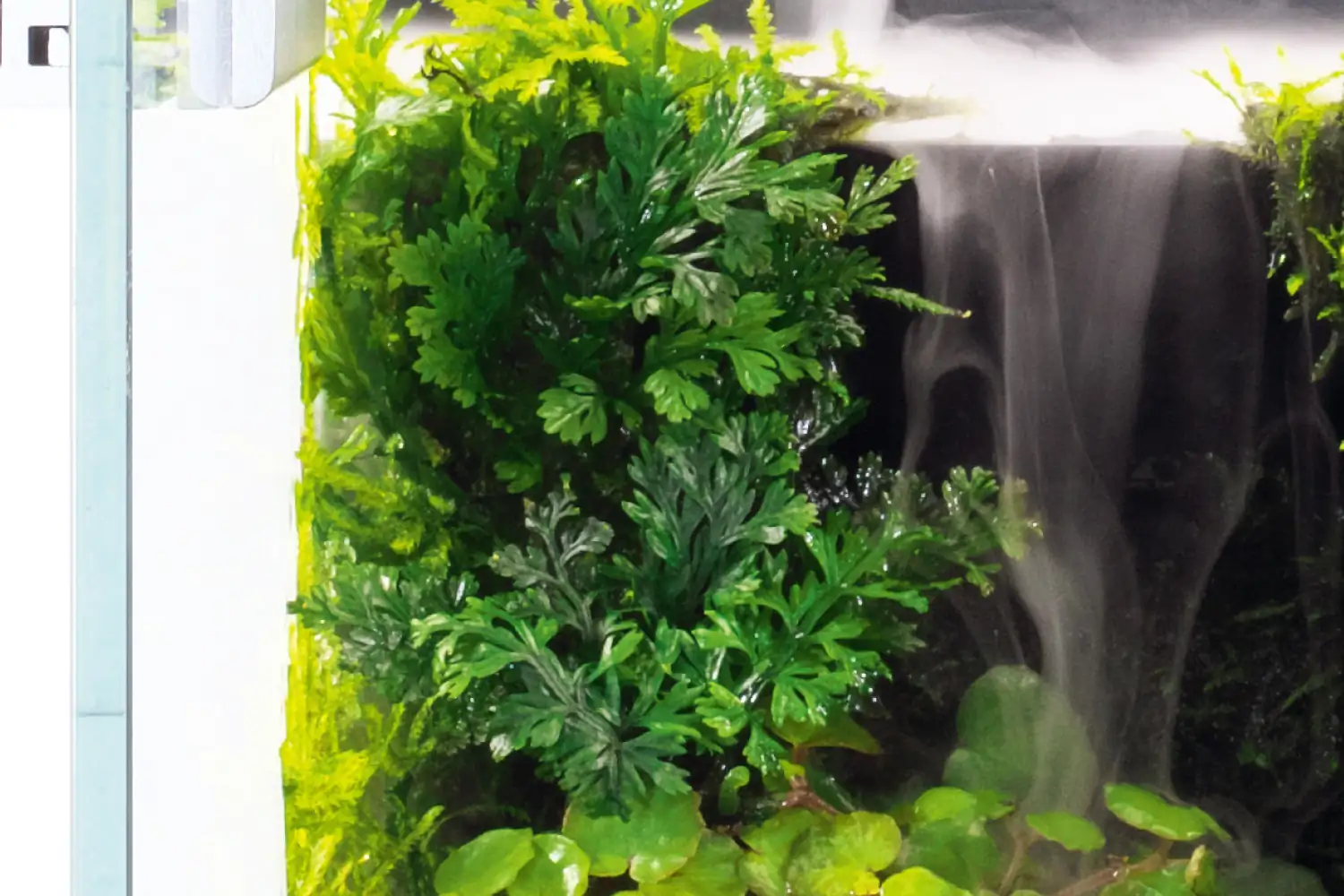
Bolbitis heteroclita cuspidata grows gradually, and its leaves grow small. A key point for the successful growth is to remove old leaves.
True identity of a growing leaf
The shape of Bolbitis heteroclita leaves is called single pinnate compound. A young Bolbitis heteroclite tends to have more trefoil shaped leaves. But some large mature Bolbitis heteroclita develop cinquefoil, 7 leaved, and 9 leaved. Although sporophylls are rarely seen in a layout, some Bolbitis heteroclita develop a longer midrib of the leaf. This can be seen when Bolbitis heteroclita makes asexual buds on the tips. Some grow up to about 50cm. That is one of the charms of Bolbitis heteroclita.
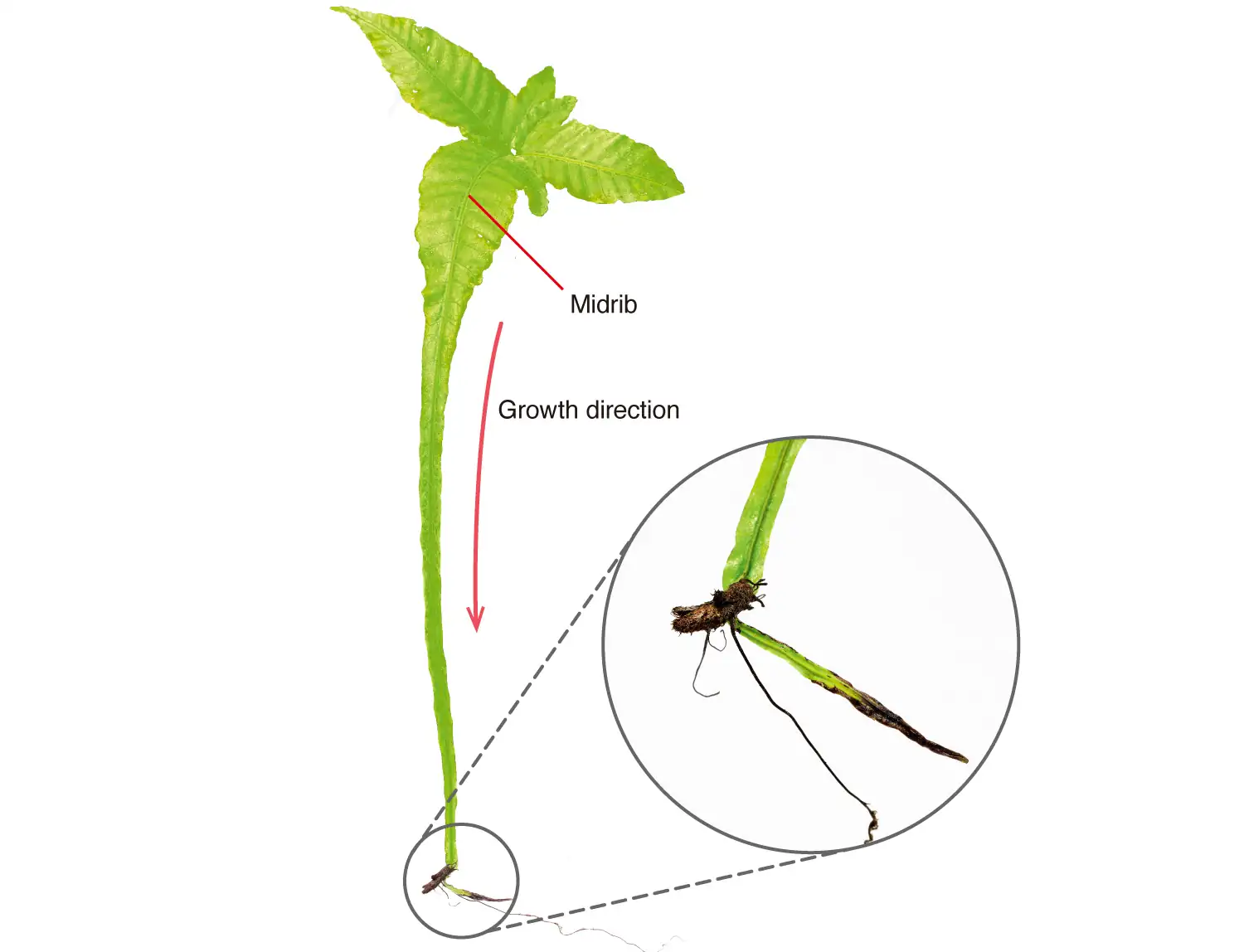
An asexual bud on the tips of a long leaf. It is observed as a mature plant.
Microsorum pteropus 'philippine'
An attractive, relatively small Java fern variant found at a brackish water location on the island of Panay (Philippines). It has a striking bullous leaf structure and a fresh green colour. It is as undemanding as other Java fern variants. Rather hard to come by in trade these days.

Microsorum pteropus, or Java fern, has long been used in the aquarium hobby. Its cultivation is very easy, it is a decorative plant and it is also readily available in trade.
During the last years, increasingly more different forms of the originally quite large and broad-leaved Java fern have been imported. One of the most attractive forms is Microsorum pteropus 'Philippine'. Its relatively small, fresh green leaves are pronouncedly structured and have a "hammered" surface, which makes this a very attractive plant. In aquaristics, M. pteropus 'Philippine' was introduced by the Danish aquatic plant nursery Tropica.
Even though the various Java fern varietys and cultivars look quite differently, their demands regarding water, fertiliser and light are more or less identical. Microsorum pteropus 'Philippine', however, is an exception. Even though it is not a difficult-to-care-for plant it has certain demands. First and foremost, it does not do too well in very soft, acidic water, which is quite plausible, as it often even grows in brackish water habitats on the island of Panay. If the water parameters in the aquarium don't befit it, the leaves of Microsorum pteropus 'Philippine' tend to develop black spots and holes. Very clearly, this is not a Java fern you want to put into a Tonina/Eriocaulon tank. A total hardness of 10° dGH and over and a pH of 6.6 or more can be considered a reference value.
The conditions in its natural habitats make M. pteropus 'Philippine' an excellent plant for brackish aquariums.
If hardness and pH are considered, Microsorum pteropus 'Philippine' is quite easy to cultivate, too. This variety grows well under low light, a low CO2 level and minimal fertilisation. Under more light, with the addition of CO2 and fertiliser, it turns bright green, grows far more rapidly and gets quite robust.
Like other Java fern varieties, 'Philippine' is also best used as an epiphyte on driftwood or rocks. It can also be placed on the ground, given that its rhizome isn't covered or planted in the substrate.
For propagation, the rhizome is cut into parts, or daugter plants growing on the leaves are separated from the mother plant and cultivated independently (please see the description of Microsorum pteropus).
The adult, fully grown plant can reach 30 cm in height or more, thus its place in the tank should be carefully selected or cut off overgrown leaves on a continuous basis. Removing adventitious plants on the leaves on a regular basis adds to the overall appearance of the plant group.
| Complete botanical name | Microsórum ptéropus (Blume) Copeland |
| Family | Polypodiaceae |
| Genus | Microsorum |
| Difficulty | very easy |
| Usage | Epiphyte (growing on hardscape), Background, Midground |
| Growth | slow |
| pH value | 5 - 8 |
| Temperature tolerance | 4 - 30°C |
| Carbonate hardness | 0 - 14°dKH |
| General hardness | 0 - 30°dGH |
| Propagation | Proliferating leaves, Proliferating roots, Rhizomteilung, Splitting, cutting off daughter plants |
| Can grow emersed? | yes |
Crepidomanes minutum
updating...
Tips on Keeping Aquarium Ferns Healthy and Thriving
Planting procedures for aquarium ferns must be done with great care and caution in order to keep these small plants safe. Although there are many different types of aquatic ferns, they all require similar conditions. Before planting your fern, make sure that the bottom of the tank is covered with a thin layer of substrates, such as aquarium-safe gravel or sand, to provide a firm and secure base for the fern’s roots.
Next, gently place the fern in the center of the tank. Make sure to press gently so that the roots adhere to the bottom of the tank.
Finally, pour enough water into the tank to bring the level of the water above the fern’s roots, and adjust the lighting according to what the specific type of fern requires. Utilizing the provided list above, aquarium ferns will thrive and add life and beauty to your tank for years to come.
Healthy aquarium ferns are essential to maintaining a balanced aquarium environment.
All aquatic plants require careful consideration when adding them to any aquarium system.
Proper water parameters, such as pH, hardness, and nitrate levels, must be properly monitored to ensure that the plants can thrive and develop. Here are a few tips to help you keep your aquarium ferns in top condition:
Choose a spot with decent lighting: Ferns require a decent amount of light to stay in peak condition, so make sure to pick an area of the tank where other plants and hardscape features don’t block needed access to lighting.
Use liquid fertilizer: Supplementing fertilizer can help keep your aquatic ferns looking luscious. Use a liquid fertilizer and feed the plants once a week if you think they need a little bit of a push.
Keep their roots moist: To ensure that your ferns thrive, their roots must remain moist. Be sure to not let them dry out in paludarium/riparium setups, as this can be damaging to the plant.
Monitor water parameters: aquatic ferns are pretty hardy and can tolerate most water conditions, but it is important to monitor pH and other factors to ensure it stays within the optimal range.
Following these tips will help you keep your aquarium ferns looking healthy and vibrant.
With proper care and maintenance, your ferns will be the envy of any tank.
Balancing the Aquarium Environment to Ensure Proper Growth of Aquarium Ferns
When it comes to aquarium ferns, adding the right number of plants to an aquarium is one of the most important decisions to make. Too many plants in the aquarium can potentially inhibit oxygen levels and reduce the water’s ability to absorb much-needed nutrients.
On the other hand, the right amount of ferns can provide a healthy balance of nutrients and oxygen in the aquarium, allowing your ferns to reach their full potential. It is also essential to make sure you have a good light source in your aquarium.
Quality lighting helps aquarium ferns to grow faster and more efficiently, giving them the nutrients and light they need to stay healthy and vibrant. The proper lighting intensity and sources, such as LED, metal-halide, and fluorescent lighting, are necessary to ensure your ferns receive optimal nutrient absorption, and photosynthesis and grow properly.
Ferns are an important part of any aquarium ecosystem, but it is important to be aware of the key factors that ensure proper aquarium fern growth. With proper care and balance, aquarium ferns can bring many benefits to any tank environment.
How to Make Sure Aquarium Ferns Get Enough Nutrition
Getting aquarium ferns the right amount of nutrition is key to their health and growth. The most important elements of nutrition that these ferns will need are good quality fertilizer, light, and carbon dioxide.
It is important to give your ferns the right balance of nutrients. You should add a good quality fertilizer to the tank to help the ferns get the proper nutrients it needs. Additionally, make sure to provide them with plenty of light, preferably in the form of full-spectrum LED lights.
This light spectrum will not only help them with photosynthesis but also allow them to have more intense colors! In order to make sure that your aquatic ferns have enough carbon dioxide, you will need some sort of way to inject it into the tank.
Many aquarium plants, including ferns, require additional CO2 for proper growth and can benefit from the use of CO2 diffusers, injectors, and reactors.
By providing your aquarium ferns with the right balance of nutrients, high-quality light, as well as additional CO2 when needed, you can ensure that they will flourish and remain healthy.
Common Problems with Aquarium Ferns: How to Solve and Prevent Them
Nutrient deficiency can occur if there are not enough nitrates and iron in the tank’s water.
To ensure your aquarium ferns receive enough nutrients, perform regular water tests and supplement with iron fertilizers.
The algae growth can occur if the tank receives too much light, or if the light does not provide the right spectrum.
If your ferns are prone to algal blooms, place filters over the lights, reduce the amount of light the tank receives and keep the tank away from direct sunlight.
Discoloration is a common issue that can occur when aquatic ferns are placed in poor lighting conditions.
If you notice your ferns taking on a yellowish hue, adjust the light intensity in the tank, and consider adding supplemental lighting.
By proactively addressing these common aquarium plant problems, you can ensure your tank remains healthy and your ferns flourish.
Frequently Asked Questions
Are there aquatic ferns?
Yes, there are aquatic ferns! Several varieties of aquatic ferns exist, including Azolla fern, water fern, and floating water fern, among others. Many of these aquatic ferns grow in slow–moving or standing water, often in shallow areas or along the margins of bodies of water.
Can ferns be kept in aquarium?
Yes, ferns can be kept in aquariums. They make a great decorative addition and also help keep aquarium water clean. When selecting a plant for an aquarium, be sure to research its needs and ensure that it is suitable for the type of aquarium setup you have. Ferns will require good lighting and filtration to thrive.
Which plant is known as aquatic fern?
The “Aquatic Fern“ is a common name for a unique species of plant, known as Marsilea quadrifolia. It is an aquatic, rhizomatous fern native to Australia, New Zealand, and other nearby regions. Its fronds are divided into four leaflets, giving it the common name of “four–leaf clover“ in some areas.
How do you plant aquatic ferns?
To plant aquatic ferns, first choose an appropriate container for them. Fill the container with damp potting soil, leaving extra room at the top. Then, put the ferns in the container and cover them with more soil. Lastly, add a thin layer of gravel over the soil and keep the container filled with water.
Are ferns good pond plants?
Yes, ferns are excellent pond plants, providing shade and oxygen for fish, tadpoles, and other aquatic wildlife. They help to keep pond water clear and free of algae, and their long roots allow them to absorb excess nutrients before they can cause algae growth. With their lush foliage and unique look, ferns make beautiful additions to any pond or water feature.
What is the smallest aquatic fern?
The smallest aquatic fern is the Azolla filiculoides, also known as the mosquito fern. Native to the Americas, this small fern typically grows to less than 2 cm (0.8 in) across and can take on colors ranging from deep red to green and pale pink. Unlike most ferns, Azolla filiculoides can live in both aquatic and terrestrial habitats, making it an ideal plant for wetland restoration.
Can Java fern be planted in sand?
Yes, Java fern can be planted in sand. With that said, you need to be careful when planting your Java fern. You can only plant the roots, but not the rhizomes. If the rhizomes are covered in sand, the Java fern won’t be able to absorb any nutrients, causing it to stop growing, rot, and slowly die.
If you can’t differentiate the roots and rhizomes, it’s best to err on the side of caution and avoid planting the fern. In the wild, Java fern is usually found on rocks or driftwood, so you should consider attaching your Java fern to rocks, wood pieces, or decorations in the tank instead.
Alternatively, you can also let the fern float around freely in the water.
Does Java fern absorb ammonia?
Yes, Java fern absorbs ammonia. Despite being a slow-grower, this classic aquarium plant efficiently absorbs ammonia from the water.
Additionally, Java fern can also absorb nitrates, nitrites, and carbon dioxide, making it one of the best aquatic plants for maintaining the water quality in your tank.
Moreover, this aquatic plant is also a natural harborer of helpful bacteria, so when taken care of properly, this plant can help nurture an abundance of beneficial bacteria in the tank. These bacteria will absorb even more ammonia, nitrates, and nitrites from the water, keeping your tank cleaner for longer.
Why is my Java fern dying?
Two possible reasons your Java fern might be dying are a lack of nutrients and too much light. Immediately check if the fern’s rhizomes are covered with substrate, hindering the plant from absorbing nutrients.
Next, check if the tank’s lighting is too bright for them. Generally, you shouldn’t expose Java fern to more than 1.5–2 watts of light for each gallon of water.
If your Java fern is dying, here’s what you can do to save it:
Make sure its rhizomes are uncovered
Remove algae from the tank
Add liquid fertilizer to the water
Increase CO2 level by adding yeast into the water
Dim the lighting
Limit exposure to light to 6-8 hours each day


Leave your comments