It’s time to help contribute for biggest aquarium gallery online

SUBMIT HEREVIEW GALLERY

Marosatherina ladigesi (Celebes Sunray Fish)

Overview

The Celebes Sunray Fish (Marosatherina ladigesi), frequently referred to in the aquarium hobby as the Celebes Rainbowfish, is a captivating and lively freshwater species. Known for their delicate, translucent bodies and brilliant flashes of neon blue, these fish are a favorite among aquarists looking to add movement and color to hard-water community tanks. While they require specific water parameters to truly thrive, their peaceful nature and stunning courtship displays make them well worth the effort.

Image of celebes sunray fish marosatherina ladigesi

Distribution and Habitat

Endemic to the island of Sulawesi (formerly known as Celebes) in Indonesia, this species is primarily found in the Maros karst region. They inhabit clear, slow-moving streams and rivers that run through limestone areas, which naturally buffers the water, making it hard and alkaline. These natural habitats are often shaded by dense rainforest canopies, providing a dappled light environment with plenty of submerged roots and vegetation.

Description of Celebes Sunray Fish

Body shape:

They possess a slender, elongated, and laterally compressed body typical of many rainbowfish and silversides, allowing them to dart quickly through the water.

Color:

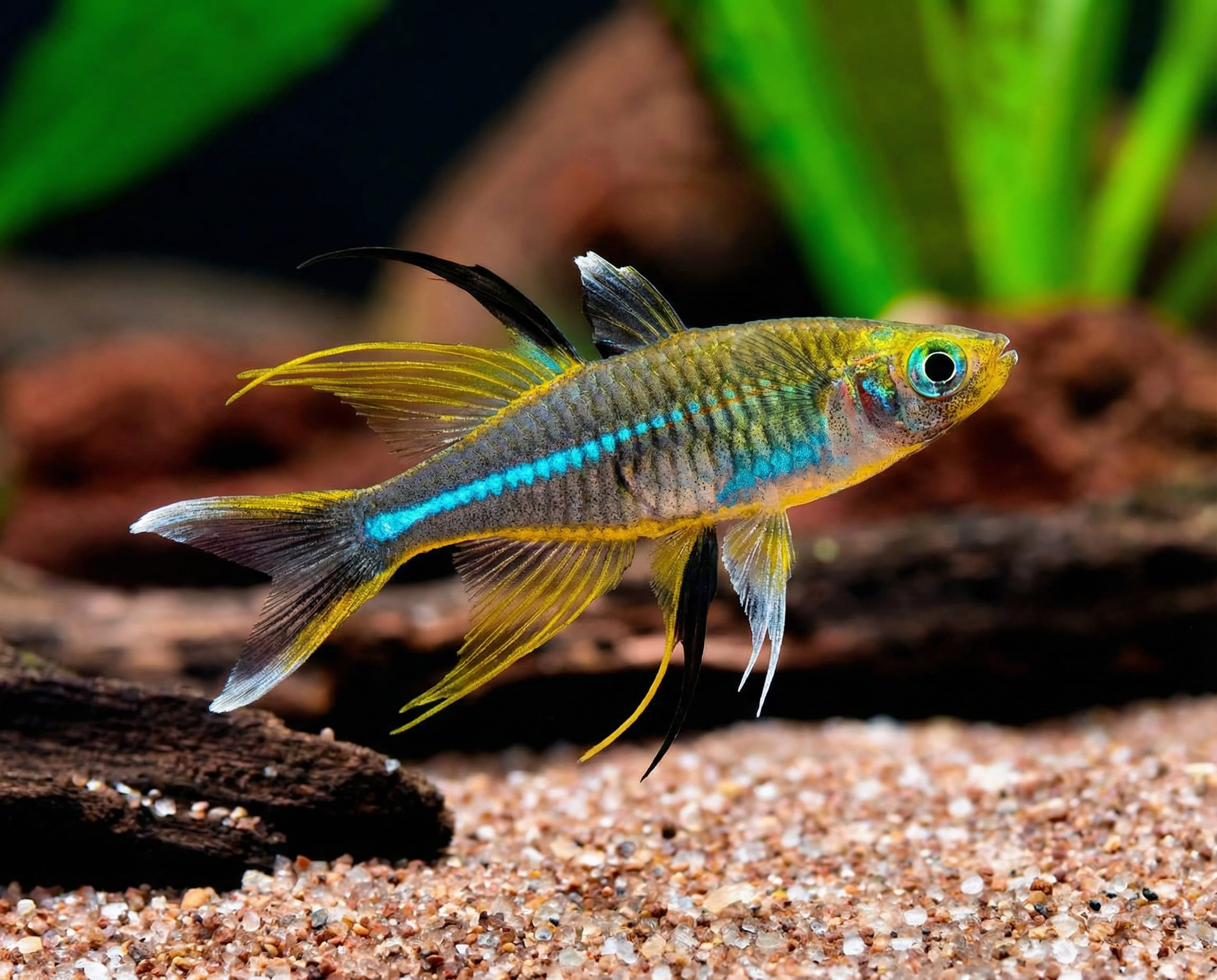
The body is largely semi-transparent with a yellowish or golden tint. A brilliant, iridescent neon blue lateral stripe runs from the pectoral area to the base of the tail. The fins feature striking contrasts of black and vibrant yellow.

Barbels:

This species does not possess any barbels.

Snout:

They have a relatively pointed snout with a slightly upturned mouth, which is perfectly adapted for snatching small insects and food particles from the water's surface.

Eyes:

Their eyes are large and prominent, often featuring a highly reflective, iridescent blue or green ring around the pupil.

Fins:

They have two distinct dorsal fins. The males are particularly famous for their heavily elongated, filamentous second dorsal and anal fins, which trail gracefully in the water and are colored in striking black with yellow or white tips.

The Tail:

The caudal (tail) fin is deeply forked, with the upper and lower lobes distinctly edged in dark black and bright yellow.

Image of celebes sunray fish marosatherina ladigesi

Temper

The Celebes Sunray Fish is entirely peaceful. They do not bother other tank mates and are generally timid if kept with overly boisterous or aggressive species.

Sociality

This is a highly social, schooling fish. They must be kept in groups of at least six individuals, though groups of eight to ten or more are highly recommended. Keeping them in larger schools encourages natural behaviors, reduces stress, and prompts the males to show off their best colors as they harmlessly spar and display for the females.

Activity

They are very active swimmers, constantly on the move during daylight hours. They predominantly occupy the middle and upper levels of the water column.

Keeping and Caring for Celebes Sunray Fish

Tank size:

A minimum aquarium size of 20 gallons (approx. 75 liters) is required for a small school, but a 30-gallon tank or larger is ideal to provide them with the ample swimming space they crave.

Water Parameters:

Temperature

They thrive in tropical temperatures ranging from 22-28°C (72-82°F).

pH

Alkaline water is crucial for their long-term health. Maintain a pH between 7.0 and 8.0.

Hardness

They originate from limestone-rich streams and require moderately hard to hard water, ideally between 10 and 20 dGH.

Ammonia, Nitrite, Nitrate

Ammonia and Nitrite must always be at 0 ppm. Nitrates should be kept as low as possible (under 20 ppm). They are highly sensitive to poor water quality, so strict maintenance is necessary.

Lighting

Moderate lighting is best. While they look stunning under bright lights, providing some shaded areas with floating plants will make them feel more secure and mimic their natural forest stream habitat.

Water flow

A moderate water flow is appreciated, simulating the gentle currents of their native streams.

Decorations and Plants

A planted aquarium with plenty of open swimming space in the center is ideal. Use driftwood, rocks, and hardy plants like Vallisneria or Anubias. Darker substrates can help their neon colors stand out more vividly.

Image of celebes sunray fish marosatherina ladigesi

Diet

They are omnivorous micro-predators in the wild. In the aquarium, they will readily accept high-quality flakes and micro-pellets. To maintain their best health and coloration, supplement their diet with live or frozen foods such as daphnia, cyclops, baby brine shrimp, and mosquito larvae.

Some Feeding Tips

Because they have relatively small throats, ensure all food is appropriately sized. It is better to feed them small amounts two to three times a day rather than one large meal. They prefer to feed from the surface or as food sinks through the water column.

Breeding

Celebes Sunray Fish are continuous egg scatterers. To breed them, set up a dedicated breeding tank with slightly hard, alkaline water and provide spawning mops or dense, fine-leaved plants like Java Moss. Condition the adults with plenty of live foods. The females will scatter a few eggs daily, which the males will fertilize. The parents will eat the eggs if given the chance, so it is best to remove the eggs or the parents after a few days. The fry are extremely tiny upon hatching and will require infusoria or liquid fry food until they are large enough to accept freshly hatched baby brine shrimp.

Conclusion

The Celebes Sunray Fish is a magnificent, active species that brings a unique flash of neon color and elegant finnage to the home aquarium. While they demand specific hard-water parameters and pristine conditions, aquarists who meet their needs will be rewarded with a lively, peaceful, and visually stunning display.
Fish info

Care level: Moderate
Temperament: Peaceful
Adult size: 6-8 cm
Life expectancy: 3-5 years
Fish type: Rainbowfish
Temperature : 22-28°C
pH: 7.0-8.0
Color Form: Black, Blue, Clear, Yellow
Leave your comments
Lastest on Fishs
  • Pseudomugil furcatus (Forktail Blue-eye)

    Moderate
    Rainbowfish
    The Forktail Blue-eye (Pseudomugil furcatus) is a captivating, highly active nano fish native to the rainforest streams of Papua New Guinea. Renowned for their striking neon blue eyes, bright yellow finnage, and peaceful schooling behavior, they have become incredibly popular additions to planted community aquariums among dedicated aquarists.
  • Hemigrammus caudovittatus (Flamingo Tetra)

    Easy
    Rainbowfish
    The Flamingo Tetra, scientifically known as Hemigrammus caudovittatus, is a robust and lively freshwater fish native to South America. Known for its energetic schooling behavior and hardy nature, it makes an excellent addition to larger community aquariums, though its fin-nipping tendencies require careful selection of tank mates.
  • Rasbora trilineata (Scissortail Rasbora)

    Easy
    Rainbowfish
    Originating from the fast-flowing streams of Southeast Asia, the Scissortail Rasbora is an active, schooling fish renowned for its striking, scissor-like tail movements. Their peaceful nature, hardy constitution, and sleek, torpedo-shaped bodies make them a highly popular and captivating addition to community freshwater aquariums.
  • Epalzeorhynchos bicolor (Red Tail Shark)

    Moderate
    Rainbowfish
    The Red Tail Shark, native to Thailand, is a striking and highly popular freshwater fish. Known for its deep velvety black body and vibrant red tail, this semi-aggressive cyprinid adds dynamic movement and a touch of drama to sufficiently large, well-structured community aquariums.
  • Pao baileyi (Hairy Pufferfish)

    Moderate - Difficult
    Rainbowfish
    The Hairy Pufferfish (Pao baileyi), native to the rocky rapids of the Mekong basin, is a highly unusual and captivating freshwater puffer. Known for its unique epidermal outgrowths resembling hairs, this aggressive ambush predator requires a dedicated, species-only setup but rewards keepers with fascinating, interactive, "water dog" behavior.
  • Badis ferrarisi (Ferrari's Badis)

    Moderate
    Rainbowfish
    Badis ferrarisi, commonly known as Ferrari's Badis, is a rare and strikingly beautiful micro-predator native to Myanmar. Known for its brilliant red and black striped pattern, this small chameleon fish exhibits fascinating behaviors. Due to its specific dietary requirements and shy nature, it is a rewarding species for dedicated aquarists.
  • Dichotomyctere ocellatus (Figure 8 Pufferfish)

    Moderate
    Rainbowfish
    The Figure 8 Pufferfish, native to Southeast Asia, is a captivating and highly intelligent species. Known for the distinctive markings on its back resembling the number eight, this slightly brackish water fish boasts an interactive personality, making it a beloved yet moderately challenging pet for dedicated aquarium enthusiasts.
  • Polypterus endlicheri (Endlicher's Bichir)

    Moderate
    Rainbowfish
    Hailing from the rivers and swamps of Africa, Endlicher's Bichir, or the Saddled Bichir, is a fascinating ancient oddball. Known for its dinosaur-like appearance, prominent dorsal finlets, and striking dark vertical bands, this bottom-dwelling predator is highly prized by aquarists looking for a captivating, prehistoric centerpiece fish.
  • Nematobrycon palmeri (Emperor Tetra)

    Easy - Moderate
    Rainbowfish
    The Emperor Tetra (Nematobrycon palmeri) is a stunning, peaceful freshwater fish native to the Atrato and San Juan river basins in Colombia. Known for its regal purple and blue iridescence, striking black lateral stripe, and unique trident-shaped tail in males, it is a highly popular choice for planted community aquariums.
  • Gnathonemus petersii (Elephant Trunk Fish)

    Moderate - Difficult
    Rainbowfish
    Originating from the murky rivers of West and Central Africa, the Elephant Trunk Fish is a fascinating oddball species. Known for its trunk-like appendage used to forage and its unique ability to generate weak electrical fields, it remains a captivating but demanding choice for experienced freshwater aquarists.
  • Oliotius oligolepis (Island Barb)

    Easy
    Rainbowfish
    The Island Barb, also known as the Checkered Barb, is a peaceful and active schooling fish native to Indonesia. Known for its striking checkerboard pattern and vibrant reddish fins, this hardy cyprinid is incredibly popular among both beginner and experienced aquarists looking to add life to planted community tanks.
  • Eirmotus octozona (Eight-banded Barb)

    Moderate
    Rainbowfish
    The Eight-banded Barb is a peaceful, shy, and captivating schooling fish native to the blackwater swamps of Southeast Asia. Known for its striking vertical black stripes over a semi-transparent body, it is a highly sought-after species for aquarists looking to build a serene, planted, or biotope aquarium.
  • Nannostomus marginatus (Dwarf Pencilfish)

    Easy - Moderate
    Rainbowfish
    Native to the slow-moving, tannin-stained waters of South America, the Dwarf Pencilfish is a captivating, peaceful species. Known for its striking horizontal stripes and distinctive hovering behavior, this diminutive fish is highly popular among aquarists seeking a lively yet tranquil addition to their planted nano or community aquariums.
  • Channa gachua (Dwarf Snakehead)

    Moderate
    Rainbowfish
    The Channa gachua 'Blue Bengalen', commonly known as the Dwarf Snakehead, is a captivating and highly sought-after predator fish. Renowned for its striking blue iridescence and manageable size, this intelligent species exhibits fascinating behaviors, making it a favorite among dedicated aquarists looking for a unique, interactive, and rewarding aquatic pet.
  • Metynnis hypsauchen (Silver Dollar)

    Moderate
    Rainbowfish
    The Silver Dollar (Metynnis hypsauchen) is a highly popular, schooling freshwater fish native to the Amazon River basin. Known for their distinct, coin-like appearance and peaceful demeanor, they are a fantastic addition to large community tanks. Predominantly herbivorous, these gentle giants are incredibly captivating and rewarding for dedicated aquarists.
  • Epiplatys dageti dageti (Crossbanded Pikeling)

    Easy - Moderate
    Rainbowfish
    The Crossbanded Pikeling, native to West African swamps and streams, is a captivating surface-dwelling killifish. Known for its striking vertical black bars and peaceful yet predatory nature towards tiny insects, this hardy species is highly favored by aquarists looking to add unique character to a planted biotope aquarium.